Political candidates pitch ideas for impeding controversial Sheep Creek mine, saving Bitterroot
May 06, 2026 | 6:58 pm ET
Description
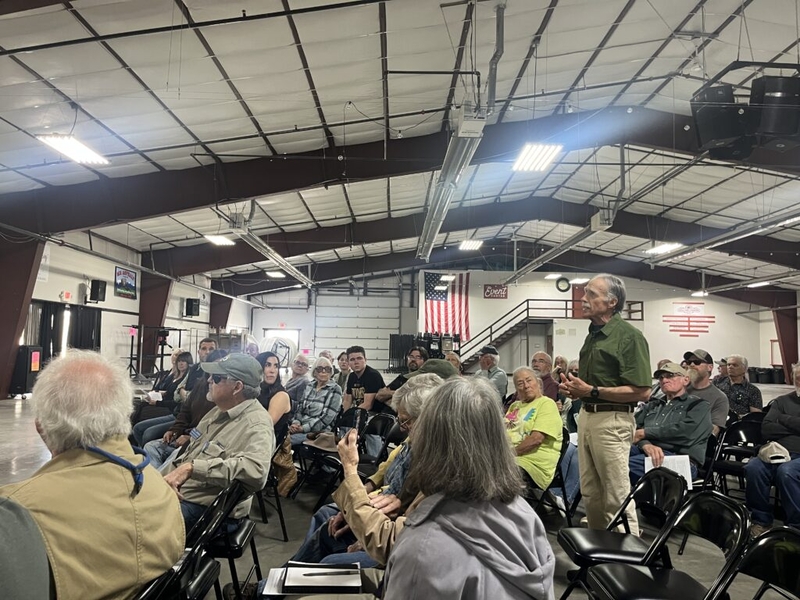
George Corn, a participant at a meeting about the controversial Sheep Creek project, asks questions. (Keila Szpaller/The Daily Montanan)
HAMILTON — What if Montana could make it easier to pull rare earth minerals from mine waste and harder to open new mines, especially in pristine places?
What if business interests and environmental ones aligned?
Those were some of the ideas a scientist and numerous political candidates discussed Tuesday at a meeting about the controversial Sheep Creek mine “exploration” proposal at the headwaters of the Bitterroot River — a project opposed by people of all political persuasions in Ravalli County.
U.S. Critical Materials has proposed exploration for “rare earth” minerals, initially for 3.9 acres, to see if a full-scale mining operation is feasible. One of the presenters said three other companies are staking ground near those claims.
But members of the public have stridently opposed the idea, and in December, Ravalli County Commissioners unanimously opposed its placement on a federal “fast track” designed to improve permitting efficiency.
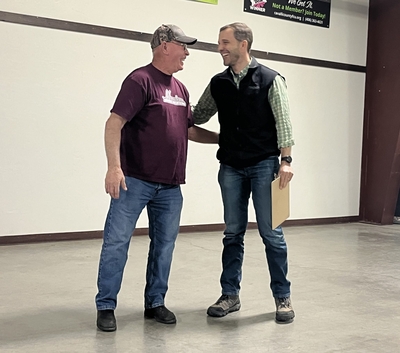
Tuesday, more than 130 people, including political candidates, showed up for an update on the project and its potential impacts, share ideas for stymieing it, and explore a way Montana could produce rare earth minerals — without Sheep Creek.
“This was once the Treasure State,” said Matt Roth, a Republican running for Ravalli County Commissioner. “We could be the Treasure State again.”
Seth Bodnar, running for the U.S. Senate as an independent, said national security is important, but that didn’t mean Montanans needed to risk their environment. The Green Beret and only statewide candidate at the meeting said Montanans don’t have to be “anti-business to be pro-environment.”
“The good news is we have plenty of critical minerals here in this country, and we don’t have to risk the Bitterroot (River) in this valley and the natural resources of this state to go and get them,” said Bodnar, former University of Montana president.
New application filed, still controversial
In a project update, Rep. David Bedey, R-Hamilton, said the Montana Department of Environmental Quality has received a request from a federal permitting council to enter into a memorandum of understanding to align state and federal permitting timelines.
Bedey, one of numerous political candidates who spoke, said the idea would be to “enhance efficiency by improving coordination, transparency and accountability.”
Bedey said he wasn’t sure what that would mean for Sheep Creek, but he also said he didn’t believe it would mean a less thorough environmental review.
“As of yesterday (Monday), DEQ is taking this proposal under consideration but has not made a decision as to whether to enter into this relationship with the federal government,” Bedey said.
But Bedey and others, including his primary opponent, Kathy Love, also offered ideas for making the Sheep Creek project unpalatable to mine.
For starters, Bedey said, bonding requirements are based on the estimated need to reclaim “the mine itself,” but such operations can have impacts far beyond the actual mines.
As such, Montana could enhance its bonding requirements to cover offsite risks, Bedey said. He said he couldn’t imagine the proposed Sheep Creek mine not creating “catastrophic effects” on the Bitterroot River and “everyone downstream.”
Bedey suggested either amending current statutes to incorporate environmental considerations or creating new statutes that introduce the idea of environmental bonds.
“It’s very difficult for me to see how that risk could be mitigated by a bond that could be affordable by any mining interest,” Bedey said.
Bedey also said the state limits the ability of DEQ to deny permits. He said offsite effects are not an allowable reason for a denial, but he believes that could be changed in existing statute, too.
According to the U.S. Forest Service, U.S. Critical Materials rescinded its original proposal for Sheep Creek, and Bedey said the company refiled its application, although it hasn’t been made public yet.
A federal dashboard for infrastructure projects estimates environmental review and permitting will be complete in May 2027.
Love, a Republican running against Bedey, said she would be interested in legislation that could “go after anything that happens in the headwaters of a river,” although she also said the project is on federal land, the Bitterroot National Forest, so she doesn’t believe such a law would apply in this case.
In response to a question about one of U.S. Critical Materials’ earlier claims about “dry mining,” or using a method with ostensibly less risk to the river, Love said she was skeptical. She said the company’s estimates for the size of the project appear to have grown from three to five acres to as many as 7,000 acres.
“So I don’t trust anything that they’ve said,” Love said.
Representatives from U.S. Critical Materials did not appear to be present, prompting one presenter to say looking for their executives was “sort of like looking for a Yeti.”
Public safety concerns for Sheep Creek, but new ways emerge to mine old waste
At the request of moderator Tony Hudson, Sheriff Steve Holton weighed in on the project from a public safety perspective. Holton said the idea for the area — some 38 miles south of Darby, according to the Forest Service — had fallen short.
“There hasn’t been a single proposal or idea or any communication on how we’re going to provide public safety on that end of the valley,” Holton said. “My best guess is probably that’s a $500,000 a year hit to the county to provide what’s going to be necessary.”
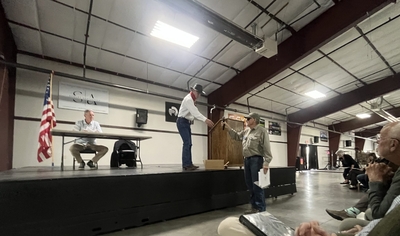
Holton said he was open to discussions about how to move forward, but he said he wouldn’t be in favor of a public safety levy so “everybody here has to pay that bill.”
In fact, some of the candidates said it would be important to place small economic hurdles in front of the project, such as requirements for power lines and roads.
For example, Democratic state House candidate Bill Jones, running unopposed in the primary, said the state could mandate a company can’t drive on roads with heavy loads “unless they beef ‘em up.”
“They have to be conquered economically,” Jones said.
Democratic House candidate Archie Thomas, also unopposed in the primary, said President Donald Trump’s initiative to cut the federal government — DOGE, or the Department of Government Efficiency — would affect the project review. He pointed to lower staffing levels with the U.S. Forest Service and Environmental Protection Agency.
“When we go through this process, which we all assume is going to be a valid process, how is that going to work with the Forest Service that’s gutted out? How is that going to work when we take it to the EPA that’s gutted out?” Thomas said.
In an overview of the history of mining in Montana, presenter Philip Ramsey said the industry created prosperity for a few people, then a history of contamination and steep cleanup bills with executives nowhere in sight.
Now, with expertise from Montana Technological University in Butte and the Department of Defense, Ramsey said the state has the potential to recover critical minerals from mine waste. But he said policy changes are needed.
“Our laws make it more attractive to develop pristine public lands than to recover metals in waste zones,” Ramsey said. “That’s a policy failure. To fix it, we must have laws that favor re-mining waste first, reopening old mines second, and opening new mines upstream of flourishing recreational and agricultural economies dead last.”
Ravalli County residents have opposed the Sheep Creek project in part because it would take place near the headwaters of the Bitterroot River in an area with elk, wolverines, Canada lynx, and other wildlife. Opponents have said the closed basin where water is over-allocated is no place for a mine exploration.
‘Dark money’ a factor for public, some candidates
At the meeting, money in politics also played a role.
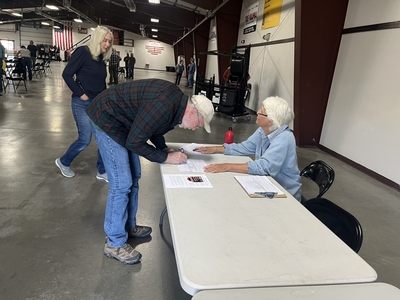
Jill Davies collected signatures for Constitutional Initiative 194, to prohibit corporations from spending money on political candidates or ballot issues, and moderator Hudson and others warned the public about dark money’s potential influence on the mine and on legislative candidates.
Montana’s congressional delegation has said the Sheep Creek proposal should have more support from the community in order to move ahead, and Hudson thanked Republican U.S. Sen. Tim Sheehy in particular for his quick action to oppose the project’s placement on the federal “fast track.”
FAST-41, Fixing America’s Surface Transportation Act, Title 41, is charged with increasing transparency in federal reviews and efficiency in permitting for certain infrastructure projects, including mining ones.
But Hudson said some outside involvement could be harmful, including Americans for Prosperity, funded by the billionaire Koch brothers. He said the Koch network spent $345 million in lobbying in 2024 alone, it has spent $400 million on the rare-earth industry, and it has a campaign running on how to expedite permits.
As such, Hudson urged the public to avoid legislative candidates endorsed by Americans for Prosperity, arguing some candidates may not recognize who they’re dealing with, but an endorsement means AFP “has got their hooks in a little bit.”
“I’m not saying they own them, but I’m telling you, these people are powerful,” Hudson said.
Helena, MT