Phillip Ensler, John Wahl meet in lieutenant governor debate
Oct 29, 2026 | 5:59 am ET
Description
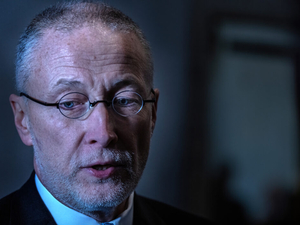
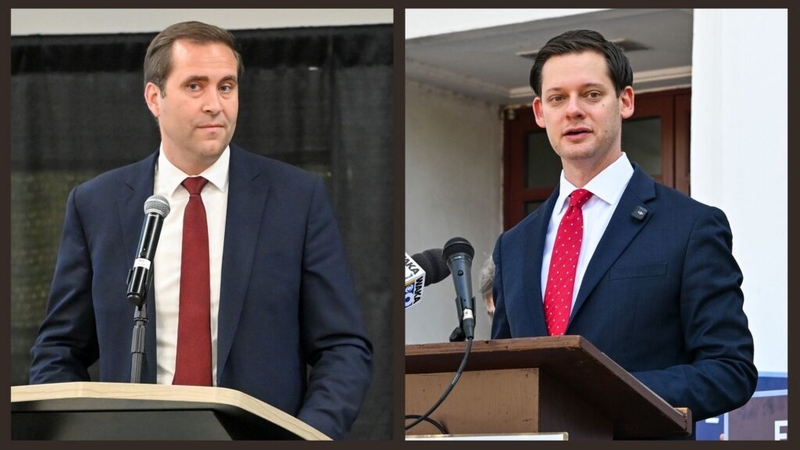
Voters will choose between Republican John Wahl and Rep. Phillip Ensler, D-Montgomery, for lieutenant governor on Nov. 3, 2026. On Wednesday night, the candidates took part in a debate in Huntsville. (Anna Barrett/Alabama Reflector)
The state’s Democratic and Republican nominees for lieutenant governor took the stage Wednesday night in Huntsville for the first, and likely only, debate between candidates for state office in this year’s election cycle.
During the hour-long debate, Democratic nominee Phillip Ensler, D-Montgomery and former Republican Party Chairman John Wahl, fielded questions about education, affordability and data centers.
Democratic gubernatorial nominee Doug Jones has called for a debate with Republican nominee Tommy Tuberville, who has declined.
Big Office, Big Ideas, Little Power
Ensler took the debate’s first question, which focused on how to keep the position relevant with the limited power it has, highlighting his time in the Legislature.
“In my four years in the legislature, now I’ve worked across the aisle,” Ensler said, citing relationships with Democratic and Republican leaders in the Legislature.
Last year, Gov. Kay Ivey signed SB 116, sponsored by Sen. Will Barfoot, R-Pike Road, which banned the usage of glock switches or devices that turn semi-automatic handguns like pistols into fully automatic weapons, which were used in a mass shooting at a nightclub in Birmingham. Ensler had pushed for a for a state-level ban on glock switches for years prior to the ban.
He also carried SB 361, sponsored by Senate President Pro Tem Garlan Gudger, R-Cullman, and signed by Ivey in April, in the House of Representatives. The legislation makes it illegal to tether a dog to a stationary object, including trees and poles, without providing adequate shelter, food or water.
In February, Ensler filed two bills to establish a lottery in the state. Neither bill made it to committee.
Later in the debate, Wahl, a former Alabama Republican Party chair, suggested that the fact some of Ensler’s bills did not come out of committee undermined claims to work across the aisle.
“If you’re not able to even get a bill through a committee or onto a committee agenda, how are you going to be effective as lieutenant governor?” he said. Most legislation does not advance out of committee.
Jones and Ensler have been campaigning together for a large majority of this year’s election cycle. In September, Jones said if both were elected, he would work to expand the lieutenant governor’s power and give Ensler a portfolio to work on. The candidates also said they would support legislation to allow the governor and lieutenant governor to be elected as a ticket like president and vice president of the United States.
Wahl said during the debate he opposes the idea of using a ticket to elect the governor and lieutenant governor.
“I think the people of Alabama deserve a chance to vote on the people for their positions for their leadership, and I think lieutenant governor is a very important position, and it’s important voters have a chance to vote there because it’s the bridge between the legislative and executive branch,” Wahl said.
Wahl did not mention if Tuberville had offered him a place in his administration.
Affordability
On the topic of affordability, Wahl said working to eliminate the grocery tax should be at the top of the next Legislative agenda and that Republicans would be able to get it done.
“It was only once Republicans got control of the state house that we were able to go in, balance the budgets, pay off some of the debt, and then actually start providing genuine tax cuts for the people of Alabama,” he said.
Alabama’s constitution, enacted in 1901, requires state budgets to be balanced each year and caps property taxes. The state’s income tax rates and thresholds are set by a 1933 constitutional amendment.
Former Rep. John Knight, D-Montgomery, a former chair of the House Ways and Means General Fund committee, joined Ensler and other Democratic candidates in the state at a press conference Monday that highlighted the party’s decades-long efforts to lower the tax.
In 2023, the Republican-controlled Legislature reduced the grocery tax from 4% to 3% and reduced the tax again to 2% in 2025. During the 2026 regular session, the Legislature approved a two-month grocery tax holiday in May and June which coincided with the primary election and the runoff.
One way to recoup the revenue loss if the grocery tax is eliminated, Ensler said, is to have a state lottery.
“I hear from Alabamians all over, Democrat, Republican, independent, they know people that are crossing state lines to all the surrounding states to buy lottery tickets. We’re missing out on hundreds of millions of dollars right here in Alabama,” he said.
In 2024, a lottery bill was passed in the Alabama House but stalled in the Senate.
Ensler also said he would work to cut taxes for Alabamians and sharply criticized the Trump administration for how affordability has been handled.
“The biggest reason (Alabamians) are hurting is because of Trump’s war overseas, from an agenda that John, that you support, and that’s an agenda that is raising gas prices,” Ensler said. “It is raising prices of fertilizer and diesel on our farmers. The tariffs and the trade wars supported by the president that got you in this race that you have stood by that is hurting Alabamians.”
Data Centers
Data centers have become a major focus in this election cycle. Earlier this month, the Lowndes County Commission approved a $1.15 billion tax break for Alabama’s largest planned data center, shocking residents who had been protesting the data center for months.
Wahl called data centers “a necessary evil” but said they need to have strict regulations as well.
“We have to make sure that those communities are protected,” he said. “Closed-loop water systems. Make sure that you know they’re not going to raise consumer rates. I want to see these data centers actually putting money up to make sure that they’re paying for their own power. They’re not affecting power rates on citizens.”
Ensler, like Jones, has called for a one-year moratorium on data centers for the Legislature to approve a review process for them.
“There are residents all over our state who are very concerned about the lack of transparency. They’re concerned about data centers being forced on their communities. They’re concerned that Alabama Power is (hiking) up their prices, so I have stood with residents,” he said.
Healthcare
When asked how to eliminate healthcare deserts in the state, Ensler said he wants to expand Medicaid.
“That is free money that we can get from the federal government, 90% of it,” he said. “Then the 10% that the state would be on the hook for, that would pay for itself because if hospitals stay open, people stay employed. That’s good for the local economy. That’s good for the state economy. So it is a moral failure. It is wrong and cruel that we have not expanded Medicaid.”
Wahl said that instead of expanding Medicaid, the focus should be on ensuring that rural hospitals remain open and working with local doctors to provide healthcare.
“We could create triage centers where people can go and have somewhere, small emergency rooms across the state where they can go and get immediate care, especially get stabilized in the case of serious injury,” he said.
According to the University of North Carolina’s Sheps Center, nine rural hospitals have closed since 2009 and only 30% of rual hospitals have labor and delivery units.
Education
When asked what should be done about the CHOOSE Act, Ensler said while he doesn’t agree with money being diverted from public schools, the voucher program is likely here to stay and should be remodeled to include an income cap for eligibility.
“I would want it to go to those who most need it because there are low-income families now who have been eligible for the CHOOSE Act, but then can’t afford the difference between what a private school charges and what they’re getting from the government,” he said.
Wahl said he supports the CHOOSE Act. Wahl, who as chair of the Alabama Public Library Service board worked to restrict library content that critics said targeted LGBTQ+ characters and themes, said he wanted to “take the social agendas out of the classroom.”
“As a state party chairman for the last few years, the number one call I got were from teachers, from any profession, and talking about the material that is being put into her curriculum, whether it’s sexually explicit, whether it’s you know pushing transgender ideologies, whatever it is,” he said. “And I think we have to go back to the basics.”
Wahl did not say what schools were using the material.
Criminal Justice
One thing both candidates agreed on was that Alabama’s prison system needs to be re-evaluated. Ensler said one way to address concerns with Alabama’s prison system is to revamp the parole process and look at strengthening re-entry programs.
“We have people that are older and they’re not a public safety threat, and we should look at a parole process that will help reduce prison overcrowding,” he said. “We should have stronger reentry and rehabilitation programs, and make sure that there are adequate mental health and healthcare services.”
Wahl also said he would be supportive of re-evaluating the re-entry process.
“If there are opportunities to look at nonviolent offenders and try to get them through rehab or other situations, I’m absolutely supportive of that. I think we have a lot of opportunities to try to get people out of our prison system and back as productive members of society. And that’s my goal, especially when it comes to drug crimes and some other things where you don’t have a victim,” he said.
Wahl’s residency also came up during the debate. He said he has a second residence in Tenneesee and criticizing him for that is “foolish.”
“I’m a farmer. I live near the Tennessee border. I have you know, I farm in different areas,” he said. “I have consistently been a citizen of Alabama. I have always voted in Alabama, and I’ve always paid my taxes in Alabama.”
The Alabama Republican party dismissed a challenge to Whal’s residency in February. Documentation for the challenge, submitted by former Rep. Gil Isbell, R-Gadsden, included a traffic citation in which Wahl submitted a Tennessee driver’s license and evidence that he allegedly was registered to vote in the state.
After Ensler pushed back by saying Wahl was registered to vote in Tennessee and had a driver’s license for the state, Wahl accused Ensler of being registered to vote in his home state of New York.
“You moved to Alabama in 2012, yet you continued to vote in New York City until 2016, and you actually have been a registered voter in New York until last year, so I think look, this is a pot calling the kettle black,” Wahl said.
The candidates were also given the chance to ask each other one question. When asked by Wahl if he would support eliminating the state income tax, Ensler said it would be “fiscally irresponsible to cut it for wealthy families who already can afford to pay their fair share.”
“If we completely cut the income tax, what would happen is that we would have to reduce services, potentially things like public safety or funds for roads and bridges or funds for hospitals,” he said. “So I wouldn’t want to take that revenue completely away, but certainly give that tax break, though, to working and middle class families.”
Ensler then asked Whal what he’d like to work with Democrats to achieve, Wahl said he wants to work to maintain civil rights and said the Republican Party has been a part of the fight before.
“Republicans don’t always get the recognition we deserve because we are the party of civil rights,” Wahl said. “We are the party who opposed slavery. We are the party who fought for the civil rights movement, and I think that’s something we don’t always get the credit we deserve.”
Ensler pushed back, noting that the Republican-controlled Legislature this spring voted to use a map previously struck down by the U.S. Supreme Court as racially discriminatory, effectively redrawing four U.S. Congressional Districts.
Montgomery