Can data center concerns help Democratic women win in deep-red West Virginia?
Oct 29, 2026 | 6:00 am ET
Description
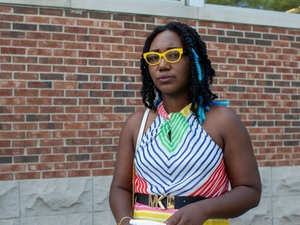
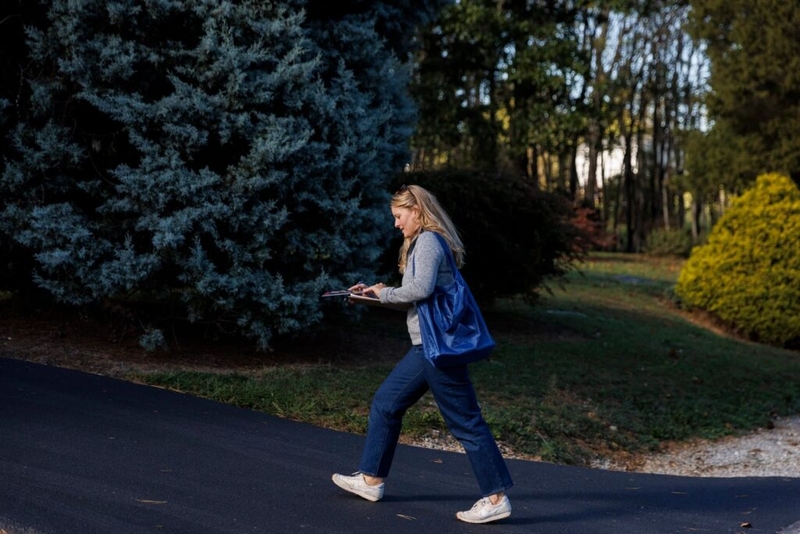
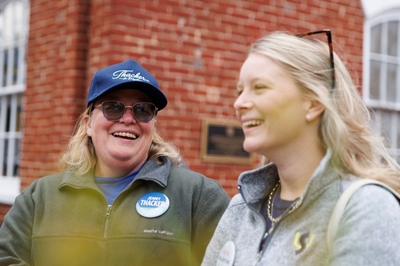
Lucia Valentine walks a neighborhood, door-knocking for her campaign in a rural area of West Virginia. (Moriah Ratner for The 19th)
This story was originally reported by Amanda Becker of The 19th. Meet Amanda and read more of their reporting on gender, politics and policy.
EASTERN PANHANDLE, W.Va. — Over and over on a recent October Saturday, Jenny Thacker explained to voters in West Virginia’s Eastern Panhandle why the groundwater in the region is particularly susceptible to contamination from data centers.
“Basically, instead of having soil that the water goes down through evenly and filters all the bad stuff out, we have a broken bedrock, and so there’s cracks,” Thacker would begin.
Thacker was nine months into her campaign to flip a House of Delegates seat for Democrats in deeply conservative West Virginia. Data centers have been “the number one issue people have talked to me about,” she said. By that Saturday, with just over two weeks until the election, she had her explanation of the region’s groundwater issues down pat.
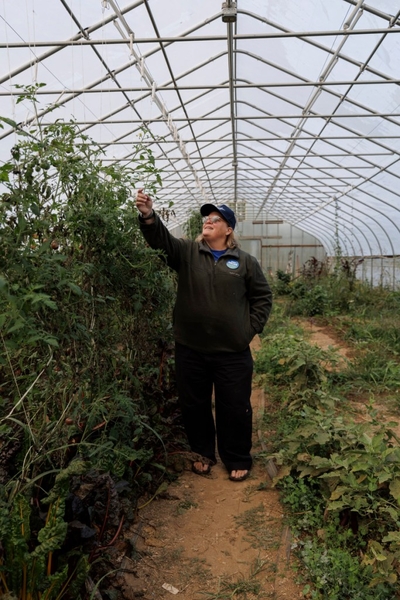
Thacker, an ocean cartographer who retired several years ago from the National Oceanic and Atmospheric Administration (NOAA), navigated her Prius from a homecoming parade to a garden group lunch to a barbecue fundraiser for a local 4-H group. Her bumper stickers hinted at the priorities that have defined her life: “May The Forest Be With You,” “Tree Hugger,” “Save The Ash Trees,” and “Peace Corps: Proud To Have Served My Country.”
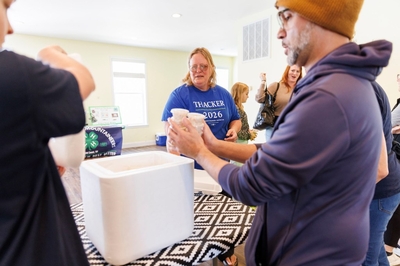
At the 4-H fundraiser — where a plate of pork barbecue, baked beans and mac ‘n’ cheese was $10 — Thacker used her hands to show Debbie Morris, 66, how cracks in the region’s bedrock act as chutes that carry water quickly from the surface to the underground water table.
If that surface water has the chemical pollutants in it that data centers use to cool their equipment, they end up in the groundwater, and boiling the water only concentrates the chemicals, Thacker explained. And as data centers extract groundwater to use for cooling systems, they can quickly use up entire pockets of water.
Thacker’s district is in Jefferson County, where as much as 90% of the population relies on municipal or private wells. Voters have told Thacker that some of their wells are already running dry. Drilling a new one — assuming they can locate a water pocket in the bedrock — can come with a $25,000 price tag.
As Thacker ate a plate of barbecue, Morris nodded along, periodically stopping to accept treats for safekeeping from her tutu-attired granddaughter. Morris met Thacker months earlier and said she has been impressed by her campaign, which has included hundreds of drop-ins to speak with voters at community events like this one.
“She’s everywhere … and this is not the easiest crowd. It’s a smart crowd, and they’ve supported her with open arms,” Morris said.
The two women discussed a law enacted last year that, as GOP Gov. Patrick Morrisey put it, took away local oversight and created a state-level “one-stop shop” for data-center permitting. West Virginia’s counties and municipalities are now legally barred from enforcing local ordinances and land-use rules related to microgrid sites or high-impact data centers. When the state legislature, which has a GOP supermajority, voted on the legislation, only three Republicans in the House of Delegates defected from their party to vote against it. In the Senate, one did. Thacker’s opponent, Del. Bill Ridenour, voted yes. Thacker’s pitch to voters focuses on why localities, and not the legislature, are best positioned to oversee data centers, based on their specific geologies and community needs.
“I have my list for when I go to the polls to make sure I don’t vote for any of these people,” Morris told Thacker. “The fact that you can meaningfully discuss this is so important.”
“I’m a little scared that even if I get elected, I won’t be able to do it by myself,” Thacker responded.
“You’re planting a seed,” Morris said as her granddaughter brought over a Ziploc bag of Italian ricotta cookies covered in sprinkles.
West Virginia has not been fertile ground for Democrats for some time. The only state that has backed President Donald Trump by a higher margin than West Virginia is Wyoming. West Virginians haven’t voted for a Democrat for the White House since Bill Clinton’s reelection in 1996. They last picked a Democrat for governor in 2016, electing Jim Justice. Now a U.S. senator, Justice announced at a rally with Trump eight months into his gubernatorial tenure that he would switch parties.
The state’s last Democrat in the U.S. Senate, Joe Manchin, announced in his final year in office that he would become an independent. All of West Virginia’s current statewide officers are Republicans. In the House of Delegates, there are nine Democrats and 91 Republicans; in the state Senate, it’s two Democrats and 32 Republicans.
West Virginia also has the distinction of having the lowest percentage of women serving in its legislature, with women holding only about 11% of its 134 seats.
Lacey Connelly, a political director who started working with the West Virginia Democratic Party this cycle, said that when the party started to recruit candidates for this year’s legislative races, it became clear that the futures of Democrats and women in the Statehouse could be intertwined.
We “got more creative with our candidate recruitment, not just looking at candidates we thought could raise the money and would have the time to do the work, but people who were already enmeshed in their communities, already doing the work advocating for policies or laws they thought would make people’s lives better,” Connelly explained.
“It tends to fall on women to deal with the public school system; it tends to be women who are dealing with the healthcare system for their families; it tends to be women who are balancing the budget and making sure they have enough money for new shoes for school,” she continued. “These women [candidates] are really showing that it’s the women interacting with the systems in this state who need the most help.”
Polling released this month by the state’s Democratic Party showed that 57% of West Virginians believed the Mountain State was on the wrong track, and just 30% were happy with the direction it was heading. The Republicans in statewide office had lower approval ratings than Trump, and his was lower as compared with past surveys. Democratic voters were more enthusiastic about their candidates than Republican voters were. Del. Mike Pushkin, the state’s Democratic Party chair, said at the time of the poll’s release that “West Virginians are tired of watching their utility bills climb, their hospitals and their schools close, and their elected officials writing blank checks to AI data centers.”
These are the issues that the Democratic women trying for the Statehouse are focused on. Thacker also talks frequently to voters about locality pay for teachers, meaning that those in more expensive areas of the state, like the Eastern Panhandle, would earn more. At the 4-H fundraiser, she met a woman who is a public school teacher, as is her husband. The couple commutes to a district in neighboring Virginia to teach and earn significantly higher salaries.
Lucia Valentine, also in the Eastern Panhandle, is running a campaign focused on lowering costs, with local data center oversight, teacher pay and improving childcare accessibility as key components. Elizabeth Ferris, running for state Senate in the Eastern Panhandle, is focused on restoring local control over data centers, public school funding and government transparency (She was able to run in part due to income from a forthcoming debut novel imagining Charlotte Brontë’s writing of “Jane Eyre.”) Kim Hundley, a teacher, is trying to flip a Senate seat in the Charleston area with a campaign focused on improving public education and a broken healthcare system that she experienced directly during breast cancer treatment.
“I don’t think anybody expects to get rid of the Republican supermajority this cycle, but I think that there’s going to be a significant number of Democratic candidates who will win, and I think a lot of them are going to be women,” said Kendra Sullivan, who was recently elected to Harrison County’s Democratic executive committee.
Democrats even believe that one of their candidates has a chance to flip a House of Delegates seat in Mingo County, which Trump won in 2024 by more than 70 points. Tara “BabyT” Sexton, a self-made environmental activist, has used her creative social media posts to highlight the drinking water crisis in the Central Appalachian Coalfield, prompting an August visit from the Republican governor.
“From stem to stern we have really strong women leading these races and I think we’ll win a lot of them,” said Sam Petsonk, an attorney who serves as one of the state’s delegates on the Democratic National Committee.
Del. Kayla Young, one of the two Democratic women in the House, where there are just 12 women total, said even if only some of these women prevail, it will considerably improve her ability to talk about “women’s issues” like schools and childcare at the Statehouse.
“A lot of times they don’t get the time of day because people consider them women’s issues, but they’re economic issues,” Young explained. “I realized also that for two whole years I was the only mom in the legislature that had kids who are under 18 years old, so when we’re talking about childcare or public education or paid leave, I’m literally the only person in the room who has any experience with that, and it’s terrifying. Women are the majority of the population in West Virginia.”
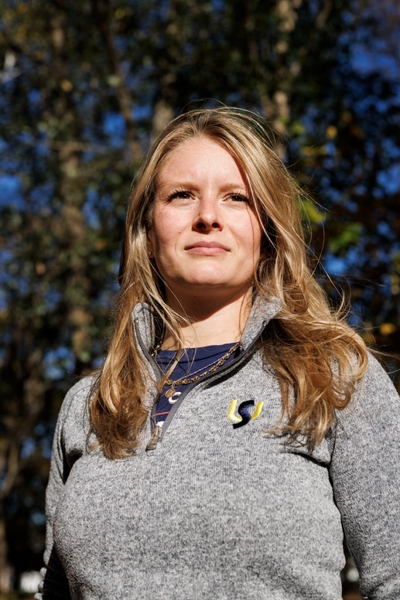
Valentine, a managing director at the “cross-partisan” West Virginia Women’s Alliance, is running in a district adjacent to Thacker’s that extends west from Shepherdstown to Martinsburg into Berkeley County. As you drive the area’s country roads, one side is often Valentine’s district, the other is Thacker’s. Many yards feature both women’s campaign signs.
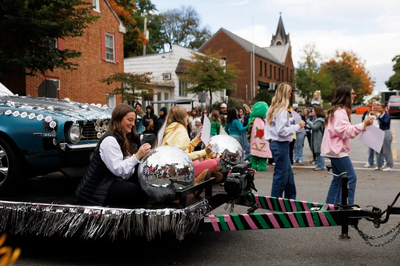
Valentine began that same Saturday at the homecoming parade in Shepherdstown with Thacker. Then, she went to Martinsburg to march in another parade. Afterward, she met up with The 19th to do some door-knocking in a rural area between the two cities that Valentine described as “winnable turf” with a mix of “red persuadable, high-turnout independents and middle-to-high turnout moderate Republicans.”
It is the second time Valentine has tried for the House of Delegates. In 2024, it was an open seat, and she lost to Republican Del. S. Chris Anders by about 700 votes. Anders is a staunch abortion opponent known for his anti-LGBTQ+ rhetoric who voted yes on the data center bill. School choice, ending the income tax and stopping “woke ideology” are among the issues featured on his campaign website. He helped relaunch the far-right West Virginia Freedom Caucus and serves as its chair.
Valentine said Anders’ focus on social issues and national debates has left a “big opportunity for me to try to appeal to that middle and moderate Republican group who are willing to look at people over party; I want to focus on the local issues we all agree on.”
A main way that Valentine has communicated with voters about these local issues is through a robust door-knocking campaign. She explained that in 2024, she didn’t start door-knocking until September. This time around, she hired a field consultant and began in May. She estimates that she had already knocked on about 4,000 doors that reached about 8,000 people — or about two-thirds of the total voters in her district. There were still two weeks and change to do more ahead of Election Day.
The second house on Valentine’s list to knock that day was a registered Republican, a man — his wife answered the door.
“Hi, I’m Lucia. I’m running for local office. I’m just checking in with neighbors today because I want to see if there’s any issues that y’all are concerned about,” Valentine began.
“You’re a Democrat, am I right?” the woman asked.
“Yeah,” Valentine replied.
“You’ve got it,” the woman said of her vote.
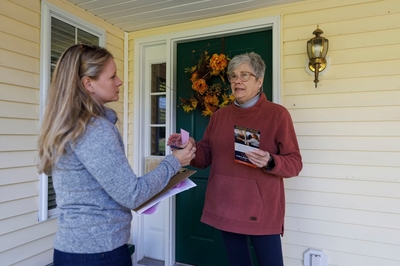
The two women laughed, and Valentine explained the issues that had come up as she knocked on doors around the district: growth, infrastructure, roads, data centers. “Get ‘em out of here,” the woman replied as she took campaign literature. “If you have any questions, feel free to reach out,” Valentine said, writing her cell phone number on a purple Post-it note.
“I almost came out and volunteered!” her husband, the registered Republican, shouted as the women wrapped up their conversation.
After a couple more hours of door-knocking, Valentine went home to change for the 30th birthday party her parents were hosting for her that evening at their home overlooking the Potomac River. Statehouse campaigns in West Virginia are mostly fueled by volunteers, friends and family, and many in Valentine’s inner circle who have powered her campaign would be there.
By 6 o’clock, the taco bar was set up, the bourbon apple cider slushy machine was spinning, and the Frank Sinatra impersonator who sang at Valentine’s father and stepmother’s wedding was testing his microphone. As the room filled with toddlers, octogenarians, friends from college, and a chaotic mix of dogs and cats, Valentine’s stepmother made a birthday toast.
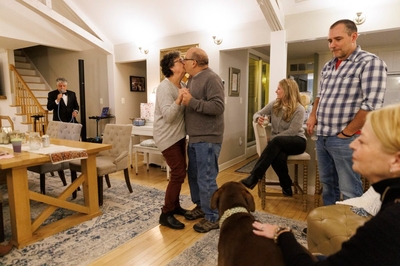
“We’re super proud of Lucia. We’re super excited for her, and most of all, we’re just really happy that we get to be her parents. So happy 30th birthday!” she said.
The Frank Sinatra impersonator started to sing: Fly me to the moon, let me play among the stars.
People began to dance.
To check your voter registration status or to get more information about how to vote and what’s on your ballot, visit vote.org.
Charleston, WV