Pappas is making campaign finance part of his US Senate bid. His opponents cry hypocrisy.
Sep 03, 2026 | 2:32 pm ET
Description
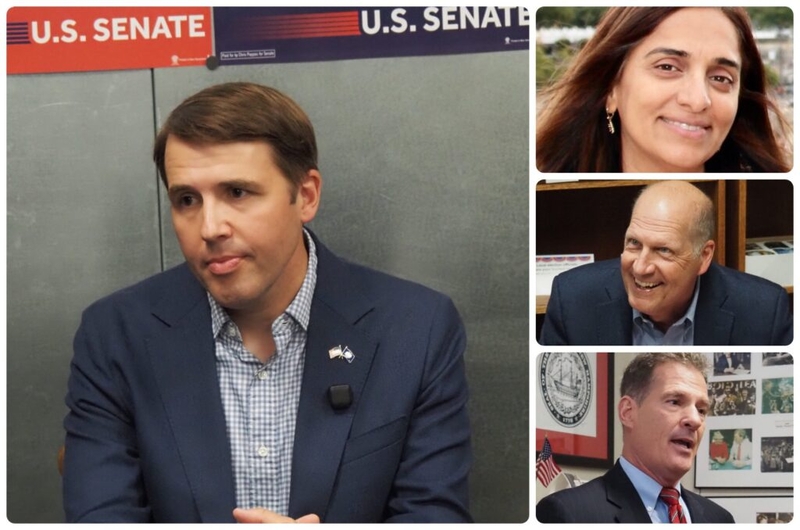
U.S. Senate candidates (clockwise from left) Chris Pappas, Karishma Manzur, John Sununu, and Scott Brown. (Pappas photo by William Skipworth/New Hampshire Bulletin; Manzur photo courtesy; Sununu photo by William Skipworth/New Hampshire Bulletin; Brown photo by Maya Mitchell/New Hampshire Bulletin)
In his effort to convince voters to send him to the U.S. Senate, Chris Pappas, who currently represents the eastern half of New Hampshire in the U.S. House of Representatives, has begun touting an agenda to keep big money out of politics.
“One of the major issues that we’re hearing about everywhere across New Hampshire is how we confront the culture of corruption in Washington, how we address the influence of big money in our political system, which is so corrosive to our democracy,” Pappas said at an event in Manchester last week. “And we’ve got to clean house in order for us to be able to make progress on the things that people are counting on.”
As a solution, Pappas is promoting the DISCLOSE Act, which aims to stem “dark money” — campaign donations delivered in a way that obscures their source, typically by routing it through an intermediate organization. The DISCLOSE ACT would require groups like super PACs, 501(c)(4)s, and other organizations to disclose any political donors who give more than $10,000. It would also attempt to shut down money transfers between organizations, which are meant to hide the identity of the original contributor; expand disclosure requirements for the funders of political ads; and close loopholes in bans on foreign money being donated to campaigns. Pappas was the lead sponsor for the House version of the legislation this year.
“This is something that cuts across party lines,” Pappas said. “This is not a Democratic talking point. This is for the good of the country and American democracy. Two hundred and fifty years after our independence, the power should be in the hands of the people, not monied corporate special interests. And Republican voters believe that just as much as Democratic voters do.”
No money from corporate PACs but lots of money from pro-Israel PACs
Pappas also boasts that he does not accept any money from corporate PACs that disburse money to campaigns on behalf of their supporters.
“I don’t take corporate PAC money in my campaigns,” Pappas said. “And I’m proud in our Senate race that we have over 120,000 donors who have given, on average, about 30 bucks online, contributing and chipping in to our effort.”
However, while none of his campaign war chest comes from corporate PACs, the congressman has long been supported by pro-Israel PACs. That includes over $600,000 in direct and earmarked contributions from the American Israel Public Affairs Committee, or AIPAC, over the course of his career, as well as more money from other pro-Israel sources.
AIPAC seeks to promote support for U.S. military aid to Israel. And the group has become a flashpoint in Democratic politics as public opinion sours on Israel amid its multi-front wars and as more and more independent experts conclude the country is committing genocide against the Palestinian people.
Pappas has supported U.S. aid to Israel throughout his time in Congress. In February, at AIPAC’s 2026 Congressional Summit, he called himself “a strong supporter of the bipartisan U.S.-Israel relationship, which is a cornerstone of our national security policy.” However, he has moderated his stance on the issue in recent months. In July, he voted “present” — neither in favor nor against — on an amendment that would’ve restricted arm sales to Israel. He called that a “tough vote” when asked about it at the Manchester event, adding “what (Israeli President Benjamin) Netanyahu has done over the last few years is indefensible and unsupportable, and I think this is an important moment for a reset with respect to the U.S. policy toward Israel.”
Asked if he views pro-Israel PACs differently than corporate PACs, Pappas said: “I support individual citizens being able to participate in the democratic process, but I’m taking on every source of effort in our political system to skew things in favor of special interests. I don’t care what PAC it happens to be.”
The progressive alternative in the race
In Tuesday’s Democratic primary election, Pappas will face Karishma Manzur, an activist who has never before held public office.
“Chris Pappas had eight years to not take money and to actually bring honor back to public service,” Manzur said in an interview. “So for eight years, he’s been part of the problem.”
“As people are turning towards me, Chris Pappas has decided that he has to step in and actually put forth the legislation,” Manzur said. “Why in 2026? Why not for the last eight years? And that is the question that all of us in New Hampshire should ask.”
However, Pappas first co-sponsored the DISCLOSE Act in 2019, his first year in Congress.
“Did it ever get passed,” Manzur said when presented with that fact, “or was it just a show?”
Manzur has made Pappas’ donations from pro-Israel groups a centerpiece of her campaign. She’s tried to contrast that with her own campaign funding.
“I’m not taking a single cent from corporate PACs, super PACs, AIPAC, foreign-aligned lobbies,” she said. “Nothing. I’m only taking money from regular folks here in New Hampshire and across the country.”
She said “every piece of legislation that I will advance, every vote, people in New Hampshire can be 100% assured that it will be in their best interest.”
An August poll from St. Anselm College shows Pappas beating Manzur 59% to 28%, with 13% of respondents unsure. The most recent UNH Granite State poll, also from August, points to a tighter race: a 47%-34% advantage for Pappas, with 18% undecided.
Asked what he’d say to voters considering supporting Manzur, Pappas deflected, saying: “I’m proud of the support I have, which comes from organized labor across the board in New Hampshire, which comes from small dollar donors. … But again, this is a campaign of ideas that’s really focused on how we beat John Sununu and MAGA Republicans, and flip the majority in the U.S. Senate.”
Looking ahead to the general
Throughout the primary, Pappas has continually tried to focus on his potential general election opponent, John Sununu.
“The big money campaign is the campaign behind John Sununu,” Pappas said. “The fact is, we’re outraising his campaign based on the individual support we’re drumming up, but he’s got a huge head of steam based on super PACs and special interests that are outspending us 3-to-1 on TV because they know he’s going to be a reliable vote for them.”
Sununu and Scott Brown, both former U.S. senators trying to return to Washington, D.C., lead the Republican primary.
Sununu did not respond to the Bulletin’s request for an interview. He was first elected to the U.S. Senate in 2002 but lost his 2008 reelection bid to current U.S. Sen. Jeanne Shaheen. Now that Shaheen is retiring, he’s asking Granite Staters to give him back the seat.
Brown served in the U.S. Senate from 2010 to 2013, representing Massachusetts after winning a special election. After losing reelection, he moved to New Hampshire and has sought to win election here in multiple races.
Like Manzur, Brown also accused Pappas of hypocrisy.
“Chris’ efforts are too little, too late,” Brown said. “He’s been there for seven years and has not made it any part of his campaign.”
Brown pointed to his own work on financial ethics in 2012, when he introduced the STOCK Act, which required members of Congress to disclose stock transactions and sought to ban insider trading. In an interview, he recalled his plea to President Barack Obama after the bill got stuck in the Senate.
“During the State of the Union, the president was walking up the dais,” Brown recounted. “And I said, ‘Sir, my insider trading bill is stuck, and it needs your help.’”
Obama signed the bill into law in April 2012.
“It was great,” Brown said. “It was bipartisan. It really did make a real difference. … But when I left, they weakened it, and I think it’s disingenuous for Chris now that he’s running to all of a sudden take on these great, amazing causes.”
Asked if he would try to reverse the rollbacks of the STOCK Act should he be reelected, Brown said, “I’d like to look at what they’re proposing now and see if it’s something that could certainly help.”
Brown also took aim at Sununu’s campaign.
“If you look at John Sununu, he’s got the Senate Leadership Fund, NRSC paying for all his ads, Americans for Prosperity paying for all his ads,” Brown said. “He approves them, but they’re paying for it — millions and millions of dollars. So while they’re not writing checks, they’re doing all of his commercials, and he has all those special interests: big oil, big pharma, big tech, big banks.”
Sununu holds a commanding 54%-24% lead over Brown in the St. Anselm Poll, and a 60%-20% advantage in the UNH poll.
Concord, NH