Oregon anti-animal cruelty initiative sounded like a good idea, until learning details
Jun 11, 2026 | 5:37 pm ET
Description
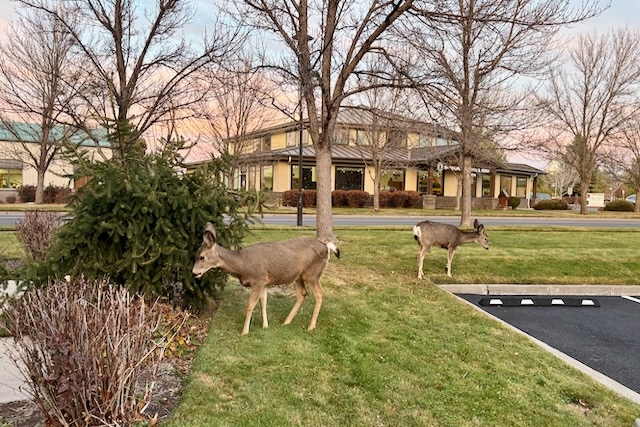
Deer graze in an office park in Bend, Oregon, in December 2025. An initiative that would ban hunting, fishing, raising animals for food and most other killing of animals other than insects could appear on Oregon ballots in 2026. (Photo by Julia Shumway/Oregon Capital Chronicle)
My wife volunteered for years in dog rescue efforts around the region, and her experiences made clear to me that Oregon’s animal cruelty and mistreatment laws were inadequate and needed strengthening.
So when Initiative Petition 28, billed as doing something like that, pulled the mass of signatures needed for ballot status, it sounded welcome.
Then I read proposed law and descriptions — especially from the advocates themselves — of what it would actually do. Even its backers acknowledge it’s unlikely to pass (once word of the details spreads more widely). If it actually did — and were fully enforced — it would unleash economic and social chaos in Oregon beyond any previous piece of legislation. And it would be intended as a template for any other states so foolish as to follow suit.
Republicans have lined up against it, as in gubernatorial candidate Christine Drazan’s statement on X that “Banning hunting, fishing, and basic animal husbandry would kill thousands of jobs and threaten our food supply at a time when we can least afford it.”
Republicans may well try to tie the initiative to Democrats, though there’s been strong opposition there too. One example is Gov. Tina Kotek, who said: “I know tribal leaders, family farmers and ranchers and Oregonians across the state who care deeply about protecting our land, waters and wildlife. This petition does nothing to help that, and it risks criminalizing common agricultural practices that are critical to Oregon’s economy.”
What’s more notable here is what the advocates themselves say.
IP 28 applies to “any nonhuman mammal, bird, reptile, amphibian or fish,” though insects would be excluded, so swatting a mosquito would remain legal. It does ban any injury to the covered species, the main exception being that humans still would be allowed to act in self-defense. The group said specifically that “we are focused specifically on criminalizing the practice of killing animals.”
It said the initiative “would prohibit the intentional injury and killing of animals, as well as the forced breeding of animals.” However, IP28 adds a rehabilitation program as an alternative to other criminal penalties. In lieu of a misdemeanor, anyone convicted of animal cruelty could choose to complete supervised community service hours at an animal care facility as well as relinquish ownership of any animals for either five or 15 years, depending on the severity of the conviction.”
Oregon petition to ban hunting and fishing moves closer to November ballot
The list of animal-related actions to be criminalized would be extensive. Fishing and hunting would be illegal and criminal, and that would apply to longstanding agreements with Indian tribes in the state: “There would not be a cultural or religious exemption for injuring, killing, or sexually violating an animal.”
Production of meat products (where any vertebrate is involved) in the state would be prohibited. The group said “a rancher would likely no longer have a reason to raise cattle. … We would encourage ranchers to transition to an alternative agriculture practice.”
Easy for them to say, as they did: “A determined soul will always manage.”
Use of slaughterhouses and of animals in medical experiments (which in some cases are critical for advancing medical care) would be not just subject to regulation but banned outright.
You have a mouse or rat infestation in your house? The advocates say “live catch mouse traps” still would be available to you, but most other approaches to combatting the rodents, including anything that might kill them, would not. Your core response — and this approach evidently would be the operative rule for pest control businesses (any that survived) as well — apparently would be “locating the spaces where mice may enter our home or business and blocking the passageway.”
People would still be able to own pets, the advocates noted. But clearly the rules surrounding pet ownership would change considerably.
The impacts of this measure, were it to become law, would affect the daily lives of nearly everyone in Oregon. It would wipe out whole categories of industries. It would lead quickly to social chaos — no too extreme a description. Its scope would be breathtaking.
I would have suspected all this as being exaggeration by opponents were it not for the descriptions that come straight from the issue’s advocates. It seems an example of what happens when an initially sound idea — avoiding cruelty to animals — is pushed too far and too fast. It may set back that cause by many years.
As a matter of politics, Republicans are on solid ground in opposing the initiative. Democrats will need to act visibly and aggressively against it to ensure they’re not handcuffed to it, since to many non-Democrats IP 28 easily could sound like the kind of thing an extremist Democrat might conceive.
As a matter of election, IP 28 would be lucky to get the super-minority vote the transportation funding package got in the primary election — if voters learn the details. But any issue reaching the ballot has to be taken seriously.
One good thing the advocates did was to make that relatively easy.
Salem, OR