One uranium project takes a step toward state permit, while another stays stalled by legal questions
Aug 20, 2026 | 6:58 pm ET
Description
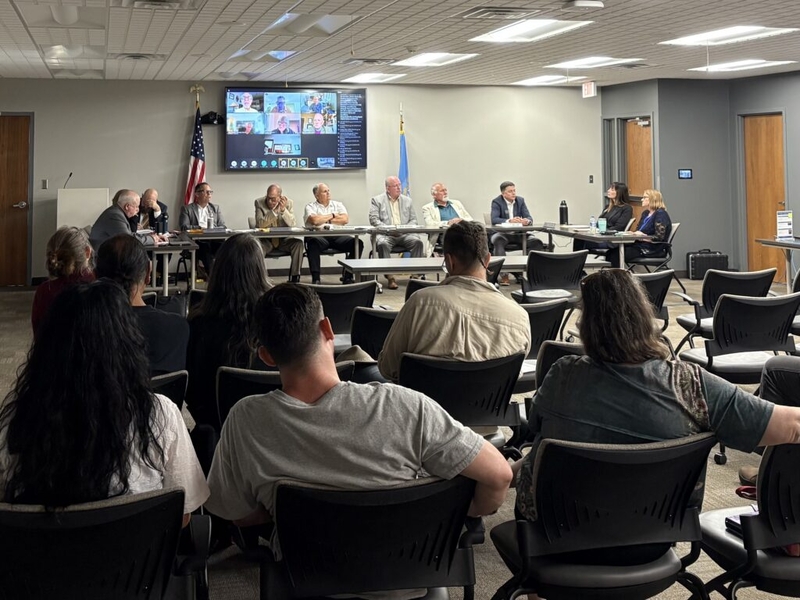
Opponents of a proposed project to drill for uranium in the southern Black Hills listen to a meeting of the Board of Minerals and Environment at the Joe Foss Building in Pierre, South Dakota, on Aug. 20, 2026. (Photo by Meghan O'Brien/South Dakota Searchlight)
Listen to an audio version of this story produced by reporter Meghan O’Brien. Broadcasters: See below for a downloadable version with a host intro script.
PIERRE — A long-lingering South Dakota uranium mining proposal restarted its state permitting process Thursday with approval from a state board to commission a study, and the board continued discussing a different proposal to conduct exploratory drilling for uranium in the same area of the state.
Uranium is a metallic, radioactive element used as fuel in nuclear weapons and nuclear power plants. Interest in uranium exploration and mining has risen recently. That’s in response to nuclear energy’s potential to supply electricity for data centers.
The proposed Dewey-Burdock uranium mine would cover nearly 20 square miles of land in Custer and Fall River counties along the southern edge of the Black Hills, near the city of Edgemont. It requires federal, state and local permits. Legal challenges kept it in a 13-year stalemate since its initial application for a state permit, but the project secured the last of its federal permits earlier this year, according to the federal Permitting Council.
Company proposing Black Hills uranium mine eyes state permitting restart after 13-year pause
On Thursday, South Dakota’s Minerals and Environment Board granted Powertech, a subsidiary of Texas-based enCore Energy, approval to hire a Wyoming-based company to conduct a socioeconomic assessment, which is an initial step in mine permitting.
The study will help evaluate the project’s effects, including its economic impact, changes in air or water quality, local employment opportunities and use of resources like grazing land. The board can deny a mining permit application if the negative impacts of a project outweigh benefits.
The mining method for the project is “in situ” — drilling wells to inject a water-based solution underground, dissolving uranium and pumping it to the surface. The water would be pulled from local aquifers and then treated and pumped back underground after being used for mining, causing opponents to fear pollution of local water sources.
Drilling proposal stalled by language interpretation law
Another proposed uranium project in the same general area of the southern Black Hills will stay stalled after board members announced they’re seeking a state judge’s opinion on a relevant law.
The board indicated it wants clarity on a new state law that took effect in July. The law requires language translation services for some government proceedings.
Clean Nuclear Energy Corp., a subsidiary of Canada-based Nexus Uranium, is seeking a permit to drill dozens of exploratory holes as much as 700 feet deep on state land, while seeking federal permission for additional drilling on federal land. The proposed sites are near the rim of Craven Canyon in the southern Black Hills.
Dozens of people and some organizations have raised formal complaints about the project to the state Board of Minerals and Environment, which will decide on the permit. Opponents have said the drilling could disturb ancient Native American petroglyphs on the canyon’s walls, disrupt Lakota ceremonies and potentially contaminate groundwater, among other concerns.
Tense hearing on uranium drilling tests new language-translation law before its effective date
A hearing on the permit began earlier this year in Hot Springs. It was cut short after a project opponent filed a federal lawsuit against the company, the board and the state Department of Agriculture and Natural Resources. That lawsuit is still pending, and the board has not resumed the hearing.
Project opponent Elizabeth Lone Eagle filed the lawsuit on the third day of what was planned to be a five-day hearing. She alleged “systematic, ongoing, and deliberate denial of meaningful participation to Lakota first-language speaking” project opponents.
The board was not legally obligated to provide interpretation services to Lakota first-language speakers at the May hearing, but agreed to do so anyway, noting that the law requiring translation services would come into effect just a couple of months later.
But on the first day of the hearing, Department of Agriculture and Natural Resources staff said they had not reached agreement with a Lakota translator and did not provide one. The staff later contracted with two Lakota speakers for the following days of the hearing, but project opponents including Lone Eagle accused the board of improperly conducting some parts of the hearing without interpretation.
The board discussed the matter Thursday in a closed meeting known as an executive session, citing the discussion of legal matters. Afterward, the board emerged back into a public session and voted to seek a state judge’s declaratory ruling on a portion of state law that includes the new interpretation provision. Board members did not publicly explain their reasoning for seeking the ruling, but the board’s lawyer told South Dakota Searchlight that board members are hoping for clarity about their obligations under the new language interpretation law.

Pierre, SD