Okefenokee Swamp clinches World Heritage status, officially joining ranks of top natural wonders
Jul 25, 2026 | 7:18 am ET
Description
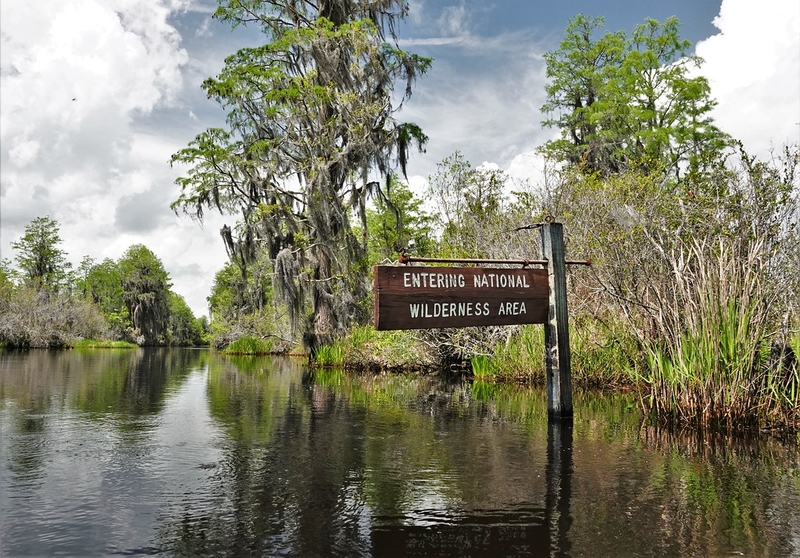
Okefenokee National Wildlife Refuge has been named a UNESCO World Heritage site. Larry Woodward/U.S. Fish and Wildlife Service
The Okefenokee National Wildlife Refuge is now a World Heritage site.
The United Nations Educational, Scientific and Cultural Organization’s World Heritage committee approved the addition around midnight Saturday morning in Georgia time and about 1 p.m. in Busan, South Korea, where the meeting was held. The decision was reached without debate from the international committee set up to recognize sites of universal environmental or cultural importance, but the effort to join that coterie was more than four decades in the making.
“The Okefenokee is a place where nature still reigns,” Kim Bednarek, executive director of Okefenokee Swamp Park and Adventures, said in an acceptance speech. “Across more than 400,000 acres, water, fire, peat and time continue to shape an intact wetland, reminding us that conservation is about protecting the natural systems that sustain life itself.”
Georgia Rivers Executive Director Rena Peck described the celebration in a phone call from Busan with a lot of clapping and cheering in the background.
“Everyone’s just thrilled,” she said. “People from all countries are coming up to congratulate us. It’s just a vision of world peace. You have all these different nations caring about protecting their treasures and sharing those treasures with the world, and the world is recognizing the Okefenokee.”
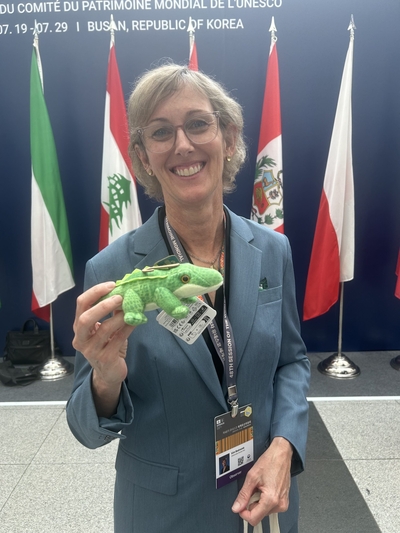
In a phone call after the hearing, Bednarek said the crowd of international diplomats and cultural experts were going crazy for a particular swampy souvenir – plush Okefenokee alligators.
“I’m going to tell you, the plush gators have been the biggest hit,” she said with a laugh. “Everyone loves the plush alligator. American alligators are the iconic charismatic megafauna for the Okefenokee. In the Okefenokee, we know them as swamp puppies, and here, the little plushies are being handed out as swamp puppies, and everyone is absolutely loving them and it’s a great way for them to get excited and to learn about the Okefenokee.”
The designation makes the Okefenokee Georgia’s first UNESCO World Heritage site, and it’s also the first national wildlife refuge in the United States to achieve that status.
A boon for tourism and education
A lot more of those plush swamp puppies could soon be on store shelves in south Georgia, along with gator keychains, magnets, hats and more.
A 2024 Conservation Fund report found that the number of people visiting the Okefenokee each year could double from 800,000 to 1.6 million by 2035 if it were to become a World Heritage site.
Some local residents have been wary of what the increased attention might mean for the swamp and the neighboring communities. But Gov. Brian Kemp celebrated the World Heritage designation as a win for those communities in a statement.
“An important part of our state’s heritage and economy, this is a fitting recognition for the Okefenokee that will further strengthen rural communities that surround it,” Kemp said.
In recommending the Okefenokee be added to the list, UNESCO praised the U.S. Department of Fish and Wildlife for its effective management of the land, but noted that it is vulnerable to a variety of threats, including climate change, water management, mining interests and “the projected increase in tourism.”
An increase in tourism at natural wonders like the Okefenokee sometimes means an increase in dangerous or damaging behavior, but Bednarek said the swamp is protected in that regard by its size and remoteness.
“We have 120 miles of water trails in the Okefenokee, which means you can really only access about 2% of the entire national wildlife refuge on those trails,” she said. “So there’s not an opportunity to harm the swamp because you can’t access it. The real opportunity is in the communities, in the gateway communities of Charlton County and Ware County and Clinch County in Georgia, and in Baker County in Florida to really see an uptick in tourism and have pride in this incredible place.”
Larry Winslett, the endangered species issue leader for the Sierra Club Georgia Chapter, agreed.
“In the future, somebody might slap some big hotels next door or something like that, I suppose it could happen with that,” he said. “But there’s more of a concern on that issue at places like Stone Mountain, Jekyll Island, Arabia Mountain, places like that that do get a tremendous amount of visitors.”
Ancestral lands
Speaking from Busan, where she addressed the UNESCO committee, Tracie Revis said she hopes the new designation will encourage people to learn about the Muscogee (Creek) Nation, which she is a member of. The Muscogee and other Native American communities lived in and around the swamp for thousands of years until they were forcibly removed in the 1800s.
The name Okefenokee comes from the Muscogee language and means “land of the trembling earth,” Revis said, a reference to the way the thick peat moves on top of the water.
“It is our ancestral lands,” she said. “It’s lands that we lost after 1814 after the Treaty of Fort Jackson, but it served as a refuge, it served as a homeland, it served as a place that had a lot of meaning for us.”
“We believe culturally that the trees are older, the water is older, and it remembers our stories and our voices,” she added. “So for us to be able to be a part of this celebration and everything moving forward, it creates a healing for our community.”
The park contains information on Native American culture and linguistics, and Revis said work is underway for more educational experiences.
‘A shooting star’
The Okefenokee now joins natural wonders like the Grand Canyon and Yellowstone National Park.
Its biodiversity helped the swamp win the day in Busan. It’s one of the world’s largest naturally driven freshwater ecosystems and home to at least 856 plant species, 48 mammal species and 238 bird species, 39 fish species and 90 reptile and amphibian species, according to UNESCO.
Last year, Alabama-based Twin Pines Minerals abandoned plans to mine valuable minerals near the refuge. The new designation does not prevent any kind of nearby development, but Bednarek said she feels optimistic that the new honor will help ensure the land surrounding the park will be protected.
“The direction is – it’s a shooting star,” she said. “And I think it’s game over for talking about the Okefenokee and having to talk about a mine at the same time.”
Atlanta, GA