Ohio Republican bill would create a $360 million special education cost reimbursement fund
Sep 29, 2026 | 3:50 am ET
Description
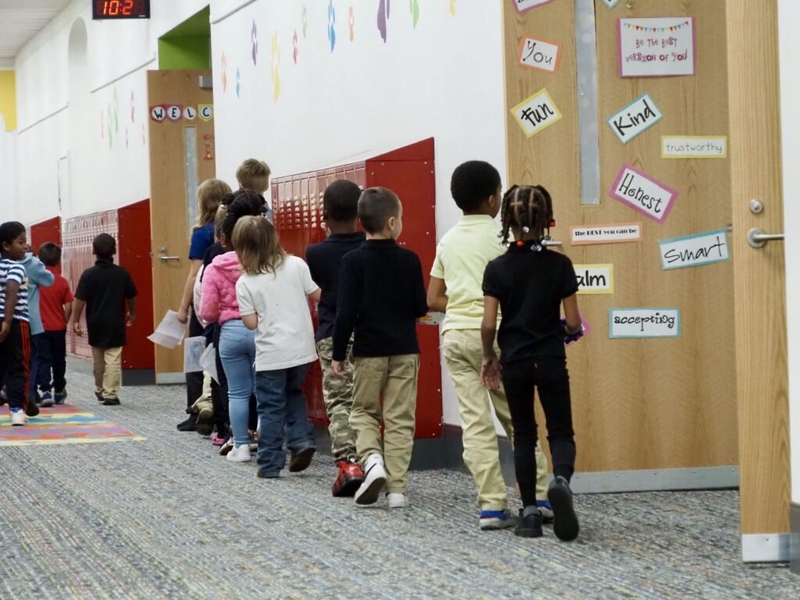
Students walk down the hall at a public elementary school. (Photo by Nuria Martinez-Keel, States Newsroom.)
A pair of Ohio Republican lawmakers have introduced a bill that would increase special education funding.
Ohio state Reps. Andrea White, R-Kettering, and Cindy Abrams, R-Harrison, recently introduced Ohio House Bill 1012 which would create a $360 million special education threshold cost reimbursement in the General Revenue Fund.
“As more students need specialized services and the cost of providing these services continues to grow at an exponential pace at the school district level, we need more financial support from the state so that no matter where a student lives, they can have access to meaningful learning and supports to help them achieve their goals,” White said in a statement.
The number of students with disabilities in Ohio has increased in the last five years, according to the Ohio Department of Education and Workforce.
- 17.7% students with disabilities — 2025-26 school year.
- 17.3% students with disabilities — 2024-25 school year
- 17.1% students with disabilities — 2023-24 school year
- 16.7% students with disabilities — 2022-23 school year
- 16.2% students with disabilities — 2021-22 school year
Under Ohio law, school districts can request reimbursement for special education costs exceeding the threshold to educate students, which ranges from $27,375 to $32,850 depending on the child’s specific disability category.
There were 22,158 student applications approved from 535 school districts receiving 25.57% reimbursement percentage totaling $90.9 million for fiscal year 2026, ODEW’s spokesperson Lacey Snoke said in an email.
“This special education funding will greatly help ensure all students receive high-quality education,” Abrams said in an email.
Jennifer Webb, past president for the Council for Exceptional Children’s Ohio chapter, said this bill would help lots of students.
“I’m certainly pleasantly surprised and amazed by the support that it shows and the recognition of the need,” said Webb, chair of the teacher education programs at Malone University, a private university in Canton.
“If schools have more funding, they can provide more services as deemed appropriate. So this could mean potentially … more materials or resources or curriculum.”
The Office of Special Education and Rehabilitative Services is responsible for making sure states follow the Individuals with Disabilities Education Act (IDEA), a federal law that ensures students with disabilities have access to a free and appropriate public education. That means school districts have to provide those services to special education students.
“What happens is when you get a student who needs significantly more support or services, that money ends up having to come out of the general fund for that school district because it’s not available anywhere else, which impacts everybody,” said Dee Marks, who sits on the Member Organization Council, an arm under the governing board of the Ohio Coalition for the Education of Children with Disabilities.
She said this bill would give more money to school districts to “ tap in to when they need it, so hopefully they’re not having to pull that additional money out of their general fund.”
Marks said there’s also been a big increase in the students who need a higher rate of funding.
“The school already receives a fixed standard amount of state funding per special education student, and it’s based on that child’s specific disability category, but the disability category doesn’t always cover everything,” she said.
School districts have to sometimes have to pull money out of the general fund, Marks said.
“All students with disabilities deserve to be educated towards a successful outcome, but all students deserve to be educated, and so when we have to pull money from general funds that benefit all students to make sure that we’re educating to the standard of the law for special education, all students, including those with special education suffer, and that’s not okay,” Marks said.
This bill comes months after the Trump administration announced in June it will move the Office of Special Education and Rehabilitative Services to the U.S. Department of Health and Human Services, and the Office for Civil Rights to the U.S. Department of Justice.
The Ohio Capital Journal reported Ohio special education advocates worry these changes will cause confusion, delays, and a loss of service to students.
Any bill that does not pass before Ohio’s two-year General Assembly ends in December would have to be reintroduced.
Follow Ohio Capital Journal Reporter Megan Henry on X or on Bluesky.
Columbus, OH