Ohio has a 15% daily school bus driver shortage as Columbus City Schools work to fill vacancies
Sep 08, 2026 | 3:55 am ET
Description
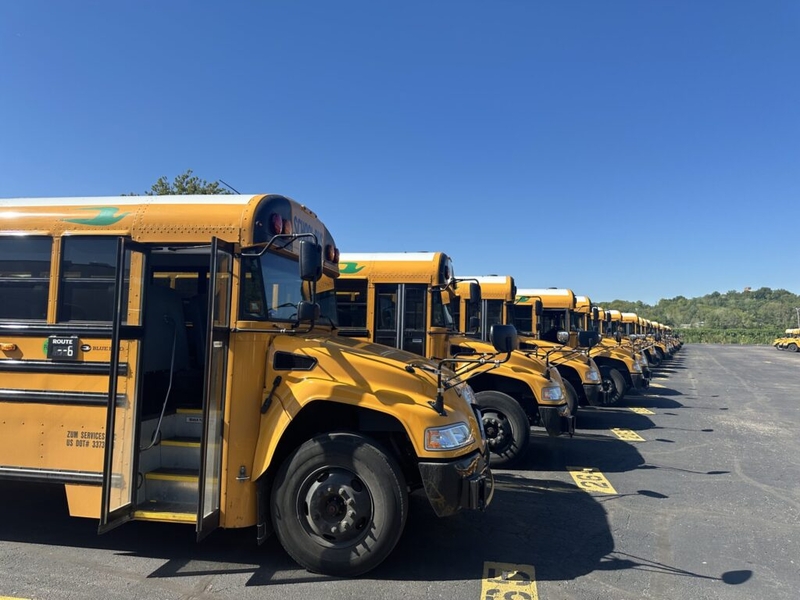
School buses lined up.(Photo by Kevin Hardy/Stateline.)
Ohio public schools are experiencing a 15% day-to-day bus shortage, according to the National Association for Pupil Transportation, and families are feeling the effects.
School bus driver shortages are often the result of recruitment, retention, financial, and operational challenges happening at the same time, said President-Elect of the National Association for Pupil Transportation Melody Coniglio.
“Transportation is one of the first and last services a student receives each school day, so when there are not enough drivers, the effects can quickly be felt by students, families, staff, schools, athletics, and the district as a whole,” said Coniglio, who is also West Geauga Local School District’s director of transportation.
There are 17,008 active bus drivers across the state as of Wednesday, said Ohio Department of Education and Workforce Spokesperson Lacey Snoke.
Columbus City Schools, the state’s largest district with about 45,000 students, is working to fill bus driver vacancies.
Columbus has 425 yellow bus and van routes and 395 active bus drivers and 68 contract drivers to bus 32,450 students — including 8,552 charter and nonpublic students as of Tuesday, said district spokesperson Michael Brown.
The district wants to have 500 drivers.
“Since school has started, my son’s bus has been late picking up and dropping off,” said Phillip Floyd, the parent of a Columbus City Schools second grader.
“When I say late, over 20 minutes late.”
As a result, his son has been late or almost late to school every morning.
“Our kids should be getting to school on time,” Floyd said.
The school bus is supposed to pick Floyd’s son up at 8:37 a.m. and instead it’s been picking him up closer to 8:55 a.m. and is getting to school some days as the bell is ringing at 9 a.m. or after the school day has already started.
“He’s really frustrated about getting to school late because my son really loves school,” Floyd said. “He’s missing him out on his morning work that he really wants to do. This is out of his control.”
Floyd also said the bus driver forgot to drop off his son one afternoon, so his son rode the bus an additional two hours.
“We’re freaking out because where’s our child?” he said. “Your job as a parent is your child’s safety, and you’re not knowing where your child is. … It’s a feeling that I just can’t even put into words.”
Mande Stedman’s fifth grade son has only ridden the Columbus City Schools afternoon bus once, but he got home nearly two hours late. His drop off time is 4:47 p.m., but he got home at 6:35 p.m.
“I was so relieved to see my son and started crying because of how panicked I had been,” she said in an email.
Her seventh-grade daughter doesn’t use the morning school bus because her pick-up time would be 5:52 a.m.
Ohio requires public school districts to provide transportation for eligible students attending nonpublic and community schools — something Coniglio said can “add another layer of complexity” since those schools can go beyond the school district’s boundaries.
“From an operational standpoint, those miles and minutes matter,” she said.
“A bus and driver assigned to transport even a small number of students outside the district may not be available to serve another route during that same period.”
Patrick Henry Local Schools in northwest Ohio buses 500 students who attend their school district and 15 students who do not attend public school, said Superintendent Josh Biederstedt.
The district has 12 full-time bus drivers and four substitutes for 12 routes and three non-public routes, he said.
“We offer our current employees a financial incentive to get their Commercial Driver’s License and become a sub driver,” Biederstedt said in an email.
“Additionally, we offer current employees an incentive for referring new bus drivers that either become a sub or full time driver.”
Retention is an important factor. 62% of bus drivers and aides reported feeling unsupported when dealing with challenging student behavior according to the Ohio School Bus Safety Working Group survey.
“Recruiting new drivers will not solve the shortage if districts are unable to retain the qualified, experienced drivers they already have,” Coniglio said.
About 22,000 Ohio students were determined to be impractical to transport last year, Coniglio said.
“When a district determines that transportation for an eligible student is impractical after considering the factors required under Ohio law, the district may offer the family payment in lieu of providing transportation,” she said.
“If Ohio did not have the Payment in Lieu of Transportation option available to districts, I believe the statewide driver shortage and its operational impact would be considerably more visible,” she said.
Follow Ohio Capital Journal Reporter Megan Henry on X or on Bluesky.

Columbus, OH