You still can’t smoke medical cannabis in Georgia, but you can vape it. What’s the difference?
Sep 08, 2026 | 5:05 am ET
Description
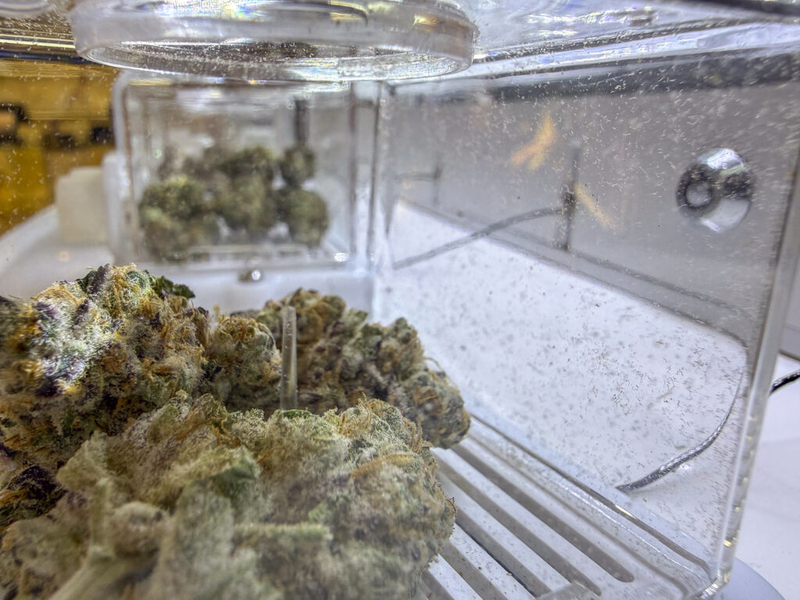
Buds of marijuana on display inside Mother Earth Wellness in Pawtucket, one of eight retailers licensed to sell recreational cannabis. (Photo by Christopher Shea/Rhode Island Current)
Medical cannabis dispensaries are now selling the flower form of the drug in Georgia, but a new state law that took effect this summer has created some confusion over how it can be legally consumed.
Lawmakers passed a measure earlier this year that overhauled the state’s medical cannabis program by dropping the confusing “low THC oil” branding, allowing dry-herb and oil vaporization, adding qualifying medical conditions and removing previous potency barriers. The changes quickly triggered significant growth in the number of patients enrolled in the program, with nearly 50,000 patients as of Sept. 2, according to the Department of Public Health.
But limits remain on how the raw cannabis flower can be used. Smoking it remains illegal under the new state law known as the Putting Patients First Act, which allows registered patients 21 and older to consume flower and oil at home strictly through vaporization.
“The law is very clear. You can vaporize flower and then of course vaporize the vape oil. So, the only thing that’s allowed in inhalables is vaporizing. That’s it,” said Newnan Republican state Sen. Matt Brass, the bill’s sponsor, in a phone interview.
Because flower is now being sold in Georgia’s dispensaries and independent pharmacies, retailers are finding themselves at the forefront of educating patients who incorrectly assume the availability of flower means the state legalized traditional smoking.
Enrollment jumps after lawmakers ease access to Georgia’s medical cannabis program
Priya Raje, the owner of Lotus Farmacy in Suwanee, an independent pharmacy specializing in medical cannabis, said she is frequently asked about the difference between smoking and vaping and said that a part of her role is to educate patients on what’s legal in Georgia. She said that most people are familiar with smoking flower because it’s the way cannabis has been historically consumed, so she spends that extra time educating patients about what is allowed under the law.
“I just tell them what the legality is and what the risks are if they choose to do anything else,” Raje said.
Yolanda Bennett, who is a patient and co-head of the Georgia Medical Cannabis Society, which is an organization that advocates for medical cannabis access and educates patients, said smoking and vaporizing flower form of cannabis are entirely different methods. She said that smoking flower burns all the particles and plant matter and creates smoke from the combustion, whereas vaporization using a device only heats up the plant matter to a certain temperature without burning it, only creating an inhalable vapor.
“When you take a flame and ignite the flower, that’s illegal,” Bennett said.
The bill did not originally allow Georgians to vaporize the flower, but Brass said he didn’t push back after the House amended the bill to include it because he figured that vaping flower could be a healthier alternative to oil vapes.
“You’ve got different additives that are put in that oil to have it hit a certain percent, and the flower is grown and there’s nothing added to it, and so that was why I agreed to it. I don’t know if that’s why [the House] added it, but to me, that makes sense,” Brass said.

Atlanta, GA