Nunn pledges to support cancer research; calls for ‘sustainable’ healthcare models
Jul 10, 2026 | 4:50 pm ET
Description
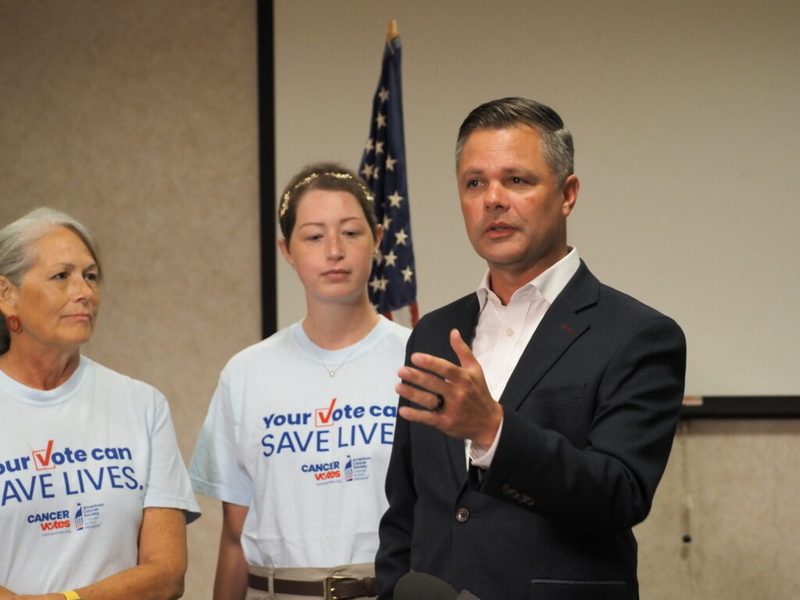
U.S. Rep. Zach Nunn, joined by with American Cancer Society Cancer Action Network volunteers Maria Steele and Clara Cirks, answered questions from reporters July 10, 2026 following a roundtable discussion at the Adel Public Library, hosted by ACS CAN about cancer in Iowa. (Photo by Robin Opsahl/Iowa Capital Dispatch)
ADEL — U.S. Rep. Zach Nunn said Friday the current Republican-led Congress has been the most effective in “generational history” to have moved forward with cancer research funding.
Nunn spoke to cancer patients, survivors and advocates at a American Cancer Society Cancer Action Network (ACS CAN) event Friday at the Adel Public Library.
Nunn, who represents Iowa’s 3rd Congressional District and is running for reelection in 2026, heard stories from individuals about their struggles battling cancer personally and supporting family and friends with cancer. His Democratic opponent, state Sen. Sarah Trone Garriott, spoke July 7 at a similar event organized by ACS CAN.
Those attending the “Cancer Votes Coffee Chat,” a nonpartisan event, urged Nunn to support continued federal funding for research into cancer, saying this was one of the best ways to support Iowans in a state with the second-highest rate of new cancer incidences nationally, and one of only three states with a rising rate of new cancers.
Gary Steinke of Urbandale told Nunn he was diagnosed with metastatic melanoma in December 2025, and doctors at the Mayo Clinic found melanoma had spread to “every major organ in my body, liver, lungs, kidneys, bladder, even my spine,” putting him at Stage Four cancer.
“This is what they said to me: number one, melanoma, 15 years ago, the doctors among themselves said that melanoma gives cancer a bad name because there was no treatment, there was no cure there, and it was hard to detect,” Steinke said. “… They said to me, looking at this scan 15 years ago, we would have said six months, maybe, because it is very widespread. But now, 15 years later, and I’m telling you what they told me because I am certainly not an expert in in this funding — but what they told me was that 15 years ago, (the National Institutes of Health) doled out $56 billion dollars and made research scientists pool the money, so that they could attack this problem and at least give people some hope or remission or something.”
Steinke said he started immunotherapy on Feb. 1, 2026. When they performed another scan in May following months of treatment, “every melanoma cell in my body is gone,” he said.
“I mean that is what research can do, and if they can do it with melanoma, which was incurable, then they can do it for you and for you,” he said, speaking to other individuals with cancer at the event. “… It can be done, and so don’t let people say, ‘oh well, you know, cancer, that’s a tough one.’ No, it’s not. No, it’s not. It’s just going to take a lot of research, and unfortunately, that takes money.”
Nunn said he agreed funding cancer research was an important goal, and noted Congress was able to get $50 billion in cancer research funding — and that he “personally fought for $128 million to be able to help afford specific targeted cancer research.” Additionally, Nunn said, he has looked at “what we can do here locally on key cancers, things like breast cancer, things like pancreatic cancer legislation, and particularly for juvenile cancers.”
“This is not a Republican or Democrat issue. This is just a good for America issue, and being able to deliver on this this year has been a good first start,” Nunn said. “… I take that as a badge of honor, but I also take as a badge of only a first start. So we have made a maximum request of $51.3 billion in next year’s funding.”
ACS CAN advocates and survivors also spoke about the need to increase access to healthcare — as well as healthcare coverage — in an effort to support those in the state battling cancer. Clara Cirks of Dallas Center said she was diagnosed stage four lung cancer, with metastases to her breast, liver, lymph nodes, bones, pelvis, ovaries, and brain in February 2025 when she was 30 years old. She moved from Colorado Springs back to Iowa to receive cancer care. Most of her care was covered during the first year of treatment through Iowa Medicaid.
But in January 2026, Cirks said, “I was notified that I got kicked off of Iowa Medicaid because they said I made too much on disability, so I had to purchase a healthcare plan on Iowa Marketplace, that didn’t kick in until February 1.” This meant Cirks was uninsured for the month of January, a period of time where she had two trips to the emergency room, saw two specialists, her oncologist and another cancer physician.
“I’ve been doing payment plans for all of those visits, which has been a very large financial burden for myself with a disability income,” Cirks said. “Thankfully, with my insurance kicking in in February, I’ve had most things covered since then, and my surgery was completely covered.”
Nunn said he believes there are certain steps Congress can take to better support individuals in situations like Cirks. He said he supported ensuring there are more navigators able to help people obtain healthcare coverage, pointing to legislation passed in the U.S. House dealing with healthcare access for veterans that he said could be used as the “gold standard to now be able to move forward to help folks in Clara’s situation.”
Democrats have criticized cuts to Medicaid in the 2025 “big, beautiful bill” law as preventing people from accessing coverage. Nunn, who supported the law, said it was an important step toward preserving public healthcare coverage options for people in the most need.
Nunn also said he believed “targeted healthcare” needs to be a focus, which he said was “one of the reasons that I broke with Republican leadership in saying we’ve got to have a plan to go after this” when supporting extending enhanced tax credits that subsidize premiums for Marketplace providers under the Affordable Care Act in January.
He also said the national $50 billion in funding through the law for the federal Rural Health Transformation Program — from which Iowa received $209 million in 2025 — will also ensure easier access to care for people in the state.
“I’ve been a strong champion for making sure that we have a Medicare, a Medicaid, and a Social Security program that are able to exist well past 2030,” Nunn said. “It means that we make sure that anybody in Clara’s situation gets the coverage that they need. It also means that anyone who’s on a Medicaid program because they’re a senior or a single parent or a child continues to get that funding. It also means that we don’t just have a one-size-fits-all government solution — and what I mean by that is a government takeover of healthcare. That is not a way that would have helped Clara at the end of this when she got onto a insurance program that was able to work for her.”
Democrats, including Nunn’s opponent, Trone Garriott, have said the Rural Health Transformation Program funds will not be enough to offset the funding lost through Medicaid cuts for healthcare providers. But Nunn said funding through the program has allowed communities like Ottumwa, which has seen two clinics close, set up a regional healthcare clinic with a greater ability to focus on issues like preventative care.
“Beyond with the 50 billion dollars, we want to make sure this is sustainable going forward,” Nunn said. “I do think we want to see real benchmarks for success, versus just blasting money at a problem and hoping that more money is going to fix it. We’ve seen very clearly that’s not the reality. If anything, it’s nearly broken our Social Security system. It has made both Medicare and Medicaid hit new heights. And even for people on private insurance, we’ve seen now years where there are double-digit increases on what their healthcare costs are. We’ve got to get after the root causes of what’s making people sick, and we also have to get after the root causes of what’s causing healthcare to go through the roof.”

Des Moines, IA