North Dakota on pace to lose out on $66M from permanent oil tax break questioned by lawmakers
Oct 12, 2026 | 6:00 am ET
Description
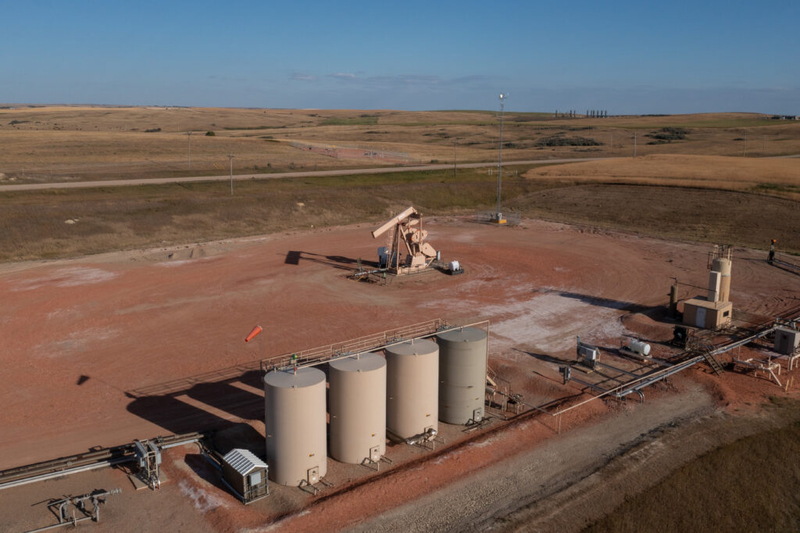
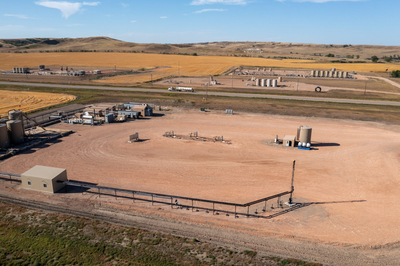
This oil well operated by XTO Energy in Williams County, pictured Sept. 2, 2026, is certified as a stripper well. It produced 280 barrels of oil per day in May, eight times the threshold for the tax exemption, state data shows. (By Kyle Martin/For the North Dakota Monitor)
This is the first in a two-part series supported by a grant from the Fund for Investigative Journalism. Coming Tuesday, how North Dakota compares to other major oil-producing states.
An obscure tax incentive to keep older oil wells afloat is potentially costing North Dakota hundreds of millions of dollars in tax revenue, even as many of those wells no longer meet the program’s criteria.
The state is on pace to lose $66 million in tax revenue this year from the more than 700 oil wells that no longer qualify for the tax break but continue reaping the benefits, a North Dakota Monitor investigation found.
Unlike other top oil-producing states, North Dakota’s tax exemption is permanent even when a well begins producing more oil.
“I just don’t think this is good policy,” said Rep. Jon Nelson, R-Rugby. “I’m disappointed that we’ve let this go this long without taking some action.”
More than half of the 20,000 active oil wells in North Dakota have been certified as stripper wells, or low-producing wells, and pay a 5% gross production tax. But they are exempt from paying a 5% oil extraction tax.
The program as a whole is on pace to cost the state an estimated $260 million in tax revenue this year, the investigation found. The North Dakota tax department has told lawmakers the tax break cost more than $200 million annually since the start of the 2023-2025 biennium.
“I don’t think anybody can deny that that is substantial,” said Sen. Mark Enget, R-Powers Lake. “That’s considerable. It’s material. No doubt about it.”
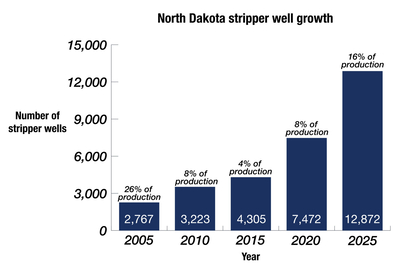
Thousands of oil wells were drilled during the Bakken oil boom, which saw a peak drilling rig count in 2012. But new drilling has slowed significantly, and many of the wells drilled during the boom are aging and less productive. Stripper wells accounted for 16% of the state’s total oil production in 2025, Department of Mineral Resources data shows.
The stripper well tax exemption was established in 1980, according to Legislative Council research. But it was in 2025 when lawmakers learned the tax break was being used so much it effectively reduced the state’s tax on oil by a full percentage point.
Rep. Don Vigesaa, R-Cooperstown, said it was an “eye-opener.”
Bakken and Three Forks wells, which account for most of North Dakota’s production, can be certified as stripper wells when their oil production falls below 35 barrels per day for 12 consecutive months.
But a well’s production can be restored to peak levels and still retain the reduced tax rate.
“A producer can just pump up the volume through technology and whatever, and we’re missing out on a lot of tax revenue,” said Vigesaa, one of the Legislature’s top budget writers.
One example is an XTO Energy oil well drilled in Williams County in 2009 and certified as a stripper well in 2017. Its production skyrocketed in 2024, according to Department of Mineral Resources data. The well has produced 228,000 barrels of oil, averaging around 300 barrels per day, in the last two years. But it was still taxed as a stripper well at half the rate.
The oil from those two years likely generated an estimated $14.9 million in revenue, according to calculations using Energy Information Administration pricing data. XTO Energy is a subsidiary of ExxonMobil, the largest American oil company.
North Dakota law does not contain any provision for revoking a stripper well’s tax exemption if its production swells. More than 700 stripper wells produced in excess of 35 barrels per day while still benefiting from the reduced tax in the first five months of 2026, state data shows.
Ron Ness, president of the North Dakota Petroleum Council, said the tax incentive helps encourage companies to keep older, less profitable wells online. Those wells pay local taxes, employ local workers and have already paid their fair share at the full tax rate, he said.
“They paid their taxes. They paid their dues. So it’s like taxing the elderly or taxing people that are at the end of their careers,” Ness said.
An ExxonMobil spokesperson said the company invests $500 million in the Bakken annually, supports around 1,000 jobs and is investing in enhanced oil recovery technologies that could benefit North Dakota.
“Increasing the cost of those projects by changing regulations to increase taxes will make it less likely for investments to come to North Dakota versus other assets that can also benefit from that technology,” the spokesperson said in an email.
Many state officials consider the development of enhanced oil recovery technology, including the use of carbon dioxide injections to restore the productivity of older wells, the key to extending North Dakota’s oil production. Rep. Craig Headland, R-Montpelier, said modifying the stripper well tax policy is premature until that technology breakthrough occurs.
“We’ve become an energy powerhouse in oil production, and we’re hoping that we can remain that way,” Headland said. “It’s going to take some incenting. How are we going to get the oil industry to invest in enhanced oil recovery, just so we can tax the hell out of them?”
Yet some lawmakers said the tax break warrants discussion when the Legislature convenes in 2027 because new revenue could help address more immediate challenges facing North Dakotans.
“Every dollar could be used for something for our citizens,” said Rep. Karla Rose Hanson, D-Fargo.
If a ballot measure to provide free school meals passes in November, lawmakers will be tasked with finding a way to pay an estimated $67 million per year for the program.
No recertification
North Dakota is unusual among major oil-producing states because its stripper well tax designation is permanent. There is no process in state law that allows an agency to revoke that status after it is granted.
“That’s fairly unique. I haven’t heard of that before,” said Dewey Bartlett, a board member with the National Stripper Well Association.
Bartlett, the owner of an oil company in Oklahoma that focuses on stripper wells, said it’s typical to have to reapply for stripper well tax breaks annually and self-certify that a well meets eligibility requirements, just like someone doing their income taxes. He said it should be easy for regulators to determine which wells are overproducing and correct the tax status.
“The rule is the rule, and if they do exceed that status, then I think that it needs to revert back,” Bartlett said. “I think it’s only fair.”
North Dakota sees uptick in oil wells that qualify for tax exemption
Enget said he was surprised to learn North Dakota doesn’t already have a review process in place. The lawmaker retired after working in the oil industry in other states for decades.
“I don’t know why there aren’t any laws in place that can cause a redesignation of the well and take the stripper status away from it,” Enget said.
North Dakota is the only one of the top eight oil-producing states to grant a permanent tax status for stripper wells. Alaska and California do not have an equivalent program. Oklahoma, Wyoming and Colorado handle eligibility through an annual tax filing process. Texas and New Mexico offer tax reductions during periods of low oil prices that only apply to qualifying wells.
The idea of an annual review process was briefly suggested during a committee meeting at the end of the 2013 legislative session but never added to state law. Lynn Helms, then the chief oil and gas regulator for the state, said at the time “it would be somewhat burdensome” depending on the details, “but it would be doable,” according to legislative audio records.
Lost revenue
The most productive stripper well in North Dakota in May was another well owned by XTO Energy in Williams County that began producing oil along the north shore of Lake Sakakawea in 2009.
In May, it produced an average of 529 barrels of oil per day, or nearly 15 times more than a stripper well should, and more than the well had ever produced before.
It was certified as a stripper well in 2021. The most productive months of the well’s life have come in April through July of this year, according to state production data.
XTO Energy’s well was one of eight stripper wells in North Dakota that produced more than 345 barrels of oil per day in May, around 10 times the threshold for stripper well status. There were at least 719 stripper wells that produced above the 35-barrel threshold in May, according to state data.
“They should lose that stripper well status at that point,” Nelson said. “That just seems to be elementary to me.”
The 700-plus wells in that category have been exempt from paying an estimated nearly $28 million in taxes in the first five months of this year, according to state production data and average oil prices from the Energy Information Administration. That puts them on pace for around $66 million in all of 2026.
Wells less than 10,000 feet deep, or from formations other than the Bakken, have lower production thresholds for the tax break. The Department of Mineral Resources told lawmakers last winter the total number for all formations was 892.
The exemption applies to more than 12,000 stripper wells. This year, the tax break has cost the state an estimated $109 million as of May 31, according to state data and Energy Information Administration pricing. That is on pace to be around $260 million by the end of 2026.
Oil taxes are the single largest source of tax revenue for North Dakota state government and account for around half of the state’s general fund budget, said Joe Morrissette, director of the Office of Management and Budget.
“The truth is that over the last like 15 years, we have had significant tax relief,” Morrissette said, citing income, corporate and property tax cuts. “Those things are made possible because of the revenues that the state collects from oil activity. So we should all care about that.”
Large companies, small communities benefit
Stripper wells can be an important source of employment, economic activity and tax revenue for local communities. Enget said big companies will often sell older oil wells to smaller companies that are often locally owned, who continue paying taxes on the oil production.
“It’s good for the state. Good for the local economy. I would say it’s good all the way around,” Enget said.
He said many smaller companies operate stripper wells in Burke County, where he lives. But that isn’t always the case in North Dakota as thousands of Bakken wells become eligible for the tax break.
The largest oil company in North Dakota, Chord Energy, operates nearly one-quarter of the state’s stripper wells. The five largest oil companies in the state operated slightly more than half of the 12,872 stripper wells that were active in 2025, according to state data.
Those stripper wells remain important for North Dakota communities, regardless of how big the company that owns them is. The tax break for stripper wells reduces the revenue collected by the state. But those stripper wells continue paying a 5% gross production tax that is primarily distributed among counties, cities, school districts and townships.
State officials worry companies could choose to shut down stripper wells if changes to the tax incentive make those wells unprofitable. Morrissette said that possibility, which is difficult to project, throws a wrench into any attempt to estimate how much additional tax revenue a change could generate.
“You’re still getting 5%,” Morrissette said. “You might be getting zero if those wells were shut in.”
Sen. Brad Bekkedahl, R-Williston, pointed out that if the state is losing out on millions of dollars of revenue, then local governments continue to collect an equal amount from the same wells.
“The tradeoff is, do you compromise that funding stream by further burdening the economics of these wells so they are no longer producing any tax revenue?” Bekkedahl said during a legislative meeting last month.
Return on investment
A Bakken oil well is most productive in its first months of oil production. Charles Gorecki, CEO of the Energy and Environmental Research Center at the University of North Dakota, said an average Bakken well produces about 75% of its oil in the first seven years of production before being certified as a stripper well. The remaining 25% of the oil could take decades to produce and would be at the reduced tax rate.
But sometimes a well can be returned to near-peak production — for a variety of reasons. Production from one of the XTO Energy wells surged in 2024 when the company hydraulically fractured the Bakken rock formation in the area for a new group of wells nearby.
Companies can achieve similar results through other restimulation methods, like refractures. Many Bakken wells drilled prior to 2013 used less effective fracking techniques. If an oil company invests to refracture the underground rock using modern technology, that well’s production can surge.
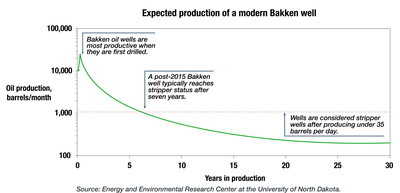
Gorecki said a successful refracture could restart the clock on how much of a well’s potential oil has been pumped to the surface. But this time the well retains the 50% tax cut of a stripper well.
Lawmakers interviewed for this article said they are concerned companies are incentivized to wait until a well reaches stripper well status before investing in any process that may increase oil production — but with half the tax.
“From a business standpoint, it makes perfect sense to do it,” Nelson said.
Nathan Anderson, director of the North Dakota Department of Mineral Resources, said it is unlikely publicly traded oil companies would plan decades ahead in order to let an oil well receive stripper well status before restoring production levels.
“Wall Street’s greedy, and they’re not waiting for 25 years from now to get their return. They want their returns today because the people that are investing in them want that,” Anderson said.
A refracture is one of the most expensive methods of increasing production at between $2 million and $3 million, and is not always successful, Ness said. He warned that trying to “squeeze every penny out of these wells” could discourage that investment into older oil wells.
State data shows there have been 216 refractures since 2022. Companies’ expense and profit data on refractures is not reported to the state.
Ness said he does not support making any changes to the stripper well tax incentive at this time.
Possible change in 2027
The prospect of additional state revenue is a big issue for some lawmakers, who see a list of needs in the state that could benefit from funding.
“This is a significant source of revenue that we need to look at. There are significant needs across our state,” Hanson said. “Even $40 million, while it might not be a big percentage of a $20 billion budget, still could make a significant difference in a program that changes a family’s life.”
Other lawmakers, like Headland, said they believe the potential of new revenue is not enough to justify making changes that could prompt oil companies to plug less productive wells and deprive local governments of even more in tax revenue.
Lawmakers said they expect stripper wells to be discussed during the 2027 legislative session.
“I think we need to keep this on the front burner. I really do,” Nelson said. “There’s a happy medium here that we could try.”
North Dakota Monitor reporter Jacob Orledge can be reached at [email protected].
Bismarck, ND