New resiliency center offers free trauma support for those affected by Brown and Pawtucket shootings
Oct 14, 2026 | 4:21 pm ET

Description
A sign hangs in the window of the Ever Hope Center, a federally funded resiliency center for people affected by the mass shootings in Pawtucket and at Brown University. The center run by Family Service of Rhode Island officially opened Oct. 14, 2026. (Photo by Christopher Shea/Rhode Island Current)
Healing takes time.
For Chris Librizzi, the process remains ongoing nearly eight months after a gunman opened fire during a high school hockey game he was coaching at a Pawtucket rink, killing three people, including the shooter.
Even after his Blackstone Valley Co-op hockey team won the state championship in March, Librizzi struggled with sleep disturbances, nightmares and reliving the shooting. Loud noises also triggered intense reactions that he mistook for gunshots, he said.
“I know I will never fully heal, and I believe my players and their families are experiencing the same struggles,” he recounted to reporters and advocates gathered Wednesday at the Rhode Island Foundation’s One Union Station headquarters in downtown Providence.
With help from Family Service of Rhode Island, Librizzi and his team began working through their trauma almost immediately after the shooting occurred on Feb. 16. Counselors arrived at the Pawtucket police station within an hour of the shooting and continued meeting with the players and coaches over the next 10 days.
In the months that followed, the organization continued connecting players, coaches and their families with support, including group therapy to help them cope with the shooting’s lasting effects.
That work helped inform the need for longer-term support, leading to the creation of the Ever Hope Center, a federally funded resiliency center run by Family Service of Rhode Island.
The center officially opened Wednesday at the Rhode Island Foundation’s headquarters in Providence, offering free, ongoing support services to people affected by the Pawtucket shooting and the December mass shooting at Brown University that killed two students and injured nine others.
“We cannot undo the events that happened on December 13th or on February 16th, but we can decide what happens next,” said Rachel Caruso, the executive director of the new Ever Hope Center. “We can be a community that responds in the moment, and we can be a community that stays.”
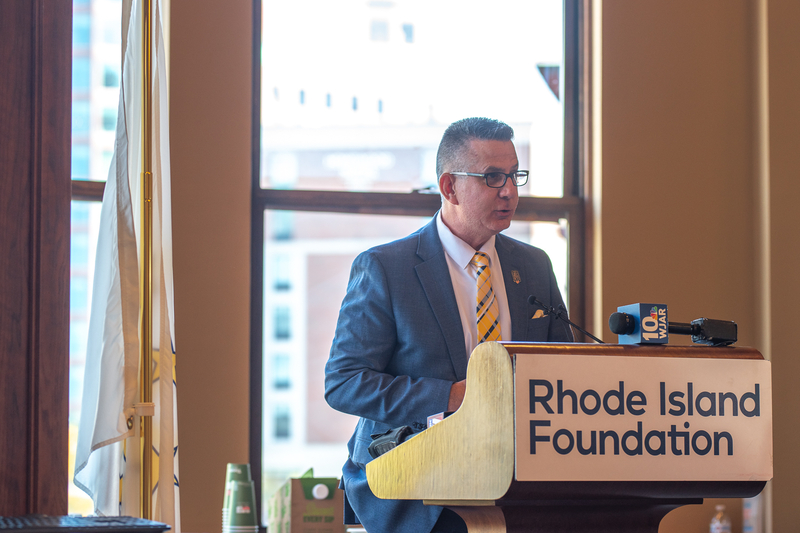
Caruso said the center grew out of months of work after the two shootings, as Family Service of Rhode Island, where she worked on its victims service team, considered what resources would be needed in the months and years ahead.
“Too often support is strongest at the beginning, and it fades over time,” she said.
The Ever Hope Center is funded primarily through a $2 million grant from the U.S. Justice Department’s Antiterrorism and Emergency Assistance Program, with an additional $200,000 allocation through the federal Victims of Crime Act.
Located on the main floor of Providence’s historic Union Station building, the center occupies space formerly used by Rhode Island KIDS COUNT, which moved out at the end of 2025 after more than three decades.
The center offers trauma-informed support groups and activities, including plans for art therapy and trauma-informed yoga — all for free, Caruso told reporters after the press conference. Other resources include games, fidget toys, books about grief and meditation, and journals with colored pencils and markers for what staff call “doodle meditation.”
A “quiet room,” still in development, will give visitors a place to decompress, with couches, pillows, blankets and noise-canceling headphones.
“We want to make sure that we’re a safe space,” Caruso said.

Trauma-trained staff
For now, the federal funding can only be used for people impacted by either the Brown or Pawtucket shootings, though Caruso said she and her team would be available in case of another large-scale tragedy.
Caruso said the center currently has three trauma-trained social service professionals, including herself, as well as a victim navigator and a training and outreach specialist. The center plans to hire an additional victim navigator and a clinician.
Pawtucket Police Chief Tina Goncalves said the February shooting underscored the importance of having support available beyond the immediate aftermath of a tragedy.
“While being on the ground is an important aspect while an event is occurring, we will know the impact of these events extends beyond the physical space where they have occurred and also beyond initial moments,” Goncalves said. “And this center helps with that.”
Hugh Clements, a former Providence police chief who now oversees Brown University’s Department of Public Safety and Emergency Management, also sees the center as a way to address the lasting effects of mass violence.
“When the sirens fade, the long work of healing begins for survivors, families, first responders, and the wider community,” Clements said.

Providence, RI