A new public medical school is essential to protecting Rhode Island’s long-term health
Jan 05, 2026 | 5:00 am ET
Description
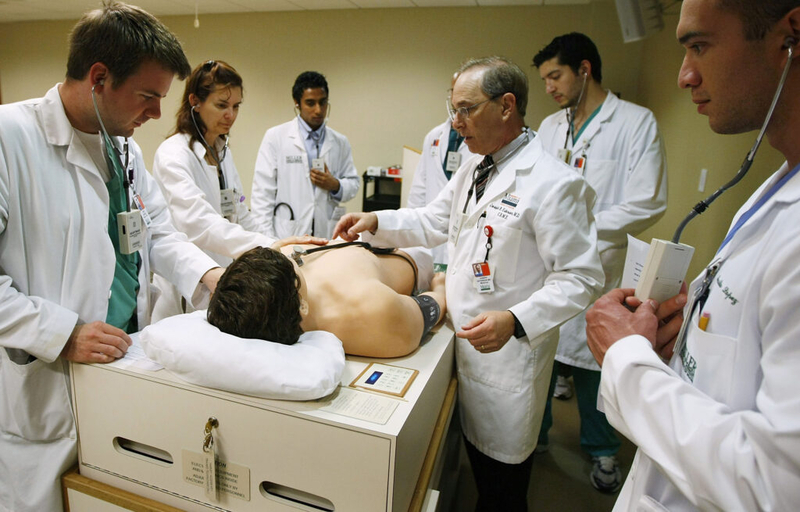
Medical school students observe their professor, Dr. Joseph Esterson, at right, director of cardiology training at The Gordon Center for Research In Medical Education at the University of Miami, working with Harvey, the cardiopulmonary patient simulator in 2009. (Photo by Joe Raedle/Getty Images)
In a recent commentary in Rhode Island Current, Robert Hackey (who has trained many of Rhode Island’s best health policy students over many years) and co-author Chloe Johnson forcefully argue that Rhode Island can’t wait nine years to address the national primary care workforce shortage in a way that protects Rhode Islanders now.
We agree.
Building a new medical school at URI isn’t adequate.
But we disagree about the value of such a medical school, which we think is a critical element of a long-term solution to our primary care woes.
A new medical school won’t cure R.I.’s primary care shortage. Here’s a better idea.
Primary care is critical to Rhode Island’s health services delivery system because the supply of primary care physicians has been shown, over and over again, to be associated with better public health outcomes and lower costs.
We think everybody in Rhode Island should have a regular source of primary care.
Rhode Island needs 133 to 266 more clinicians than we have now, according to a 2024 presentation to the Rhode Island Senate Study Commission on the new Medical School by the advocacy group Primary Care for All Americans.
That means committing the state to developing this workforce, but an arms race to steal them from neighboring states is not a viable long-term strategy. A new medical school, if it admits Rhode Islanders preferentially and obligates them to practice in Rhode Island for a number of years, is critical to this “grow your own” strategy.
Building a new medical school at URI isn’t adequate. But we disagree about the value of such a medical school, which we think is a critical element of a long-term solution to our primary care woes.
Rhode Island’s primary care workforce strategy should also include developing primary care nurse practitioners and physicians’ assistants. Nurse practitioners now constitute about 50% of the primary care workforce. But though a number of good studies show that nurse practitioners can provide the same quality of care for specific procedures as physicians, high quality primary care is a team sport with physicians using their training to help lead the team and handle complex cases.
That new medical school can also help seed the development of new primary care residencies, which, as Hackey and Johnson correctly indicate, are critical to addressing our workforce needs. (We should also be developing nurse practitioner residencies to make sure all our primary care clinicians are well trained.)
A new medical school is also an economic engine for the state, as testimony to the special legislative commission’s report explains. And that new medical school gives Rhode Islanders their best shot at attending medical school near home — most of the Rhode Island high school students who go to medical school now have to leave the state to do so. There is good evidence that students who go to both medical school and residency in their home state are much more likely to stay and practice here — and we need lots more Rhode Islanders to go to medical school, do a primary care residency, and then stay to practice here, in their own communities.
We need to act today on the more immediate fixes Hackey and Johnson note: improving primary care physician take-home pay; reducing the primary care administrative burden; improving electronic medical records so they are user friendly and helping clinicians manage their workload, instead of adding to it.
In the medium term, creating robust loan repayment programs is essential, so clinicians in training today will take primary care jobs in Rhode Island. We need to continue to fund scholarships with obligations to practice primary care in Rhode Island, so we train more primary care physicians, nurse practitioners, and PAs who commit themselves to practicing primary care here; and build many more new community-based residency programs for primary care physicians, nurse practitioners and PAs. Our strong community health center system is the logical base for this work.
There is no quick and easy fix to this national problem that took 30 or more years to develop. Massachusetts now has a new statewide Task Force on Primary Care Access, Delivery, and Payment. Delaware is reportedly planning to use $100 million of its Rural Health Transformation Grant funds to build a new medical school and help address the challenges we also face. Rhode Island’s U.S. Sen. Sheldon Whitehouse is leading discussions in Washington to implement essential reforms in Medicare to rebalance its payments from specialty care to primary care,
The cost of a new medical school represents a tiny fraction of Rhode Island’s $4 billion yearly health care spend, much of which is unnecessary or wasted. A new medical school alone won’t fix primary care fix the mess — but it is an important step forward, one that will give hope to Rhode Islanders, a place to study near home for our students, and the pathway for everybody in our state to have a relationship with a skilled, compassionate clinician as they seek long, healthy and fulfilling lives in our state.
Providence, RI