New Mexico lawmaker seeks to scrutinize insurers’ ‘catastrophe models’ used to deny home coverage
Oct 28, 2026 | 6:13 pm ET

Description
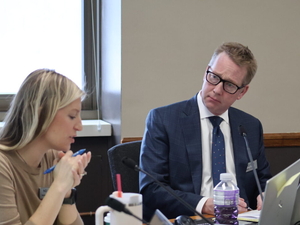
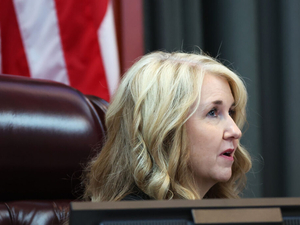
New Mexico state Rep. Anita Gonzales (D-Las Vegas) on Oct. 28, 2026, provided early details of a bill she intends to introduce that aims to give homeowners more information about how insurers determine whether a home is at too high a wildfire risk to justify coverage. (Patrick Lohmann/Source NM)
A New Mexico lawmaker on Wednesday previewed a bill she said will shed more light on how insurance companies use sophisticated “catastrophe” modeling to justify canceling an increasing number of policies in wildfire-prone areas of the state.
Rep. Anita Gonzales (D-Las Vegas) told lawmakers on the interim Courts, Corrections and Justice Committee that she intends to introduce a bill at the upcoming legislative session that aims to curb a recent trend of rising premiums and insurance non-renewals in the state.
The bill would require insurance companies to provide more information to homeowners about how they evaluate wildfire risk to homes and neighborhoods. It would also require companies to provide premium discounts to homeowners that have taken established risk reduction steps, and give them a means to appeal company determinations homeowners think are in error.
Faced with a growing number of expensive natural disasters, insurers are increasingly relying on complex and secret so-called “catastrophe” modeling that informs their decisions to raise premiums or not renew policies, Gonzales said Wednesday.
Christian Myers, chief actuary for the state Office of the Superintendent of Insurance, said Wednesday that the systems insurance companies use to determine risk remain something of a “black box.”
But he said “catastrophe” modeling generally incorporates simulations of thousands of wildfire or other disaster scenarios to determine average expected losses in particular ZIP codes and also contemplates how a “worst case scenario” — like a once-in-a-1,000-year wildfire — would play out in an area given its insurance rate, housing profile and other factors.
Gonzales said New Mexico homeowners deserve to understand how insurance companies make such a determination, especially if it costs them coverage.
“The question isn’t whether insurers should assess risk. They must,” Gonzales said. “The question is whether homeowners and regulators understand how that risk is being assessed; whether investments that reduce risk are being recognized; and whether homeowners have a meaningful path to improve that risk classification.”
The Office of the Superintendent of Insurance, the state’s insurance regulator, recently announced that insurers opted not to renew more than 6,600 policies in 2025, marking the highest-ever number of non-renewals in state history and a near-tripling of that number since 2021.
Meanwhile, the Fair Access to Insurance Requirements Plan, which offers insurance to homeowners who can’t find coverage on the private market, has seen a steady increase in enrollees, from approximately 7,400 in December 2024 to more than 7,800 in August 2026, according to data from the OSI Gonzales presented Wednesday, alongside the office’s chief actuary.
New Mexico insurers refused to renew policies for record number of homes in 2025, official says
While most FAIR Plan holders live in eastern New Mexico, where wind and hail often make homeowners insurance difficult to procure, data state officials presented Wednesday show the most significant FAIR Plan growth in recent years has been in wildfire-prone areas like Lincoln, Los Alamos, Santa Fe, Mora, and Otero counties.
Gonzales’ district includes San Miguel County, which the 2022 Hermits Peak-Calf Canyon Fire hit hard. The number of homeowners relying on the FAIR Plan has increased in that county nearly 18% in that 21-month period, Gonzales noted, from 286 policies to 337 policies.
The lawmaker noted the increasing reliance on the “insurer of last resort” in her county and elsewhere, along with increasing number of non-renewals in a state that already has among the nation’s highest uninsured rates, makes it all the more important that homeowners receive more information about their policies and what they can do to keep them.
Gonzales’ bill would require insurers to disclose information about the catastrophe models they use to state regulators; take into account property- and community-level mitigation in their premium prices; disclose to consumers how high-risk they deem their homes; and outline steps homeowners can take to improve their risk certification.
For homeowners, wildfire mitigation often involves establishing a buffer around homes cleared of brush or other fire fuels and using fire-resistant materials in their roofs or siding. But Gonzales said homeowners currently don’t have guarantees that implementing those changes will reduce their premiums or keep them covered.
New Mexico Gov. Lujan Grisham approves $8.25M for flooding, seeks additional federal assistance
If the Legislature fails to act during the session beginning Jan. 19 next year, Gonzales said, “Homeowners may continue spending thousands of dollars on mitigation without knowing whether those improvements affect their classification.”
Gonzales also said she is considering language in the bill that would require insurers to be more up-front about modeling in “other hazards that have been indicated in our state, again as recently as the last few weeks,” she said, referring to recent flooding in northern New Mexico.
Insurance Superintendent Alice Kane told lawmakers that her office supports Gonzales’ bill and would lobby for it at the upcoming session.
Gonzales introduced a similar bill in the 30-day session earlier this year, but it never received a hearing. Bills that are not budget-related need special designations from the governor to be heard during 30-day sessions, and House Bill 204 did not receive one.
Santa Fe, NM