Business group pushes to open Oregon land for industry ahead of 2027 session
Oct 28, 2026 | 6:36 pm ET
Description
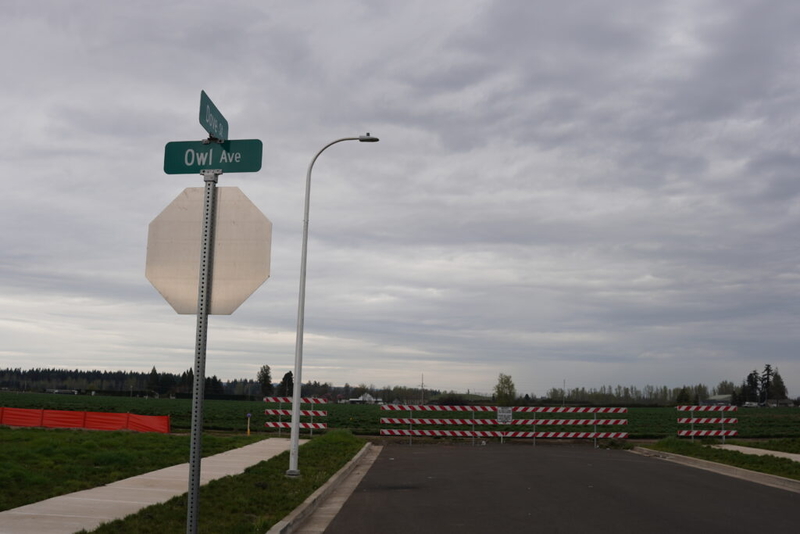
A street ends at an empty field at the edge of Woodburn's urban growth boundary. A new report argues that state lawmakers need to change the land use system governing those boundaries to improve accessibility for development. (Photo by Robin Linares/Oregon Capital Chronicle)
Oregon should open up a “phantom supply” of land in the state for economic development by creating a $250 million industrial site readiness fund, expanding local programs allowing industries to set up across multiple jurisdictions and establishing dedicated swaths of underdeveloped land for future growth, according to a new report from business leaders.
The 29-page Industrial Lands & Economic Competitiveness report released Monday by the Oregon Business Council frames the state’s decades-old land use system as outdated. The system regulates residential, industrial and commercial development to protect Oregon’s natural resources and environment, including through limiting where and how cities can grow. The council is made up of more than 40 business leaders in the state, including top executives and public policy leaders.
The report argues that Oregon’s economic landscape has changed since the origins of the system, shifting from a focus on agriculture and timber to manufacturing and semiconductors. It points to a forthcoming survey finding that 80% of respondents reported missing out on economic development projects due to a lack of developable land and a 2026 report by the University of Oregon noting that limited industrial land availability is stymieing new semiconductor investment in the state.
“Oregon has also spent decades building competitive advantages in industries such as semiconductors through private capital investment, specialized workers, supplier networks, research capacity and public infrastructure,” the report reads. “Those advantages are no more automatic or permanent than productive farmland.”
Oregon’s land use system was established about 50 years ago with the goal of stemming the loss of farm and vulnerable forestland to suburbanization and sprawl. But lawmakers on both sides of the aisle have suggested that the system needs updating, making it an issue that could be revisited in the 2027 legislative session.
State lawmakers earlier this year voted to expand a program to allow cities to push past their urban growth boundaries for additional senior and manufactured housing. While Business Oregon, the state’s economic development agency, offers a $25 million industrial site loan fund, the report praises Kotek’s prosperity council recommendation this summer that Oregon invest in a larger $250 million dedicated site readiness and infrastructure fund.
“Land without infrastructure isn’t ready. Land cannot support homes or industry without adequate roads, utilities and electricity,” John Tapogna, president of the Oregon Business Council, said at a Tuesday webinar. “The prosperity council certainly pointed that out on the industrial land side. It is also true on the housing land side.”
Other key areas identified in the report that could turn into potential legislation next session include expansion of industrial land banks, which are often publicly-controlled swaths of land that are underutilized or contaminated and set for development in the future.
The report also recommends expanding a “large lot” industrial program to create more regional voluntary programs across the state, pointing to an arrangement in Central Oregon allowing cities and counties to collaborate and designate land that is prime for employment and industrialization opportunities.
The Bend-based Central Oregon LandWatch, an environmental nonprofit, didn’t oppose specific policies outlined in the report but expressed hesitant support for some of its recommendations. It also said the ideas outlined in the report are similar to efforts to improve access to land in the housing sector.
“Some of these ideas have merit, such as better land inventories and a focus on infrastructure, and others don’t,” Corie Harlan, the organization’s cities and towns program director, said in a statement. “We’re ready to engage in this industrial lands work to ensure our land use program delivers the opportunities and exceptional livability Oregonians know, love, and need.”
Salem, OR