New Mexico judge orders Meta to pay state $25B
Oct 21, 2026 | 2:27 pm ET
Description
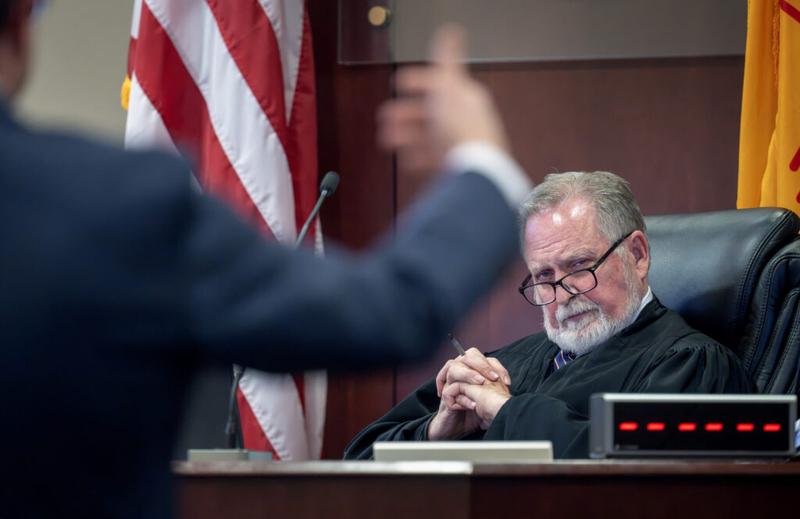
New Mexico First Judicial District Judge Francis Mathew listens to attorney Matthew Nicholson, representing Meta Platforms Inc., during an Oct. 1, 2026, hearing to determine the penalties against Meta. Mathew issued that ruling on Oct. 21, 2026, fining the company $25 billion. (Eddie Moore/Albuquerque Journal)
A New Mexico District judge on Wednesday ordered Meta to pay $25 billion in penalties for violating state law regarding unfair and deceptive trade practices.
The state was entitled to closer to $220 billion, First Judicial District Judge Francis Mathew wrote, although the company will accrue 15% in interest annually until it pays off the penalty.
The decision follows a Santa Fe jury’s finding in late September that Facebook, which is owned by Meta, committed close to 44 million violations of New Mexico’s Unfair Practices Act.
New Mexico jury overwhelmingly sides with state, says Facebook violated consumer protection law
“This is a historic day for New Mexico and for consumers across the country,” Attorney General Raúl Torrez said in a statement following Mathew’s ruling. “We took on one of the largest companies in the world because New Mexicans deserve honesty, accountability, and the protection of their personal information. Today’s result makes clear that no corporation is too powerful to be held accountable.”
In five separate categories, the jury found that Facebook misrepresented or made false statements regarding users’ ability to control their data; the company’s own efforts to combat hate speech and misinformation; its application of community standards uniformly; and its commitment to conduct a thorough investigation after the Cambridge Analytica scandal broke. In total, the jury sided with the state on 31 out of 34 counts, according to the jury verdict form.
Attorneys for New Mexico’s Department of Justice had requested up to $40 billion in penalties, though the state was entitled to up to $5,000 per violation.
In fact, Mathew wrote in his decision that “the extraordinary number of willful violations found by the jury, the duration and repetition of the conduct, the breadth of subjects on which violations occurred, the involvement of senior Facebook leadership, the size of the New Mexico audiences reached, and the clearly intentional and systematic nature of Facebook’s repeated misstatements established in the trial record support the highest level of penalty.”
Torrez, at a Wednesday news conference, told reporters that the multibillion-dollar judgment was a clear sign of what New Mexico is capable of by going it alone in court. The $25 billion is larger than settlements delivered in high-profile multi-state lawsuits that settled earlier this year.
“I think today’s judgment from a state which admittedly is not very big in terms of population should be a clear warning to everyone in big tech,” Torrez said.
Mathew’s decision not to award the full $219.5 billion judgment “shouldn’t be mistaken for the larger message, which is this…one of the largest, if not the largest, state-led recoveries and jury verdicts in American history.”
The New Mexico Department of Justice brought the suit under the state’s consumer protection law, the Unfair Practices Act. Torrez and a state lawmaker recently announced their plans to revamp the decades-old law, which caps penalties at $5,000 per violation, in the upcoming legislative session.
“While I am extraordinarily proud of the fact that we achieved this outcome using a law that came into effect before I was born, I think it is very clear that that’s a law that needs to be dramatically restructured,” he told reporters. “The Unfair Practices Act was designed for an era that frankly doesn’t exist anymore.”
One of the attorneys who represented the state, Randi McGinn from the McGinn Montoya Love Curry and Sievers law firm, issued a statement that said the court “spoke to Meta in the only language it understands, which is money, and the value of its stock price.” Her statement also noted that with the ruling, Meta “learned that lying to New Mexicans has a price. I’m grateful to our Attorney General Raul Torrez for letting a New Mexico jury of ordinary citizens stand up for truth against one of the largest social media companies in the world.”
New Mexico House Democrats also issued statements praising Torrez and the ruling, with state Rep. Nathan Small (D-Las Cruces), who chairs the Legislative Finance Council and the House Appropriations and Finance Committee issuing a statement that the money would be put to good use: “As we build our state budgets for the years to come,” he said, “We will make sure these dollars are directed to protecting New Mexicans that have been harmed, and most importantly to protecting and engaging our kids who are navigating an unprecedented world.”
Torrez, during the conference, said he expects Meta to appeal.
Indeed, a statement provided to Source NM from C.J. Mahoney, Meta’s chief legal officer, said: “This ruling, and the Attorney General’s approach to this enforcement, makes it all but impossible to do business in the state of New Mexico. At its core, this lawsuit seeks to impose a tax on speech to enforce new rules for what people can say online. We are confident we will prevail on appeal. In the meantime, Meta will continue to build a safe and free platform to connect millions of Americans, grow small businesses, and help the country maintain its competitive edge.”
- 4:34 pmThis story was updated following publication to also include statements from a private attorney that represented the state in the lawsuit and a New Mexico state legislator.
- 1:14 pmThis story was updated following publication to include a statement from Meta's chief legal officer.
Santa Fe, NM