Texas agency sues to stop release of data center records that it says could aid terrorists
Oct 06, 2026 | 6:34 pm ET
Description
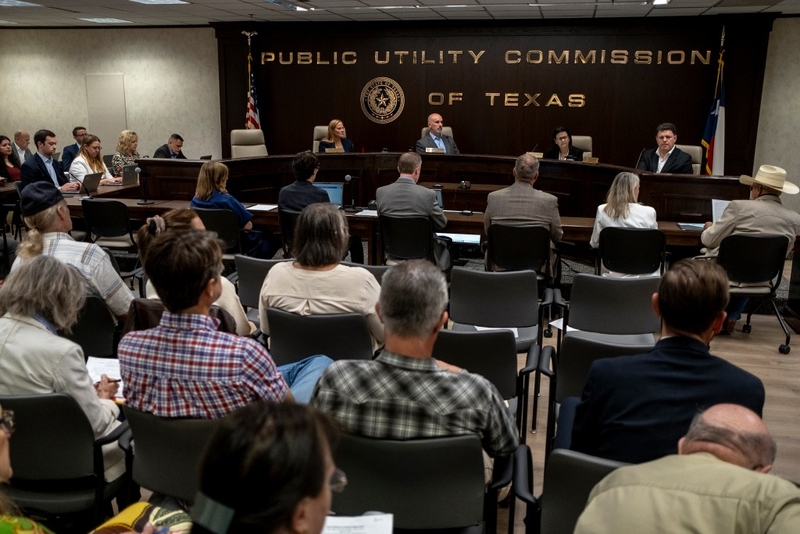
Commissioners of the Public Utility Commission of Texas listen to public comment during a special open meeting in Austin on Aug. 14. (Joel Angel Juarez for The Texas Tribune)
The Public Utility Commission of Texas is asking a Travis County judge to block the release of information showing where data centers and virtual currency mines operate, saying those details could aid terrorists.
The lawsuit filed Monday pits the state agency responsible for regulating utilities against Attorney General Ken Paxton’s office over the scope of Texas’ public-records law and the state’s protections for critical infrastructure.
At the center of the dispute are two seemingly basic geographic details: the county where a facility is located and the regional water planning area in which it sits.
The PUC argues that those details are “privileged information” and become sensitive when combined with other information collected through its survey of the industry, including electricity demand, actual electricity consumption, projected peak demand, water consumption, water sources, cooling technology and the utilities and infrastructure serving a facility.
The commission is not asking the court to declare the entire survey confidential. Instead, it wants the court to rule that the two geographic fields are exempt from disclosure under the Texas Homeland Security Act, which is meant to “protect against homeland security threats and hazards . . . and prevent significant criminal and terrorist attacks.”
The lawsuit does not represent a final ruling on whether the information ultimately must be released. But it does come as Texas officials are seeking more information about the state’s data center industry.
Gov. Greg Abbott has ordered state agencies to conduct additional reviews of data centers seeking to connect to the state’s electric grid, including reviews of electricity and water use, cooling systems and other information. He has also directed the Texas Water Development Board to take enforcement action against data centers that fail to comply with required water use reporting.
What’s in the PUC water and energy use survey?
In 2025, Texas lawmakers directed the PUC to collect information about water and energy consumption at data centers and virtual-currency-mining facilities to better understand the growth of the industry.
The effort reflects a growing concern among state officials and Texans about the resources required by large computing facilities.
Data centers can consume enormous amounts of electricity because of the thousands of servers operating inside them. Depending on their cooling systems, they can also require substantial quantities of water to help keep their servers cool during operation.
The PUC developed its survey in cooperation with the Texas Water Development Board, the state agency tasked with overseeing the state’s water planning process. The information was intended to help state officials better understand the relationship between electricity demand and water consumption and to inform future planning. The Legislature also directed the PUC to share information with other state agencies and produce a report on its findings.
The survey was sent to 377 facilities and sought information including a facility’s location, county and regional water-planning area, electricity load and consumption, projected future peak demand, cooling technology, water consumption and sources and information about the facility’s connection to the electric grid.
The response was limited and called “pathetic” by one state representative during a June legislative hearing where PUC officials said 28 companies representing 92 facilities had responded to the survey. Lawmakers questioned whether the resulting data would be sufficient to support long-term policy decisions.
The PUC later reopened the voluntary survey for an additional 10 days in July. As of August, 13 virtual currency mining and 77 data center facilities had filled out the survey, according to an email from a PUC spokesperson.
The PUC lawsuit
The PUC dispute with the attorney general’s office began after a resident from McLennan County and four journalists, including a reporter at The Texas Tribune, sought the survey responses through open records requests.
The PUC denied those requests, saying that the information should be protected from disclosure in its entirety. Those requestors have an opportunity to participate in the open records dispute if they choose.
Under Texas law, when a governmental agency believes requested records aren’t open to the public, it can ask the Attorney General’s Open Records Division for a ruling.
That is what the PUC did.
The commission argued that at least some of the survey information was protected under the Texas Homeland Security Act, which makes certain information concerning vulnerabilities in critical infrastructure confidential.
But the PUC, the government entity seeking to withhold records, must establish that the statutory exception applies.
That distinction is at the heart of the dispute.
The Attorney General’s office issued two rulings concluding that the PUC had not sufficiently established that the disputed information identified the kind of technical vulnerabilities covered by the Homeland Security Act.
The PUC is now challenging those rulings by asking a court to reach a different conclusion. The agency argues that the individual pieces of information in the survey cannot be considered in isolation.
A county name, for example, ordinarily would not reveal much about a facility’s security. But the commission argues that the county and regional water planning area can be combined with information about a facility’s electricity consumption, water use and the infrastructure that supplies those resources.
In the PUC’s view, identifying the facility allows otherwise general operational information to be connected to a particular physical site and potentially reveal vulnerabilities that could be exploited in a physical or cyberattack, which could then affect the reliability of the state’s power grid and drinking water systems.
“This combined disclosure would give a person intending an act of terrorism or a hostile act by a foreign adversary of the United States what the released fields alone do not,” the lawsuit states.
The geographic information also has an important role in Texas’ water-planning system.
Texas relies on regional water-planning groups to develop projections of future water demand and identify strategies for meeting those needs. The regional plans feed into the state’s broader water planning process. State law requires regional planning to account for projected water use.
That makes the location of major industrial water users relevant to planners so they can understand future demand and the infrastructure needed to serve it.
The importance of that information has grown as Texas experiences rapid data center development. A separate, mandatory water-use survey conducted by the Water Board has also produced relatively low response rates from data centers.
It’s unclear whether other information like the facility name or water usage will be released — or if the PUC has given up that fight. A PUC spokesperson said in an email that the agency does not comment on pending legal matters.
The PUC survey is different from that annual TWDB survey. The PUC’s effort was voluntary and was designed specifically to gather information about the relationship between water use and electricity demand at large computing facilities.
This is not the first time the PUC and the Attorney General’s office have fought over the disclosure of information. The same thing happened with records regarding a power plant loan program and cryptocurrency mines registered in Texas.
The agency spent more than $56,000 in taxpayer funds to hire outside lawyers to help them withhold information, according to invoices obtained by the Houston Chronicle through a public records request last year. The agency argued at the time that it was a common practice.
Taylor Goldenstein contributed to this reporting.
Austin, TX