New law allows NH voters to veto school administrator pay increases
Jun 30, 2026 | 5:00 am ET

Description
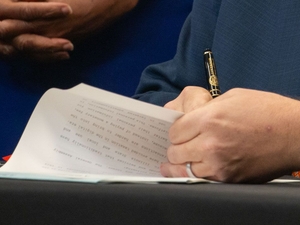
"If the proposed budget is voted down, the SAU must adopt an “adjusted budget” that would fund the SAU at the same level as the past year, with no pay increases, benefit increases, new positions, or new programs." (Photo by Dave Cummings/New Hampshire Bulletin)
Rep. Michael Vose has no personal problem with the performance of his local public school administrators. “The SAU in my town does a great job,” the Epping Republican said at a hearing last year, referring to the school administrative unit.
But verifying that belief, Vose says, is harder. If he or another resident wanted to check on how much the top school officials in the SAU were spending on their own management efforts, the traditional system would make that difficult.
“The administrative costs of running the SAU are buried in the school district budget, and it’s virtually impossible for the average person to dig through that budget and find the line items that apply to the SAU,” Vose said.
A year later, that system is changing. New Hampshire school administrative units will soon be required to craft their own budgets and voters will be empowered to vote down those budgets, under a law signed by Gov. Kelly Ayotte that Republicans hope will help drive down school administrative costs.
House Bill 564, which Ayotte signed June 19, requires all school districts to separate the school administrative unit’s budget from the rest of the school district’s budget every year. At their annual town meeting or deliberative session, voters will be allowed to approve or reject that budget as its own warrant article.
And if the proposed budget is voted down, the SAU must adopt an “adjusted budget” that would fund the SAU at the same level as the past year, with no pay increases, benefit increases, new positions, or new programs.
The new process provides important transparency and accountability, supporters say. And it’s part of a broader effort by Republicans to tackle rising administrative costs in public schools, which they argue are unnecessary and come at the expense of taxpayers and teacher salaries.
“This bill would allow future voters to vote on the SAU budget,” Vose said. “Not just look at it, but vote on it as well.”
Eric Pauer, the president of the School District Governance Association of New Hampshire, an advocacy group that has pushed for laws to curb school spending, said the new process may also inspire restraint among school administrators.
“When the school boards are doing their proposed budget, they may be a little less ambitious in trying to make these SAUs grow bigger, because now voters are going to have that as an option,” he said in an interview.
School administrators and Democrats say the reality is more complicated. The increasing administrative budgets in public schools have been driven by the need for more specialized programs to address learning loss and behavioral problems in schools since the pandemic, they say.
And Democrats say the new law is too harsh. Requiring administrators to adopt a level-funded budget if voters reject the proposed budget could hamstring school districts from adopting reasonable new programs.
Opponents have “grave concerns with legislation that is eroding the local control of a process that otherwise has been deeply rooted in communities,” argued Rep. Megan Murray, an Amherst Democrat, in January.
But to Republicans, the change is meant to boost local control, not diminish it.
Pauer said too few school districts provide for direct votes on SAU budgets — especially the ones that only serve one school district.
“So if you have a single-district SAU, they don’t really have to have a budget — it just becomes part of the school budget,” Pauer said. “And I think that’s the frustration.”
Prior to the new law, multi-district school administrative units were allowed to opt into the system of providing a separate budget for SAUs. The new law now makes that system mandatory for all SAUs.
Pauer argues that opt-in approach is cumbersome and that few districts have done it. That means most districts don’t give voters direct say over administrative costs, he says. “I think that’s part of the problem in the growth in SAU budgets, because there’s this process where the voters have very little control,” Pauer added.
School district administrators have raised concerns about representation under the new law. As written, HB 564 would allow a majority of voters across a school administrative unit to vote down the SAU’s budget. But Scott Gross, the operations manager for SAU 19, noted that his SAU contains two school districts, Goffstown and New Boston, and that Goffstown residents pay about 78% of the costs of the SAU.
If more New Boston residents show up to vote than Goffstown residents, New Boston could help vote down an SAU budget despite paying much less into the budget, Gross said. That and other scenarios could create chaos, he argued. And he said voters are better served electing school board members, allowing them to make decisions on the administrative budget.
“If the communities do not like what the SAU budget is, they will then vote those people out,” Gross said. “And I’ve seen that in both of our towns. Where people thought that the spending was too liberal, they brought on more conservative candidates.”
Barrett Christina, the executive director for the New Hampshire School Boards Association, took issue with the timing. Under current law, school boards must finalize their proposed budgets by Jan. 1 in order to allow voters to weigh in at the deliberative session.
The reason for that, Christina said, is that “individual school districts are having their budget hearings in the middle of January, so the district needs to know what its SAU costs are going to be.” Requiring the board to pass a separate SAU budget that might be voted down will make the budget calendar more confusing, he said.
“I think this is just going to cause confusion,” Christina said.
Pauer, on the other hand, thinks the new transparency will force SAUs to make the case to voters that cost increases are necessary. Failing to convince the voters could lead to an adjusted budget that stops any pay raises.
That means proposing budget increases “is a bit of a gamble, because if you want to add positions, now you’re putting all of the SAU raises at risk,” he said.
The law comes amid other Republican efforts to require more voter engagement with school budgets.
School districts are already required to provide information to voters about how administrator pay has changed in recent years. Under a 2025 law, districts must publish a report seven days ahead of the budget vote that includes information on top-line costs. Those include the cost per pupil, the average teacher salary, the salaries for the top four highest-paid administrators, and the total administrator pay. The report must use graphs to show those metrics over the past decade.
Under the latest law, if voters oppose those proposed administrative salary increases, they will be able to veto them by voting down the separate SAU budget.
Lawmakers also passed House Bill 1300, which would require cities and towns to ask voters whether to impose an annual tax cap over their school district during the 2026 to 2028 general elections. The question will be put on the general election ballot; if three-fifths of voters in a school district vote yes, the tax cap will go into effect.
That bill is heading to Gov. Kelly Ayotte’s desk in the coming weeks.
Concord, NH