Native small business owner: Main Street needs someone in the room
Oct 12, 2026 | 10:45 am ET
Description
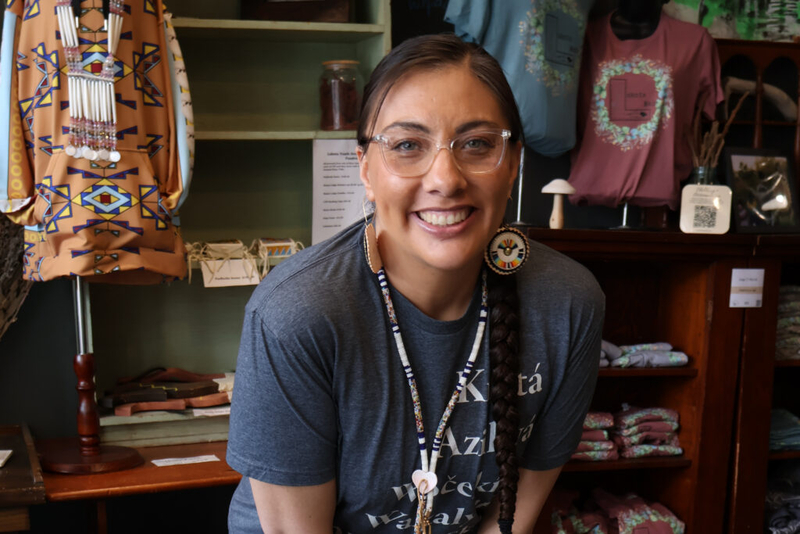
Megan Bull Bear poses for a photo in her Mankato store, Lakota Made. (Photo courtesy of Megan Bull Bear)
I started Lakota Made in 2018 at my kitchen table with six salves, made from plant medicines I learned from Lakota elders. Today, we have a storefront on Riverfront Drive, a small production team, more than 100,000 online orders and customers in 213 countries and territories around the world. Our social media community has 179,000 followers and reaches an average of 2 to 4 million views a day. Along the way I learned where a small business’s power starts and where it ends.
It starts with community. Our storefront sits blocks from where the Dakota 38 were hanged, and we chose that on purpose. It’s a place where Indigenous artists sell their work, where people come to learn about plant medicine and where history gets told by the people it happened to.
It also brings people to Mankato. Customers have told us they changed their vacation plans just to come see our store. People plan trips around our store hours, and groups come in from out of town. While they’re here they ask us where to eat, where to get their car fixed — and what else Mankato has to offer. I couldn’t begin to measure what that means for this town, especially when we hold our big events.
That work doesn’t stay inside our walls. I’ve taught tea blending classes at Hocokata Ti Cultural Center in Shakopee. This summer, a delegation of the Minnesota Indian Women’s Sexual Assault Coalition traveled to a national conference in California, where I gave the opening keynote and led a plant teaching. I also travel to Omaha for classes and speaking events.
This November, I’ll be working with science teachers from across the state at the Minnesota Conference on Science Education conference in Mankato, helping schools connect with local Indigenous communities. Through our nonprofit, the Mahkato Revitalization Project, we’re building a free plant medicine curriculum for young people that will never be sold.
None of this shows up on a balance sheet. But it matters, especially now, when so much history is being pushed aside and smaller voices are the first ones lost. Small businesses like ours are often the ones carrying that work.
Where our power ends is with the suppliers we depend on. Over the past two years, we spent more than $105,000 with Uline — a packaging and shipping company — on jars, droppers, tins and boxes. In that time our prices on the same items, the same quantities, went up 10 to 22%. An 8-oz jar went from 96 cents to $1.07. The best prices go to whoever can buy the most at once, so a business our size pays more per jar and ties up cash in inventory we don’t have room to store. Switching isn’t simple either, because our labels and listings are built around those exact containers.
We also wanted to buy local, so our soap boxes are made by Taylor Corp. here in Mankato. We paid the setup costs to get our boxes made there. Our orders have been quoted at two weeks, and we have waited as long as six months. Because we don’t know when the charge will come, we hold that money in our account the whole time. That’s money a business our size needs for materials and payroll.
I’m not accusing anyone. This is just what it looks like when a small business depends on companies many times its size. We don’t have the volume to negotiate better terms, and often there’s no real alternative.
That’s why I want our representatives, including U.S. Rep. Brad Finstad, to keep small businesses in mind when they make decisions about trade, supply chains and small business support.
Main Street shops need someone in the room, too.
I’m not asking for a bailout. I’m asking for leaders who remember that small businesses are what hold towns like Mankato together.

Saint Paul, MN