NASA leaders urge Iowa State University students to join lunar base program
Sep 08, 2026 | 6:30 pm ET
Description
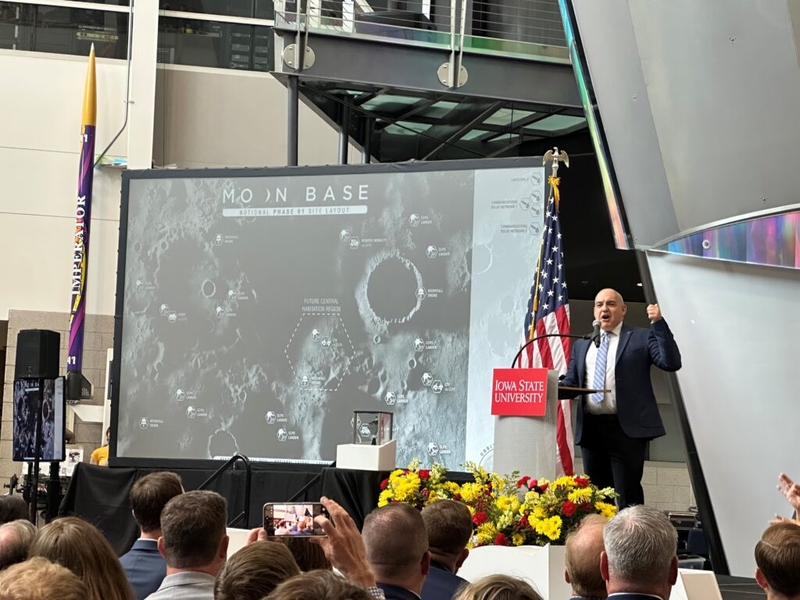
NASA Moon Base Project Manager Carlos García-Galán speaks at Iowa State University Sept. 8, 2026, about the mission to establish a permanent base on the moon. (Photo by Brooklyn Draisey/Iowa Capital Dispatch)
State and federal officials connected to U.S. space exploration detailed plans of eventual moon habitation Tuesday to a room packed to the brim with Iowa State University students, hoping to entice their interest in using their education to aid in the newest space race.
National Aeronautics and Space Administration Administrator Jared Isaacman and Moon Base Project Manager Carlos García-Galán toured the Ames National Laboratory and then held a presentation for ISU students to show the three phases of moon base development. They were joined by U.S. Rep. Zach Nunn, U.S. Assistant Secretary for Postsecondary Education David Barker, Nuclear Regulatory Commission Ho Nieh, ISU President David Cook and others.
NASA announced in March a plan to return to the moon in 2028 and build a permanent base there by 2032. The NASA officials told students Tuesday the education and training they are pursuing are just what NASA is looking for — if they’re willing to “pick up the fire of exploration and join us on this extraordinary adventure,” Isaacman said.
“You could help us build the moon base. You could operate it in mission control. You could walk on the lunar surface or be the nuclear engineer building the spacecraft to take us to the next destination on this endless mission of discovery,” Isaacman said. “And decades from now, when the history books look back on this moment — the moment humanity became a true spacefaring civilization — the people responsible, the generation that will have made it happen, are represented right here in this room.”
ISU already has a strong relationship with NASA and many of its projects, Cook said, with the university leading close to 30 active NASA-funded projects and collaborating on nine more. The Ames National Laboratory and the Iowa Space Grant Consortium are also housed at the university, he said, bringing more connection and collaboration on important projects.
Isaacman said current and future ISU students “are part of the most exciting era of exploration since Apollo.”
NASA and its partners will build the moon base in three different phases, García-Galán said, taking the mission from establishing consistent contact with the lunar surface to setting up infrastructure for astronaut residence to having astronauts live on the moon’s surface for at least one month.
The first phase of the mission is already underway, García-Galán said, and should wrap up in 2029. NASA selected the moon’s south pole as the place to explore and develop, and will send rovers and equipment to the area to both better map it out and establish “reliable access to the lunar surface.” The south pole provides a mix of sunlight and shadow and houses spots that are permanently shadowed, offering potential findings that could reveal information billions of years old.
Four landers holding different rovers and equipment are currently being developed for the mission, García-Galán said, alongside lunar vehicles for astronauts, drones and other technology.
“In phase one, we’re not going to be afraid to fail. We really want to test the things that work or don’t,” García-Galán said. “We’re doing everything we know how to, to make those things successful, even the tech demonstrations, but we want to see the operations and the area; the things that are not going to work, we actually want to find them out in phase one.”
Phase two will involve deploying necessary infrastructure for moon base missions, including power, habitation, communications, moving cargo and more. García-Galán said up to four astronauts will live in a central region and explore areas around it, with the U.S. working with partners in Japan and other countries to develop rovers and hubs where people could survive.
Phase three would bring with it the development of permanent living environments on the moon for astronauts.
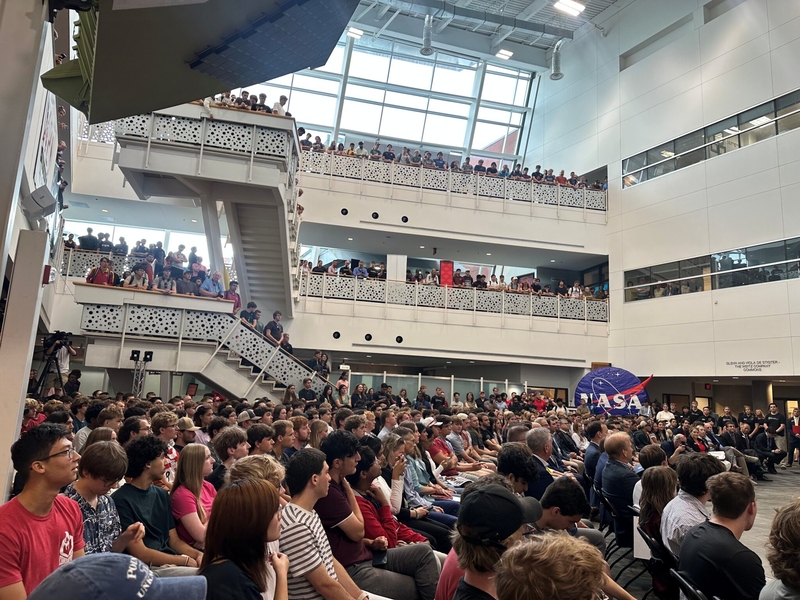
ISU students packed into Howe Hall’s atrium — sitting in chairs, leaning on walls and craning to see over staircase and balcony railings — were the first to see early concept designs for the “habitation cluster” for lunar surface residents, García-Galán said. They were also shown imaging of the moon’s south pole and renderings of how the base and research areas would be set up.
Students can bring their hard work and passion to the moon base mission in many different ways, Isaacman said, as NASA will need technicians, entrepreneurs, researchers, operators, explorers, astronauts and more to be the first to have humans living on the moon.
García-Galán asked students to not treat the information provided to them Tuesday as a presentation but a “briefing,” as they will need to know these things for their future should they wish to join the ranks of scientists, researchers, engineers and others contributing to the space race.
“What’s exciting for me here at Iowa State is seeing the vision, and then seeing the role our students are going to have looking forward,” Cook said. “Really exciting to be on the cusp of something that truly is a moonshot.”

Des Moines, IA