Lancaster County judge dismisses challenge to Nebraska K-12, collegiate sports ballot measure
Sep 08, 2026 | 6:23 pm ET
Description
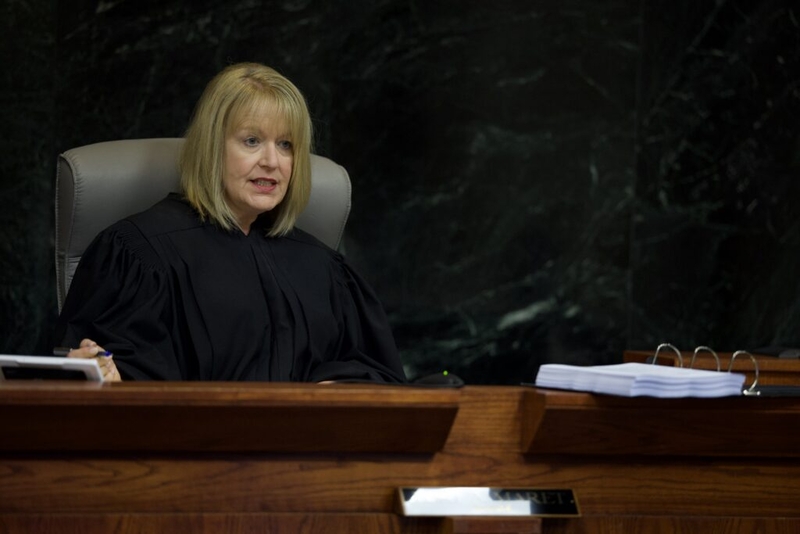
Lancaster County District Judge Lori Maret listens to attorneys during a hearing where the Nebraska Attorney General's Office is challenging a Lincoln city ordinance enacted in response to a new state minimum wage law at the Lancaster County Courthouse on Thursday, July 2, 2026, in Lincoln. (Pool photo by Kenneth Ferriera/Lincoln Journal Star)
LINCOLN — A district court judge dismissed all objections Tuesday to a last-minute legal effort seeking to disqualify a ballot measure that would cement sex-separate school sports requirements in the Nebraska Constitution.
Lancaster County District Court Judge Lori Maret ruled against Cara Ullman of Lincoln, who asserted that because the Fairness for Girls campaign lacked detail in some specific petition language, known as an “object statement,” she signed a petition to place the measure on the general election ballot without fully knowing what it would do.
Maret disagreed and said in a five-page decision Tuesday that while the Fairness for Girls object statement was “certainly brief,” state law only requires that the statement be “concise.”
The statement, which went through the Nebraska Secretary of State’s Office, reads: “The object of this petition is to amend the Nebraska Constitution to establish constitutional protections for sex-separate athletics to ensure equal access to athletic opportunities for females.”
“In sum, the petition’s object statement is a concise statement of the legal effect of the filing of the petition and the object sought to be secured,” Maret wrote. “It is therefore ordered, adjudged and decreed that the action is dismissed.”
Lancaster County judge hears challenge to Nebraska K-12, collegiate sports ballot measure
Ullman is appealing Maret’s ruling to the Nebraska Court of Appeals. The matter could be expedited to the Nebraska Supreme Court, which might again refuse to hear the case. The Supreme Court declined Sept. 1 to hear the challenge, so Ullman filed it before Maret.
Nebraska Secretary of State Bob Evnen must certify the ballot by Friday.
The Fairness for Girls proposal would make permanent part of a 2025 state law requiring public K-12 schools, colleges and universities, and any private schools or colleges in the state playing against those schools, to designate sports and teams as male, female or coed. Male students couldn’t play on female-only teams.
The ballot measure would not define “sex” in the constitution. State law defines sex as whether someone “naturally has, had, will or would have, but for a congenital anomaly or intentional or unintentional disruption, the reproductive system that at some point produces, transports and utilizes” either eggs (female) or sperm (male) for fertilization.
Attorney Sydney Hayes, on behalf of Ullman, had argued last week that if object statements could be so broad, it could be “open season for vague, incomplete and misleading” statements.

Former state Sen. Andrew La Grone of Dunbar, on behalf of the three sponsors behind Fairness for Girls, disagreed and said the campaign followed the law as written. He said the sponsors — including former state Sen. Julie Slama of Dunbar and University of Nebraska Regent Rob Schafer — had a broad First Amendment right to the object statement they provided.
Maret said that while Ullman’s attorneys argue that an object statement needs to state the “major provisions” or “major features” of a proposal, those standards are “nowhere” in the law.
“Our Legislature has chosen not to add such requirements,” Maret wrote. “The court must defer to the Legislature.”
Such a “strict interpretation,” Maret added, would “unduly restrict the power of the initiative.”
Hayes had also pointed to the measure’s “ballot title,” a separate 100-word statement that will go on ballots this fall. But Maret said the comparison is not “helpful” because an object statement, written by sponsors, and a ballot title, written by the Nebraska Attorney General’s Office, are used in different circumstances and under different legislatively set requirements.
Maret also echoed an argument from the Nebraska AG’s Office: If a voter wants more information before signing, they can flip the page over and read the full proposal.
Absent appellate intervention, voters will see the following language on the Nov. 3 ballot:
“Shall the Nebraska Constitution be amended to provide: (1) Schools must expressly designate each athletic team or sport as one of the following based on biological sex: (a) males, men or boys; (b) females, women or girls; or (c) coed or mixed; and (2) Athletic teams or sports designated for females, women or girls shall not be open to students of the male sex? The amendment would apply to all athletic teams or sports sponsored by public schools or postsecondary educational institutions and private schools or educational institutions whose athletic teams or sports compete against public schools or institutions.”
Lincoln, NE