Nanticoke Powwow brings dance, cultural preservation to Milton
Sep 15, 2026 | 6:00 am ET
Description
Photo courtesy of Spotlight Delaware
Why Should Delaware Care?
Nanticoke and Lenape Indians were the first settlers in the state of Delaware, but their history is not widely known among the state’s population. The Nanticoke tribe’s annual powwow aims to bring more awareness about their culture and traditions to the public, while also providing an opportunity for a cultural exchange with other Native American tribes.
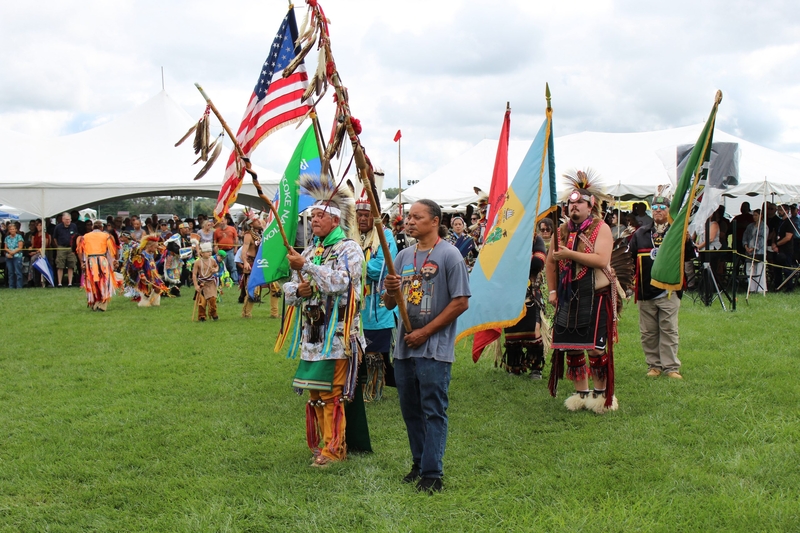
The 48th annual Nanticoke Indian Tribe Powwow filled Milton’s Hudson Fields this past weekend with a vibrant, diverse celebration of the tribe’s drumming, traditional dances and popular Native American food.
Attendees — from members of the Nanticoke, to members of other tribes and non-Indigenous guests alike — said the jubilant, two-day event embodied the classic meaning of a powwow: a social gathering where different cultural practices are exchanged and celebrated.
But on a deeper level, some powwow-goers described this year’s gathering, which took place on Sept. 12 and 13, as a chance to reflect on what being Nanticoke means to them and how Native American culture is preserved, both in Delaware and in the country as whole.
The Nanticoke Indian Tribe has been formally recognized by the state of Delaware since 1881, but its roots in the area date back to at least 1608. The tribe now has about 600 active members, the majority of whom are concentrated in the Millsboro area of Sussex County, where the group has a history museum and community center.
As the powwow picked up steam around noon each day, performers — including Nanticoke members and people others tribes who had traveled from North Carolina, Virginia and New Jersey — took to the arena wearing feather headdresses, wide shawls and multi-colored dresses for the daily “Grand Entry.”
The Grand Entry, an essential part of most Native American festivities, involves tribal leaders leading a flag-bearing procession. The procession is followed by all participating dancers entering the arena to officially kick off the day in a moment of unity.
Following the entry, different iterations of tribe members performed varied styles of dance, including the traditional, slower men’s and women’s dances and the flexible open intertribal dances, where people of any tribal affiliation, age and gender can participate.
While audience members clapped along to the drum beat and munched on ‘Indian tacos’ – classic Native American frybread topped with meat, cheese and lettuce – Nanticoke Assistant Chief Farrah Norwood-Stigall gave a brief speech about the meaning of the powwow and the Nanticokes’ place in Delaware.
“Through it all, one message remains: ‘We are still here,’” she said to the crowd. “When you hear the drum today, listen closely. That is more than a drum. That is the heartbeat of our people.”
Finding the Nanticoke identity
Many federally recognized Native American tribes have a “blood quantum” requirement, meaning an individual must have at least one-quarter or one half of tribal ancestry in order to be considered a member.
The Nanticoke tribe defines tribal membership differently, which some powwow attendees said allowed them to discover their Nanticoke identity later in life and seamlessly feel connected to the tribe.
The tribe had 30 original signers of the contract that made them officially recognized by the state of Delaware in 1881. Now, the tribe structures its membership so that individuals are eligible to become members if they are related to one of the 30 original members, Norwood-Stigall said.
For Dover resident Robert “Junie” Duff, this structure allowed him to become a Nanticoke member later in life, after reconnecting with some extended family members.
Going down the tribe’s ancestry list with the Nanticoke historian, Duff said he discovered three ancestral connections within minutes of reading.
Now, Duff said, becoming a member of the tribe has provided him and his daughters with a sense of “reawakening” and camaraderie.
Jeannie “Warm Heart” Mosley Hall and Paul “Dancing Man” Brooks of Bear, two mainstays of Sunday’s dance performances, also described the beauty of growing closer to their Nanticoke heritage in recent years.
Mosley Hall had been living in Ohio for most of her adult life, and wasn’t able to become as active with the Nanticoke community until she retired in Delaware. Once living here, she began dancing with the tribe with her daughter, who was already an involved member.
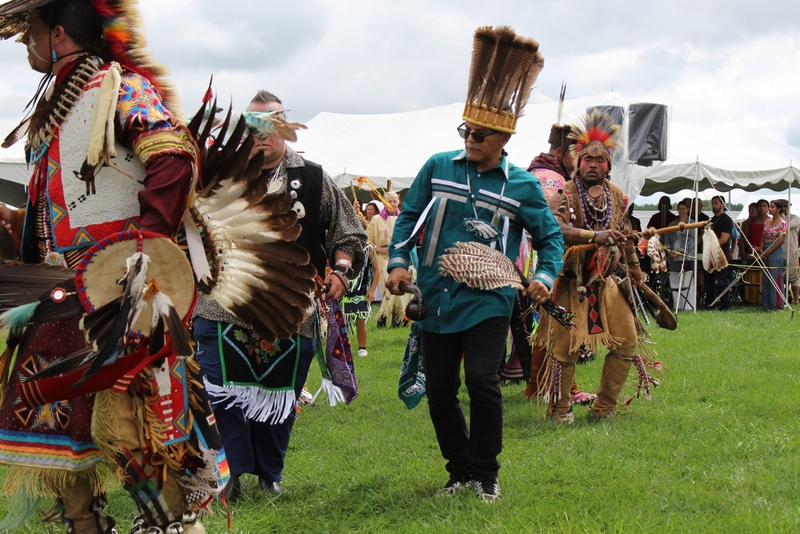
Brooks is half Black and spent a lot of his life embracing that dance culture, until he learned his mother was Native American. He then began “engulfing myself in the Native American aspect.”
During his dance performances on Sunday, Brooks sported an inventive outfit that combined traditional feathers and headdress with a Philadelphia Eagles shirt and necklace.
The pair said they have enjoyed doing the traditional dances for the opportunity it gives them to slow down, feel the beat and connect with the Earth.
“When your foot touches the ground and back, it keeps you grounded to the Earth,” Mosley Hall said. “It’s a very dignified kind of dance. There’s more to it than it might look.”
In addition to the yearly powwow dance performance, Mosley Hall said she and some other tribe members do visits to schools throughout the year, where they dance and show the kids tribal artifacts.
Preserving the language, crops
In recent years, some Nanticoke members have taken on projects to preserve often-forgotten parts of the tribe’s history, including its language and crops.
To Courtney Streett, the rapid population growth in Sussex County has accelerated a disconnection between indigenous people and their land and its native plants.
With this pattern in mind, Streett launched the Native Roots Farm Foundation in 2020, an organization aimed at reintroducing native plants and harvesting practices to the area, like the three sisters gardening practice, where growers combine the corn, bean and squash crops to help each other grow.
Streett’s group currently operates a Three Sisters Garden with blue corn from the Kent County and New Jersey-based Lenape Tribe and Nanticoke squash. She also recently purchased a 50-acre property in the Georgetown area, where the foundation plans to open a public garden, or Hakihakàn in the Lenape language, for Sussex Countians to learn about native plants.
At the powwow, Streett and her team passed out samples of pawpaw, a tropical fruit native to North America, and Tehim juice — the Lenape word for strawberry — made from local fruits.
“These are plants that are historically from this area and named after our people,” she said. “But again, because of that forced disconnection with the land, our communities have not been able to have a relationship with these plants in a very long time.”
Karelle Hall, a cultural anthropologist and Moseley Hall’s daughter, and Keith Cunningham, a linguist, have spent years reconstructing the Nanticoke language, which has not been spoken since the 1850s.
The pair, along with tribal storyteller Ragghi Rain, completed a language book in 2023 replete with vocabulary words, phonetic pronunciations and kid-friendly illustrations, titled “Once it has been spoken… it cannot be unspoken.”
Now, they are teaming up with Streett to represent the names for native plants in the Nanticoke language, and write a book describing the process of planting traditional foods.
A number of people at the powwow happily described starting to learn the Nanticoke language, and using the event as an opportunity to use some of the phrases they’ve learned.
Hall said the community’s enthusiasm for revitalizing the Nanticoke language has been exciting, and it has encouraged them to develop resources suitable for different types of learners.
“You have some people who are approaching the language like they want to gain some level of fluency, and then you have others who are like, ‘I just want to learn how to introduce myself or say a prayer,’” she said. “We’re kind of building a curriculum for all of that.”
A broader representation
Vincent Cruz of Queens, New York, travels to various powwows and other Native American celebrations, selling textiles made by his relatives, the Quichua tribe in Ecuador.
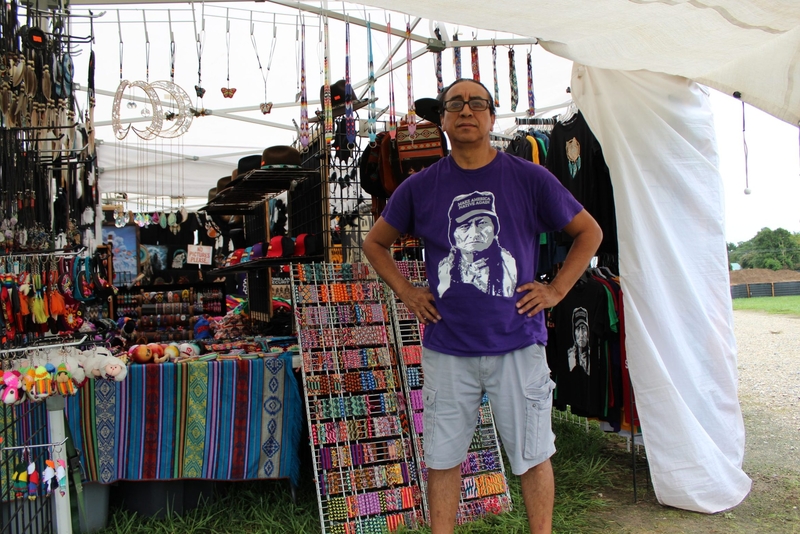
Among the items Cruz displayed prominently at the powwow was a shirt with the face of Sitting Bull, a Native American leader known for his resistance to U.S. military encroachment on Native land in the late 19th century, and the words “Make America Native Again.”
Cruz said people often laugh at the shirt when they see it. But he wears the shirt himself and sells it in order to invite more historical reflection.
“People laugh when they are ignorant about history,” he said. “These things are really sad that they committed to native people, our brothers and sisters. Imagine if it was the other way around, us doing this to Europeans.”
With the tribe’s biggest event of the year having come to a close, Nanticoke leadership will now turn their attention to fundraising for their new cultural center in Millsboro, Norwood-Stigall said, all while preparing for the energy to return to Sussex County once again for next year’s powwow.
Maggie Reynolds is a Report for America corps member and Spotlight Delaware reporter who covers rural communities in Delaware. Your donation to match our Report for America grant helps keep her writing stories like this one; please consider making a tax-deductible gift of any amount today by visiting https://spotlightdelaware.org/support/.
Dover