Moore shuffles staff, announcing new chief legislative officer, lottery head
Jul 24, 2026 | 11:00 am ET

Description
Will Tilburg, the former head of the state's cannabis administration, will join the governor's office next month as Gov. Wes Moore's chief legislative officer. (File photo by Bryan P. Sears/Maryland Matters)
Changes are coming to the second floor as a longtime State House aide leaves and the former regulator of the state’s cannabis industry moves in.
Gov. Wes Moore (D) Friday named Will Tilburg, the former director of the Maryland Cannabis Administration, as his new chief legislative officer. Tilburg will replace Jeremy Baker, the current chief legislative officer, who is moving to become acting director of the Maryland Lottery and Gaming Control Agency.
Both are expected to assume their new positions on Aug. 19, following the upcoming special General Assembly session.
Tilburg made his reputation in Maryland as the state’s top cannabis regulator, coming in at a time when state was struggling to get its medical cannabis program on track and eyeing the eventual entry into legalized recreational cannabis.
“I never heard a lawmaker have a bad thing to say about Will,” Sen. Pam Beidle (D-Anne Arundel) said Friday.
That reputation will likely serve him — and his new boss — well as Tilburg returns to Annapolis.
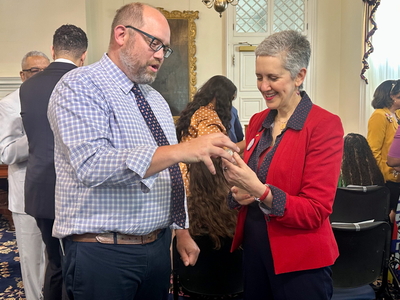
Tilburg left the cannabis agency nearly two years ago. Since then, he’s served as vice president of government and regulatory affairs at the University of Maryland Medical System.
Should Moore, the presumptive frontrunner in the 2026 campaign for governor, win re-election, Tilburg will be charged with shepherding the governor’s agenda through the General Assembly.
It won’t be an easy assignment.
Del. C.T. Wilson, (D-Charles) worked with Tilburg on cannabis issues, including the 2023 Cannabis Reform Act. Wilson, who is running unopposed for state Senate, called the addition of Tilburg “a phenomenal addition to the governor’s staff at a time where I think there’s what feels like a rift between the legislature and the governor, at least from the Senate side.”
Looming are budget concerns driven by a costly public education program and the possibility of a debate over taxes including a sales tax increase. Moore would also enter his second term with some lawmakers concerned that the governor, who continues to raise his national profile, is too focused on a political future outside of Maryland and a possible run for president in 2028.
“He [Tilburg] will find a way to thread that needle,” Wilson said. “He will listen to the complaints about policies that the governor may want and bring back alternative solutions. So, the only question is, will the administration listen to him?”
There are also frayed relationships — most notably between Moore and Senate President Bill Ferguson (D-Baltimore City), over the midcycle congressional redistricting fight that included a primetime appearance with House Speaker Joseline Peña-Melnyk (D-Prince George’s and Anne Arundel) and Moore’s failure to endorse Ferguson in the primary.
Baker leaves his position as Moore’s chief lobbyist after two years to become the state’s top gaming regulator — a policy area that brings its own challenges and a learning curve.
Baker is Moore’s second chief legislative officer. He moved into the position after serving as chief of staff to former House Speaker Adrienne Jones and a senior adviser to the late House Speaker Michael E. Busch.
Top election official asks state prosecutor to investigate prediction markets
He brings with him a deep understanding of state government and the legislature as well as relationships with members of the House and Senate. He also has a reputation for relying on subject-matter experts.
“Jeremy knows a lot about a lot of things, but he’s not overconfident about it,” Beidle said. “He’s not haughty.”
Beidle worked closely with Baker to craft a scoring rubric for transportation projects in 2016 that was passed as a response to then-Gov. Larry Hogan’s cancellation of the Red Line light-rail project in Baltimore.
“I may have been the (sponsor), but Jeremy was behind me the whole time, helping me and preparing me to do that,” Beidle said. “I think that’s one of the things he did well. Jeremy wasn’t in the limelight, you know. He helped other people be successful.”
Baker moves to an agency that has its own difficulties with the General Assembly.
Current director John Martin butted heads with Ferguson at the end of the 2026 session over a bill that would have made it easier for the lottery agency to go after social gaming apps the agency feels are operating illegally as internet gaming portals.
The House passed the legislation only to have it stall in the Senate. Martin, in a letter days before the end of the legislative session, questioned Ferguson’s motivations for blocking a bill that had passed in the Senate a year earlier. Neither would comment on the letter.
Baker will also take charge as the agency has stumbled over the awarding of a lucrative 10-year contract to manage the state’s lottery system. The contract remains embroiled in legal disputes both in court and at the state Board of Contract Appeals.
And there will be pressure for the the agency to find ways to contribute more to covering the costs of the Blueprint for Maryland’s Future education program. Those pressures are likely to renew debates over expanded gaming including internet gaming and casinos.
The agency may also be pulled into a likely effort to regulate prediction markets because of the ability to trade on sporting events. Critics call prediction markets a thinly veiled sports betting program and that prediction market platforms skirt Maryland’s sports betting laws and are not licensed, regulated or taxed in the way traditional sports books are in the state.
If Moore wins reelection this year to a second term, he is expected to submit baker’s name as the permanent head of the agency that regulates the state’s six casinos and its sport betting industry.
Martin, the current director, was expected to retire this year. He will remain at the agency until the end of the year to assist with Baker as he takes the reins next month.
Annapolis, MD