Montana officials praise rollback of Biden-era coal leasing moratorium
Dec 17, 2025 | 6:31 pm ET
Description
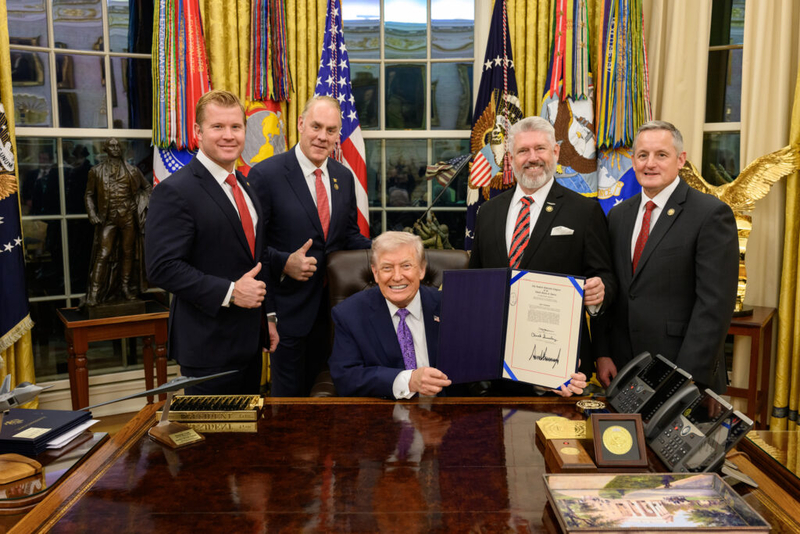
President Donald Trump poses with members of Montana's federal delegation after signing H.J.Res. 104, rolling back a BLM rule which prohibited future coal leasing in eastern Montana.
President Donald Trump signed a resolution sponsored by Montana’s federal delegation overturning Biden-era restrictions on coal extraction across most of eastern Montanan, helping the state’s stated goals of bolstering its mining and energy sectors.
But the move happens even as demand for coal continues to drop and production in Montana decreases.
House Joint Resolution 104, carried by the state’s eastern congressman, Rep. Troy Downing, and cosponsored by Rep. Ryan Zinke, passed both chambers on near-partisan lines, with a single Republican representative joining all Democrats in opposition.
Montana’s U.S. Sens. Steve Daines and Tim Sheehy sponsored an identical Senate Joint Resolution 61.
“Now more than ever, America needs affordable, reliable energy to fuel our new golden age,” Downing said in a statement. “With the signing of my bill to permanently roll back burdensome restrictions on coal leasing for the nation’s largest deposit, we aren’t just meeting the demands of today, we’re ensuring that we can power our country’s future. We are also making sure that subsequent administrations cannot undo the good work of the current one, safeguarding American energy independence.
The new law is one of several bills the president signed Thursday rescinding resource management plans on tens of millions of acres of public land in Montana, North Dakota, Wyoming and Alaska.
In Montana, the legislation overturns a rule issued by the Bureau of Land Management in 2024 that covered the state’s portion of the Powder River Basin, the nation’s largest coal-producing area.
“The approved RMP Amendment makes unavailable 1,745,040 acres of BLM administered coal from further consideration for leasing in order to reduce greenhouse gas (GHG) emissions as a proxy for climate change. The BLM would not accept new coal lease applications,” the decision said, setting out timelines to phase out coal production in the region.
Montana’s leaders had opposed the decision, saying that it would eliminate crucial revenue from coal taxes, which fund public schools and infrastructure, as well as stifle the national energy industry.
Last year Montana and Wyoming sued the federal government over the move to end coal leasing, and earlier this year, Gov. Greg Gianforte sent a letter to the Trump administration urging the federal government to maximize the availability of federal coal in Montana.
In a statement last week, he praised Trump and the state’s delegation for acting to “defend coal-based power and strengthen our nation’s energy security.”
The governor said that the move opens up nearly $4 billion in coal tax revenue for Montana.
Supply versus demand
However, amid the backdrop of the state and federal government’s push for increasing coal mining and coal-based power, the demand for coal is declining.
The U.S. Energy Information Administration projects U.S. coal production to drop from 610 million tons in 2022 to 450 million tons in 2040, and Western U.S. production to drop from 335 million tons to 224 million tons over the same period.
Since 2002, two of Montana’s largest coal mines have decreased production by roughly a third.
In October, the federal government rejected a bid on a new coal lease offered for 167 million tons from Montana’s Powder River Basin.
For what was the largest Montana coal lease sale in more than a decade, the sole bid, from Navajo Transitional Energy Company, was for just $186,000, fractions of a penny per ton and below BLM-estimates as a fair market value.
The BLM postponed a subsequent sale in Wyoming due to the low demand.
In addition to highlight the shifting demand away from fossil fuels, conservation groups decried the move as reversing environmental protections and said it side-stepped input from local stakeholders and the scientific community.
“Americans deserve public lands that protect clean air and water, support wildlife and preserve the freedom of future generations to explore,” Alison Flint, senior legal director at The Wilderness Society, said in a statement. “Instead, the president and Congress have muzzled voices in local communities and tossed aside science-based management plans that would deliver a balanced approach to managing our public lands. And meanwhile, even as the Congress seeks ways to permit development projects faster and better, they have thrown years of permits into question with this action. The public deserves better.”
But Republicans in Congress, and in Montana, are happy with their win.
“Now, thanks to the hard work of our Montana delegation, Biden’s rule is repealed and Montana energy is back,” Daines said in a statement, calling the Biden plan an “anti-coal rule.”
“Together, we are delivering the America First, commonsense policies Montanans voted for to achieve American energy dominance, create jobs, and make energy affordable, accessible, and reliable again,” Sheehy said. “I’ll continue working alongside President Trump and the Montana delegation to unleash Montana’s resource economy, protect Montana jobs, and bring prosperity to rural Montana communities.”
Zinke said the legislation will “lower energy costs by unlocking Montana’s vast natural resources and brings security to the jobs of the hardworking men and women who mine in Montana.”
“This is another success in the fight to make energy more affordable and protect the families who depend on it,” his statement said.
Helena, MT