Mississippi Today summit centers on learning in the classroom and on the job

Description
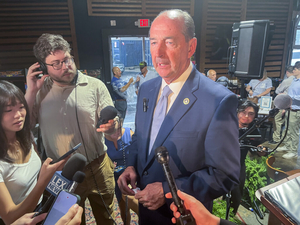
Photo courtesy of Mississippi Today
Audio articles are automated for accessibility. Humans wrote and edited the story; however, this audio has not been reviewed for accuracy and may contain errors. Read more about how we use AI to increase access to our reporting.
Local and national changemakers joined Mississippi Today staff in Jackson to examine how to best build on Mississippi’s gains in education and workforce development.
The discussions were part of Mississippi Today’s “All In On Mississippi” summit, which commemorated the publication’s 10-year anniversary. The event attracted hundreds of attendees to the state’s capital to learn more from the people behind the headlines.
Mississippi miracle? More like marathon
The state’s upward climb from the bottom of the nation when it came to fourth and eighth grade reading proficiency emerged after years of work. Beyond introducing more phonics-based instruction into classrooms, the state’s recent educational outcomes also leaned into accountability.
Rachel Canter, the founder and former executive director of Mississippi First, said many states only want to implement the “feel-good” aspects of Mississippi’s literacy plan, such as training teachers on phonics-based instruction, while doing less to hold districts accountable for poor outcomes for students.
“Change starts with honesty,” Canter, who now directs policy for the Reinventing America’s Schools project at the Progressive Policy Institute, told a crowd at the Two Mississippi Museums. “But we all have to take responsibility for our role in the system when the system is broken. And what Mississippi did right is think about that whole agenda.”

A large part of that agenda was outlined in the Literacy Based Promotion Act, a 2013 state law that mandated that third graders who do not pass the state reading test must be held back. The act also mandated early screenings for students to identify reading challenges. The Legislature also agreed to pay for literacy coaches to train teachers on more phonics-based instruction.
As a high school teacher in Mississippi in the early 2000s, Kymyona Burk, a policy analyst at ExcelinEd, said she noticed students were nearing graduation with gaps in their reading ability. She realized that socially promoting students set them up for failure.

Burk later led the Literacy Based Promotion Act’s implementation as state literacy director in the Mississippi Department of Education. She found part of her job required changing the way local district employees perceived the department. In her own experience as a teacher, state employee visits were not welcome.
“There are so many who are not a fan of the top-down approach, but that is what we had to do in Mississippi to get everyone rolling in the right direction,” said Burk. “I think now we’ve met in the middle, and we understand what we need to do as partners to get things done.”
Expanding apprenticeships to keep opportunities in Mississippi
A challenge for Mississippi is losing the investment in early education when graduates move out of state for jobs. Between 2010 and 2024, roughly 80,000 more residents left the state than moved in, continuing what many experts have labeled a brain drain.
At 55%, Mississippi consistently records one of the lowest workforce participation rates in the country. But state-sponsored training programs have been growing, and will play a vital role in the future of economic development, speakers said during a panel on apprenticeship programs.
In August, Gov. Tate Reeves appointed Daniel “Deano” Harrison to direct the Mississippi Office Of Apprenticeship. Reeves has said he created the office with the long-term goal of doubling the number of apprenticeships statewide to about 7,000.

At the summit, an audience member asked Harrison if the office would launch an apprenticeship pipeline for youths coming out of juvenile detention. Harrison said no population is off-limits.
“We need to go into every nook and cranny and grab anybody we can,” he said.
The state’s first medical apprenticeship program started at Singing River Hospital System on the Gulf Coast. Stephanie Utesch, the system’s human resources operations director, helps run what she called an “earn-while-you-learn” campus in Ocean Springs that has graduated over 600 apprentices since it launched.
The program started small. In 2021, Utesch recalled during the panel, she walked into an empty clinic and said: “Where’s the chairs? Where’s the tables?”

Since then, the program has grown and many of its students have thrived, Utesch said. She recalled a single mother caring for her mother and daughter while apprenticing. The single mother is on track to become a licensed practical nurse with no debt, Utesch said. Another registered nurse who is nearing retirement but doesn’t want to give up work has been taking coding classes through the program, Utesch said. Her goal is to switch to a remote schedule, she said, giving her greater flexibility while still working.
Singing River’s apprenticeship program is a success story, Harrison said, and he encouraged employers statewide to consider starting their own programs.
“When Mississippians leave Mississippi, we do great things,” Harrison said. “But let’s give them the opportunity to do great things in Mississippi.”
These conversations about educational outcomes and expanding apprenticeship programs folded into a broader discussion about the economic wellbeing of Mississippi during the “All In on Mississippi” summit, an event hosted by Mississippi Today featuring conversations about the forces shaping Mississippi’s future. The summit event is the second of a two-day event celebrating Mississippi Today’s first decade of reporting.

Jackson, MS