Minnesota health department urges people to get measles vaccine amid outbreaks
Oct 15, 2026 | 5:33 pm ET
Description
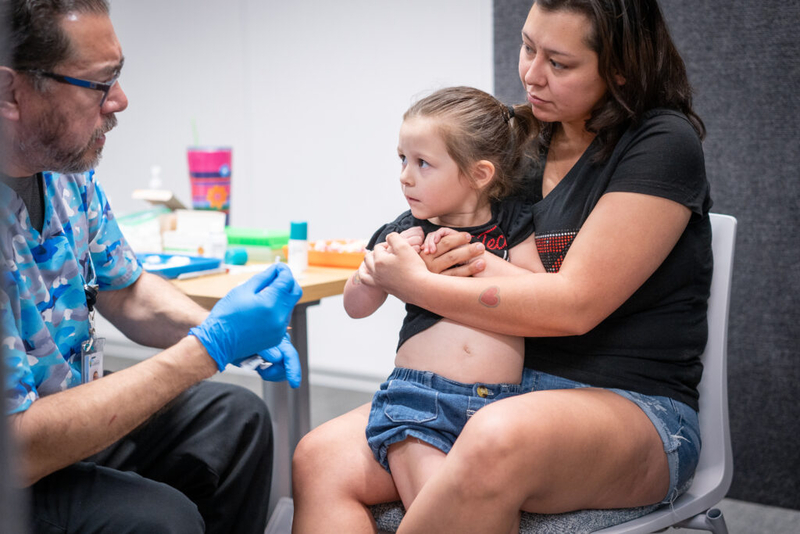
A 3-year-old girl gets an MMR vaccine at a clinic in Texas in March 2025. (Photo by Jan Sonnenmair/Getty Images)
The Minnesota Department of Health is urging people to get vaccinated for measles if they haven’t already.
The guidance comes amid two unrelated outbreaks of measles since mid-September in rural Fillmore and Todd counties. Minnesota has had 42 recorded cases of measles in 2026, already exceeding the total of 26 cases in 2025. The year prior saw 70 measles cases, largely affecting unvaccinated Somali American kids in the Twin Cities.
All of the people who have contracted measles in recent outbreaks were unvaccinated, the health department said.
Kids in Minnesota are required to get two doses of the measles, mumps, and rubella vaccine — known as the MMR vaccine — before kindergarten, unless their families submit an exemption.
The number of kindergartners with a non-medical exemption has risen sharply since 2020, reflecting growing vaccine skepticism. In the 2025-2026 school year, 6.8% of kindergartners had a non-medical exemption in Minnesota compared with the national rate of 4%, according to data from the federal Centers for Disease Control and Prevention.
Around 86% of Minnesota kindergartners have received the MMR vaccine, according to health department data — the third lowest rate in the nation, MPR News reported.
Vaccine skepticism has become federal policy under President Trump’s Health and Human Services Secretary Robert F. Kennedy Jr., who has long promoted unsubstantiated claims about vaccines. Under Kennedy’s leadership, the federal government cut the childhood vaccination schedule (later blocked by a judge), cut funding to vaccine development projects and started a program to study vaccine injury.
Kennedy has encouraged the measles vaccine but has stopped short of supporting a mandate for it.
“The most effective way to prevent the spread of measles is the MMR vaccine,” Kennedy wrote on X in 2025, following a visit to families of children who died in a Texas measles outbreak. He also previously said that he’d “probably” vaccinate his own child for measles.
Minnesota adds two cases to measles surge amid decline in routine vaccinations
Measles is a highly contagious illness that, before the 1960s, nearly all children contracted and from which tens of thousands were hospitalized every year. Thanks to decades of widespread vaccination, it was declared eliminated in the U.S. in 2000, though the number of measles cases in 2026 — the highest in three decades — is now threatening that status. The U.S. now has had more than 4,000 cases in 2026, far exceeding the 2,289 total confirmed cases in 2025.
Symptoms start with a fever, cough and runny nose, and progress to include a characteristic, blotchy head-to-toe rash. Around 1 in 5 unvaccinated Americans who get measles are hospitalized, according to the CDC.
People can get the MMR vaccine at any age. Generally, one dose of the vaccine is sufficient for adults.
In light of recent measles outbreaks, NPR published a guide for those who don’t know their measles immunity status. In short: People born before 1957 are presumed immune because measles used to be very common; people born after 1957 and vaccinated before 1968 might need an additional dose; those at high risk and in areas with high measles activity might want to get a second dose; and there’s no harm in getting an additional measles dose if you really don’t know if you are vaccinated.

Saint Paul, MN