Mingo County residents file federal lawsuit against company building power plants, data center in WV
Dec 05, 2025 | 2:36 pm ET
Description
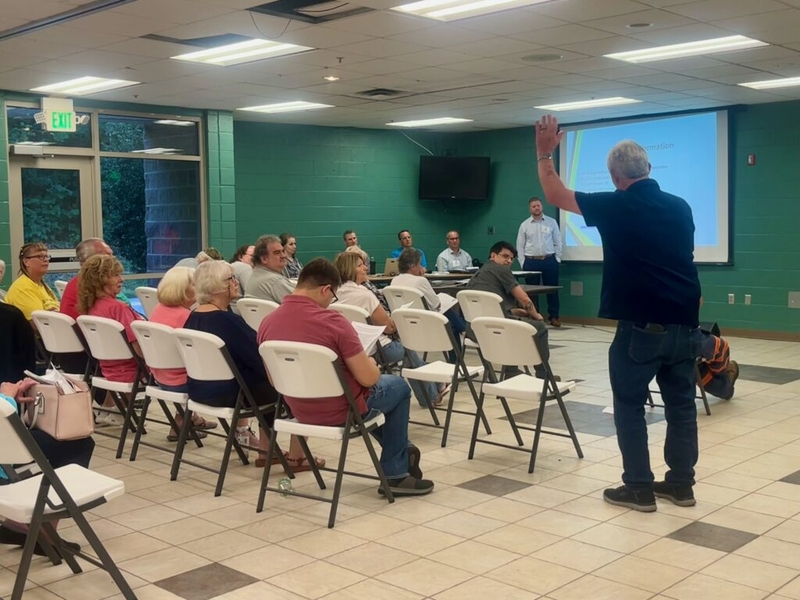
Tommy Powers, a retired pastor from Delbarton, West Virginia, speaks to regulators from the DEP’s Division of Air Quality at a public hearing on Thursday, Sept. 18, 2025. Powers shared concerns over how emissions from the proposed developments would harm the health of him and his neighbors. (Photo by Caity Coyne/West Virginia Watch)
Residents in Mingo County filed a federal lawsuit this week against the New York-based company working to build an ammonia plant, two natural gas power plants and a data center complex in their communities.
The lawsuit was filed on Dec. 3 in the U.S. District Court for the Southern District of West Virginia on behalf of 10 Mingo County residents.
Defendants named in the suit are TransGas Development Systems, the Huntington District of the U.S. Army Corps of Engineers, the U.S. Fish and Wildlife Services and the Federal Energy Regulatory Commission.
Raleigh County-based attorney Stephen New is representing the plaintiffs in the case.
In their suit, the residents in the case allege that the proposed projects — both the ammonia plant and the power plants, which have received separate air quality permits from the state Department of Environmental Protection — could threaten local, endangered wildlife. They say that TransGas, the company behind these projects, has failed to undergo federal actions necessary to make the construction of the facilities legal.
Those actions, per the lawsuit, include consulting with the federal Fish and Wildlife Services on whether the proposed projects would affect protected species or habitats; receiving a permit under the Clean Water Act to affect local waterways; undergoing a review through the National Environmental Policy Act to create an environmental impact statement for the projects and receiving approval from FERC to construct pipelines that could be necessary to supply natural gas to the power facilities.
Unless the court acts to require these actions, the lawsuit reads, then TransGas will move forward in the project and potentially cause “the precise procedural and environmental harm” the named federal agencies are meant to prevent.
The projects by TransGas are collectively referred to as the Adams Fork Energy Project. One portion of the proposed project includes building the largest natural gas-fueled ammonia plant in the world. It would produce up to 2.1 million metric tons of ammonia per year, according to the company.
The West Virginia DEP Air Quality Board granted a permit to TransGas for that project last year. That permit was carried over from one previously granted to the company nearly 20 years ago for the construction of a plant that would convert coal into liquid fuel. That plant — also proposed for Mingo County — was never built.
At community meetings earlier this year, Mingo County resident Ernie Sammons — who is selling his property to TransGas for the proposed data center complex — told concerned residents that the proposed ammonia plant was no longer happening. But no other evidence has been provided by TransGas or anyone else to demonstrate that. As long as the permit is in place, the company can move forward with its plans.
Representatives for TransGas did not respond to requests for comments for this story.
The more recent portion of the proposed TransGas development would entail constructing two new methane- and diesel-burning natural gas power plants. Per the near-identical air quality applications submitted to the DEP, the plants would operate as “microgrids,” powering two new data centers: one at the Twisted Gun Golf Course in Wharncliffe and another near the Mingo-Logan county line at the Harless Industrial Park, in Holden.
The two natural gas plants would each house 117 engines powered by methane, with 114 of those running full-time. If no gas is available, the engines would run on diesel that is stored in 40 tanks on each site.
Annually, per the applications, each facility would have the potential to emit up to 206 tons of carbon monoxide, 194 tons of nitrogen oxides, 118 tons of volatile organic compounds and 188 tons of fine particulate matter, or soot.
These kinds of emissions are known to negatively affect air quality in surrounding areas and contribute to climate change. People at risk of developing respiratory problems — including asthma, chronic obstructive pulmonary disease, black lung or other illnesses — are particularly vulnerable to negative health impacts from these emissions.
Residents in Mingo and Logan County have been outspoken against the proposed projects. They’ve shared concerns how the new power plants could impact their air quality, their health and their water, as well as their overall quality of life. Their concerns have been met with few answers from either the company or state regulators.
Despite the concerns and continued public pushback, the state DEP granted air quality permits for both power plants in October.
In the suit filed this week, residents are asking the court to put a halt on any “ground-disturbing or project-advancing activities” for the Adams Fork project until TransGas undergoes the named federal processes.
Charleston, WV