Midwest Innocence Project files claim of wrongful conviction in KCK barbershop homicide case
Aug 11, 2026 | 11:27 am ET
Description
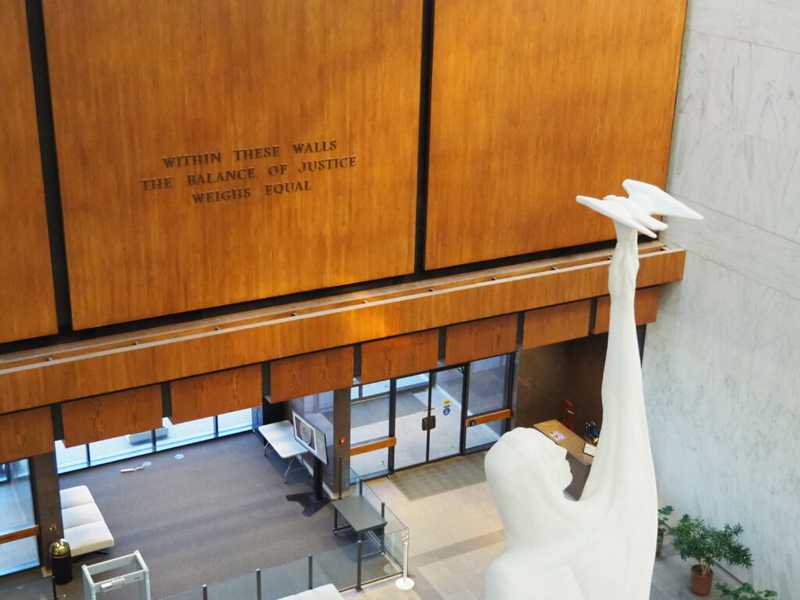
The Midwest Innocence Project is petitioning for a court review of newly compiled evidence suggesting a Kansas City, Kansas, man was unjustifiably convicted of murder in 2009 when framed by corrupt police investigators. In this image, the statue of justice greets visitors to the lobby of a Topeka building where the Kansas Supreme Court convenes. (Photo by Tim Carpenter/Kansas Reflector)
TOPEKA — Appellate attorneys representing Donnell Dobbs say their client had no role in the Kansas City, Kansas, barbershop death of Muryel Josenberger despite a jury conviction for first-degree murder based on testimony from a survivor of the violent melee.
Questions about Dobbs’ guilt lingered after police and prosecutors closed the case. Five years ago, the Community Integrity Unit created by the Wyandotte County District Attorney’s Office concluded that Dobbs was innocent of murder, said Evan Glasner, part of the Midwest Innocence Project’s legal team.
The Midwest Innocence Project says its own inquiry uncovered evidence that former KCK police detective Roger Golubski and others tainted the original investigation to ensnare Dobbs. The organization’s petition seeking to vacate Dobbs’ sentence was filed in Wyandotte County District Court and delivered to District Attorney Mark Dupree.
“Donnell Dobbs is innocent, sentenced to spend decades in prison for a crime he did not commit,” Glasner’s petition says. “Strong evidence implicates an alternate suspect as the perpetrator of the shooting for which Dobbs has spent the last 17 years incarcerated. The single eyewitness in this case provided flawed and unreliable testimony at trial and has since admitted that his testimony was false.”
Dobbs, ordered to serve a life term without possibility of parole for 25 years, claimed he couldn’t have taken part in the slaying because on the day of the 2008 shooting he attended a friend’s funeral and gathered with others at his mother’s residence. No physical evidence tied Dobbs to the crime scene.
Witnesses described the barbershop shooter as a man with braided hair standing about 5-foot-9 and weighing 190 pounds, the Midwest Innocence Project says. Dobbs was a former college football defensive lineman who weighed 260 pounds and wore his hair short. At trial, Dobbs’ defense lawyer didn’t present an opening argument or call witnesses. Dobbs’ alibi wasn’t shared with jurors.
In a twist, the Midwest Innocence Project says relatives of the man killed at the barbershop quickly tracked down an alternate suspect, Keith Wright, who matched the general description of the individual who shot Josenberger. Wright responded to the retaliatory attack by wounding one person in a shootout. Wright surrendered to police, but Dobbs’ current attorneys say no evidence existed KCK police questioned Wright about the barbershop crime.
Dobbs’ appellate attorneys maintain Mario Mitchell, who was shot a dozen times but escaped out a back door of the barbershop, was visited at the hospital by Kansas City, Kansas, police officers. The petition for fresh consideration of the Dobbs case says Mitchell was presented a photo array that included Dobbs and one of his friends, Casey Ellis. In an unrecorded police interview, Mitchell purportedly pointed a finger at Dobbs and Ellis. Both men were arrested the next day. A Wyandotte County jury in 2009 found Dobbs guilty but acquitted Ellis.
In 2013, the Kansas Supreme Court rejected Dobbs’ appeal in the murder case. A three-judge panel of the Kansas Court of Appeals affirmed his conviction in 2018.
The petition filed by the Midwest Innocence Project on Dobbs’ behalf sought an evidentiary hearing, the casting aside of his conviction and scheduling of a new trial.
Glasner’s petition says Golubski, the KCK investigator involved in Dobbs’ case, was implicated in multiple instances of corruption, sexual abuse of Black women and framing of innocent people in Wyandotte County. Golubski died by suicide in 2024 as his federal trial on alleged kidnapping, rape and civil rights violations was to begin.
Golubski was a figure in the wrongful conviction of Lamonte McIntyre in a double homicide in Kansas City, Kansas. McIntyre was released in 2017 after 23 years in prison.
Glasner’s 93-page filing in the Dobbs case drew upon similarities with Golubski’s manipulation of evidence in a campaign to implicate McIntyre. In the McIntyre case, McIntyre’s mother had refused Golubski’s sexual advances. In response, Golubski pressured a woman to falsely identify McIntyre as a killer. Golubski committed suicide before Dobbs’ mother, Davilyn, could testify in federal court that Golubski attempted to coerce sexual favors from her in the years before Donnell Dobbs’ arrest in the barbershop case, the Dobbs petition says.
Documents submitted July 28 on behalf of Dobbs by the Midwest Innocence Project asserted Dobbs’ due process rights were violated because Wyandotte County prosecutors failed to disclose exculpatory evidence that an alternate suspect could have committed the crime. In addition, the petition says Dobbs received ineffective trial counsel and a prosecutor presented evidence at trial that she should have known was false.
Lindsay Runnels, an attorney with the Morgan Pilate firm serving as Dobbs’ co-counsel with Glasner of the Midwest Innocence Project, said revelations about Dobbs’ alibi, flawed eyewitness testimony and police misconduct needed to be taken into account.
“Five years ago, Wyandotte County’s own independent CIU investigation uncovered evidence of Dobbs’ innocence, corroborating what we know is true,” Runnels said. “Donnell Dobbs did not kill Muryel Josenberger and he did not injure Mario Mitchell. Disgraced Captain Roger Golubski knew it in 2008. The current Wyandotte County DA’s Office knew it in 2021. And yet, Mr. Dobbs remains in prison for a crime he did not commit. That is not justice.”
Runnels said the public deserved transparency and accountability in the prosecution of criminal cases.
“It is long past time for Wyandotte County to reckon with the abuse this community endured for decades,” she said. “For Donnell Dobbs, the secrecy ends today. We are ready to present the overwhelming evidence of Mr. Dobbs’ innocence in a full and fair hearing.”
Since its founding in 2001, the Midwest Innocence Project helped secure the exoneration of 11 wrongfully convicted individuals and the release of eight people.

Topeka, KS