Midterm winners include several who made history
Nov 04, 2026 | 4:07 pm ET
Description
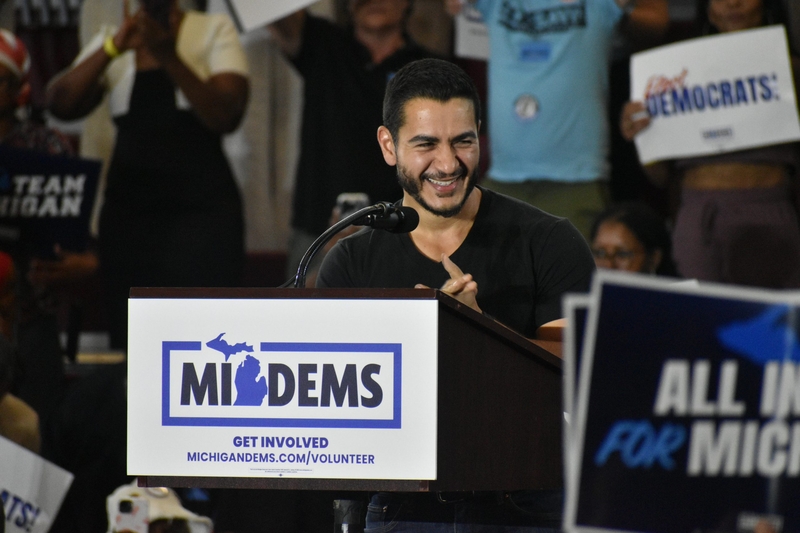
Abdul El-Sayed, a Democrat who is now senator-elect for Michigan, speaks to Democratic supporters at a unity rally held at Renaissance High School in Detroit on Aug. 7, 2026. (Photo by Ben Solis/Michigan Advance)
WASHINGTON — Winners of more than a dozen congressional and gubernatorial races have broken longstanding barriers of race, gender and sexuality.
The results set records for the most Black governors and most women governors, and the first Black woman governor, Georgia’s Keisha Lance Bottoms.
Democrats, who flipped the U.S. House and Senate, had more historic firsts, though Rep. Byron Donalds will become the first elected Black Republican governor in the country after winning his race in Florida.
Nevada and Wisconsin also elected their first Black governors.
Seventeen women will serve as governor in 2027, breaking the previous record of 14 in 2025, according to the Center for American Women and Politics at Rutgers University.
That includes Democrat Deb Haaland, a member of the Pueblo of Laguna who made history in 2021 as the first Native American to serve as a Cabinet secretary. Haaland won her race in New Mexico, making her the first Indigenous woman to be elected governor in the U.S.
And three Democratic senators-elect will make history once they are sworn in for the 120th Congress in January.
In New Hampshire, Democratic Rep. Chris Pappas will be the first openly gay elected senator. Michigan elected the first Muslim senator, Democrat Abdul El-Sayed, and Minnesota voters made Lt. Gov. Peggy Flanagan the first Native American woman senator, who could be joined by Alaska Democratic candidate Mary Peltola, an Alaska Native whose Senate race was too close to call Wednesday.
Another tight Senate race is in Mississippi, where Democratic candidate Scott Colom could become the first Black senator from the state since the Reconstruction era if he defeats GOP incumbent Sen. Cindy Hyde-Smith.
Race-based caucuses expand
Tuesday’s historic wins also means growth for certain caucuses aligned with Democrats.
The Congressional Hispanic Caucus will grow to more than 50 members from 44. Six incoming members of the all-Democratic caucus flipped Republican-held seats in Arizona, California, Colorado, Nevada and Texas.
The Congressional Asian Pacific American Caucus will gain at least four new members, growing to the largest size in its history at 22 members, Rep. Grace Meng, chair of the caucus said in a statement.
A House race in Arizona that has not been called would give the caucus 23 members if Democratic candidate Amish Shah wins.
“Last night’s election was a resounding repudiation of President Trump and his failed policies that put the safety, security, and civil rights of Asian Americans, Native Hawaiians, and Pacific Islanders at risk,” Meng said.
Record-setting women
Following Tuesday’s election, Democrats will control 28 governorships compared to 20 for Republicans, with two results still unknown.
Several will be their states’ first elected women governors.
“This was an impressive result for women in American politics, with women setting records and breaking significant barriers around the nation,” the Center for American Women and Politics Director Debbie Walsh said in a statement. “I’m particularly encouraged to see an increase in the number of women governors.”
In Minnesota, Democratic Sen. Amy Klobuchar will become the state's first woman governor.
As part of a Democratic sweep of Texas, the Lone Star State elected its first Latina governor, Gina Hinojosa, who ousted Republican Gov. Greg Abbott seeking his fourth term.
And in Ohio, Dr. Amy Acton will become the Buckeye State’s first woman and first Jewish governor.
Acton, who served as Ohio’s health director, defeated her Republican challenger Vivek Ramaswamy, who in the closing weeks of the campaign stood by a political ad featuring Acton’s estranged mother calling her daughter a liar. Acton was removed from her mother’s custody after her stepfather was indicted for sexually abusing her as a child.
Black governors
Five Black governors won their races on Election Day, setting a record for the most Black governors in office at once.
Bottoms, Georgia’s first Democratic governor since 1998, will be the first Black person and first woman governor of Georgia.
In Wisconsin, voters elected their first Black governor, David Crowley, a former county executive who billed himself as a centrist Democrat.
And in Nevada, Aaron Ford, a Democrat and the state’s attorney general, ousted Republican Gov. Joe Lombardo.
Maryland Democratic Gov. Wes Moore easily won his reelection bid.
All States Newsroom content is free to republish. Read our republishing policy for more information.