Peggy Flanagan wins Minnesota US Senate seat in first for Native American women
Nov 04, 2026 | 12:22 am ET
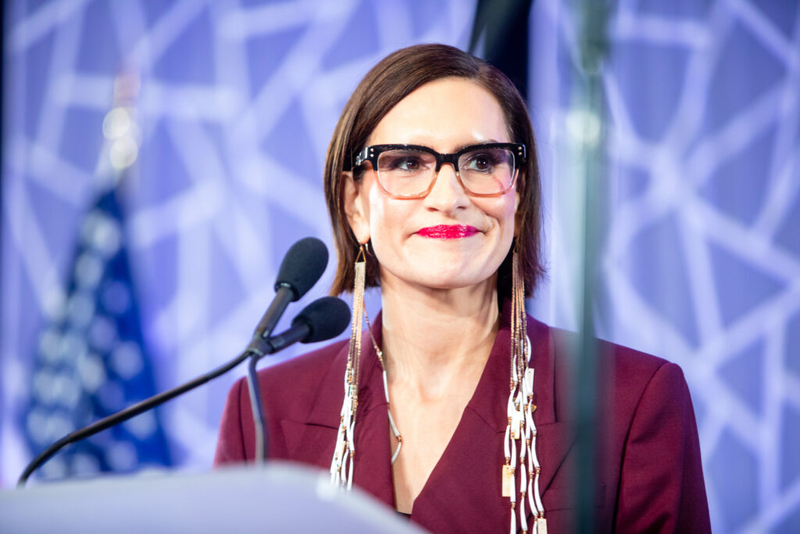
Description
Lt. Gov. Peggy Flanagan delivers a speech after the Senate race was called in her favor at the DFL watch party during the midterm elections Tuesday, Nov. 3, 2026 in St. Paul, Minnesota. (Photo by Nicole Neri/Minnesota Reformer)
Minnesota Democrat Peggy Flanagan made history Tuesday as the first Native American woman elected to the U.S. Senate, a distinction she may share with Alaska Democrat Mary Peltola if she wins her race.
The two-term lieutenant governor beat out Republican Michele Tafoya, a former NFL sideline reporter and conservative podcaster, on a progressive economic platform and promise to “rip ICE apart” following the incursion of some 3,000 federal immigration agents to the state earlier this year that left two Americans dead.
In her victory speech in St. Paul, Flanagan said the election marked a triumph over President Donald Trump.
“You said no more war. No more health care cuts. No more taking away food from children and seniors. No more selling this country off to the highest bidder. And no more masked goons shooting our neighbors,” Flanagan said.
Republicans tried to make the election a referendum on fraud in state-run programs that grew into a crisis under Gov. Tim Walz and led him to drop his bid for a third term.
Flanagan denied any responsibility for failing to stop fraud sooner, repeatedly citing the governor’s statement that the “buck stops” with him. She then redirected voters’ attention to reports of Trump and his family enriching themselves through crypto, international real estate and mineral deals, defense contracts and presidential pardons.
“The grift stops now,” Flanagan said Tuesday night.
Flanagan, who supports Medicare for All, universal childcare and raising the minimum wage to $17 an hour, was backed by lefty icons including Sen. Bernie Sanders, and her victory is a win for the left flank of the Senate Democratic caucus. By winning the seat vacated by Sen. Tina Smith and previously held by progressive standard-bearers Paul Wellstone and Al Franken, Flanagan will continue a decades-long legacy.
Flanagan’s victory is something of a comeback after a rocky few years. She was sidelined during the Walz administration, with tensions between her and the governor spilling into the open after his 2024 vice presidential run. She also faced a tough Democratic-Farmer-Labor primary opponent in U.S. Rep. Angie Craig.
The election of Flanagan, an enrolled member of White Earth Nation, is highly symbolic for Native Americans. Just four enrolled tribal members have served in the country’s most powerful legislative body, all men.
What Peggy Flanagan’s Senate victory would mean for Indian Country
But her ascension to the Senate goes beyond representation. Flanagan brings deep experience working with tribal governments that promises to make her a powerful advocate for the 575 federally recognized tribes.
White Earth Chairman Michael Fairbanks and other Native men played a victory song for Flanagan at a large drum at the watch party in St. Paul. Fairbanks said Flanagan’s success was monumental for their Tribe and protecting their natural resources from mining.
“This really means a lot for White Earth,” Fairbanks said.
Flanagan’s husband Tom Weber, in introducing her before her victory speech, noted the significance of a Native woman being elected to the seat held more than a century ago by U.S. Sen. Knute Nelson. He was the architect of an 1889 federal law that sought to force thousands of Ojibwe people onto the White Earth reservation and that opened their lands to non-Native settlement and logging.
As lieutenant governor, Flanagan helped reshape state government’s relationship with the 11 tribal nations in Minnesota. The Walz-Flanagan administration expanded consultation with tribal leaders, restored thousands of acres of land, protected tribal gambling interests, supported an emerging tribal cannabis industry and established the first state office of Missing and Murdered Indigenous Relatives.
Flanagan’s election is not surprising in a state that hasn’t elected a Republican senator since 2002, especially given Trump’s deep unpopularity and voters’ frustration with tariff-fueled inflation and higher gas prices that are the result of the war in Iran. Still, nonpartisan polls largely showed a tight race leading up to Election Day, raising fears among Democrats that Minnesota could swing right while reddish states swung left.
Minnesota Republicans, who haven’t won a Senate race since 2002, saw Tafoya as their best chance in years to win a statewide seat. Tafoya is well known and brought strong communication skills from her years on television, and she presented herself as an independent thinker willing to challenge Trump and a moderate on issues such as abortion.
Flanagan graduated Phi Beta Kappa with a major in child psychology and a minor in American Indian studies from the University of Minnesota. She took a job at the Division of Indian Work in south Minneapolis before joining Wellstone Action, the nonprofit dedicated to carrying on the legacy of Sen. Paul Wellstone by training political organizers and candidates.
She served on the Minneapolis School Board and led the Children’s Defense Fund of Minnesota, and then won a seat in the state House in 2015. Walz tapped her to join his ticket for governor in 2017 and they were elected the next year.

Saint Paul, MN