As Medicaid coverage shrinks, charity care has to grow
Oct 07, 2026 | 5:55 am ET
Description
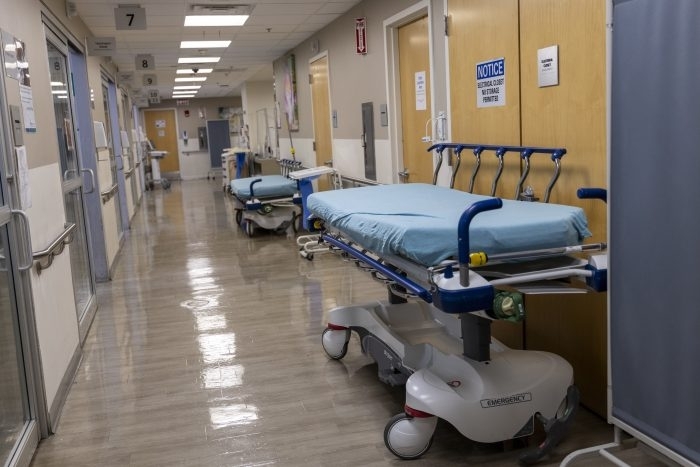
As changes to both Medicaid eligibility and the provider tax loom, hospitals have warned that this will destabilize their operations. (Photo by Anne-Marie Caruso/New Jersey Monitor)
H.R. 1, also known as “One Big Beautiful Bill,” may soon reduce Medicaid enrollees in West Virginia by as many as 75,000, according to the Urban Institute. This reduction in enrollment will depend mostly on how states implement new rules, including work requirements and six-month redeterminations that begin Jan. 1, 2027.
While policymakers at the state and federal level grapple with how to handle this adjustment, patients in West Virginia are more concerned about what it means for their ability to access and afford care. Over 13% of West Virginia’s adults carry medical debt, half again the national rate. In rural Appalachia, 24% of the population has medical debt in collections. Worse, healthcare costs have continued to rise. West Virginia’s hospitals charge, on average, 337% of Medicare rates, the third-highest markup nationally.
For West Virginians, the high cost of care isn’t simply a risk of unaffordability, but a choice about whether to seek care at all. Medical debt is consistently associated with deferring care. With few alternatives outside of system-delivered care, lower-cost options are out of reach for many.
Yet, many conversations around these changes — whether one agrees with H.R. 1 or not — have focused on hospital losses rather than patients’. As changes to both Medicaid eligibility and the provider tax loom, hospitals have warned that this will destabilize their operations.
Non-profit hospitals control more than 75% of beds in West Virginia and are exempt from income, property and sales tax. As part of this exemption comes an agreement: that non-profit hospitals would provide free or reduced care for the poor and underinsured, otherwise referred to as “charity care.” However, this engagement with the non-profit hospital status has become more distorted as the years have gone on. In West Virginia, charity care averages 0.9% of net patient revenue.
In the most recent report from the West Virginia Hospital Association’s Community Benefit numbers, they cite $79 million in charity care and $103 million in bad debt — hospitals wrote off more as unpaid bills than they forgave. In some instances, hospitals even report in their IRS 990s how much bad debt is “FAP-eligible,” or estimated to have qualified under their own financial assistance policy but was written off as debt.
These numbers often become inflated because of the broad legal standard of “community benefit,” which West Virginia hospitals claim equates to $1.19 billion annually. A closer look at this number shows that the Catholic Health Association standard the state hospital association says it follows excludes bad debt and Medicare shortfalls; WVHA tallies both. This inflates the contribution to West Virginians; less than 7% of “community benefit” is working to ease the burden of high-cost care for patients.
About $204 million of this benefit is attributable to the current provider tax, a fee that hospitals pay to draw more federal Medicaid matching, which is returned to hospitals through Medicaid payments. WVHA counts the fee as a community benefit. Meanwhile, WVHA says reduced payments from hospitals to the state under changes from H.R. 1 will further strain hospital resources. If the provider tax were a net cost to hospitals, limiting it would be a relief. WVHA calls it a loss.
Moreover, the Catholic Health Association counts the provider tax as a Medicaid cost. In their words, “these amounts generate Medicaid revenue.”
In truth, hospitals should be part of the solution for patients and affordable, accessible care. IRS reporting on charity care provided shows they are not. The tax exemption so many hospitals enjoy should come along with a return to patient investment and care, particularly through the moral function of hospital charity care.
Texas and Oregon are two examples, red and blue, that have sought to correct the drift from the tax exemption’s original intent. Texas conditions tax exemption on meeting its charity care standard. Oregon requires financial screening before collection. At Oregon Health & Science University, presumptive screening raised the share of patients identified as eligible for financial assistance from 12% to 64%. At the same time, expanded financial assistance has shown no effect on hospital net patient revenue.
Hospitals should take their financial obligation to patients more seriously. Amid significant changes to federal policy, now more than ever is a good time to do so. The upcoming legislative session offers an opportunity to stay ahead of federal changes and put patients first by requiring hospitals to deliver true charity care, not bad debt, and to screen all patients for financial assistance before any collections activity.
Charleston, WV