McKee OKs $6M in funding to replace federal food benefits — far short of what RI needs
Oct 28, 2025 | 7:23 pm ET

Description
The Rhode Island Community Food Bank in Providence had 730,000 pounds of food on hand on Tuesday, Oct. 28, 2025 — enough to meet current demand for about two weeks. (Photo by Alexander Castro/Rhode Island Current)
Gov. Dan McKee plans to take $6 million from one pot of federal money to fund food benefits for a portion of the 145,000 Rhode Islanders whose monthly federal food subsidy is set to disappear on Nov. 1.
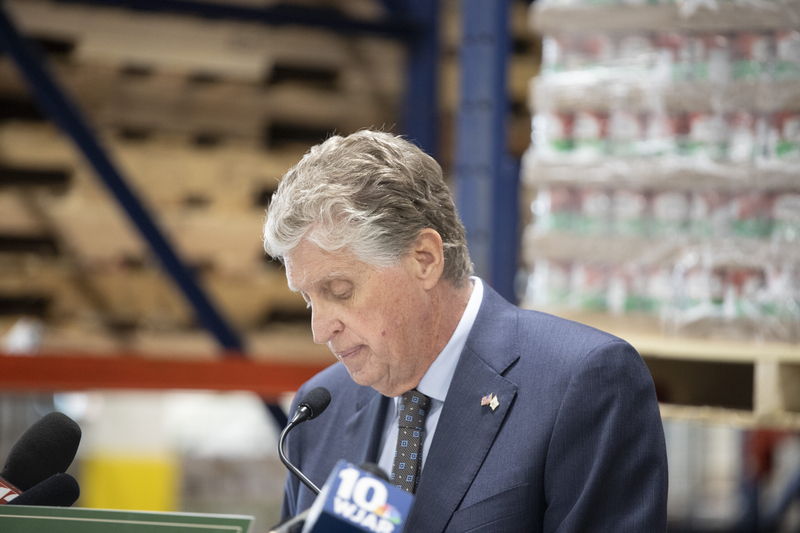
Joined by state, nonprofit and labor leaders at the Rhode Island Community Food Bank on Tuesday afternoon, McKee declared a state of emergency and said he is authorizing the money to be drawn from Temporary Assistance for Needy Families (TANF) funds.
The loss of benefits from the Supplemental Nutrition Assistance Program or SNAP has been a growing concern among area food banks. The program is a victim of the ongoing federal shutdown — even though it has been funded in previous shutdowns. In 2019, the U.S. Department of Agriculture frontloaded a month’s worth of benefits. This time around, President Donald Trump’s administration declined to pursue the same course of action.
The governor twice echoed the famous adage: “It’s the Trump administration version of, ‘Let them eat cake,’ and it’s cruel.”
McKee acknowledged that Rhode Island receives $29 million a month in federal funds for food assistance — but said these are funds that taxpayers have already paid.
“Rhode Islanders have already paid to the federal government to create a safety net for our neighbors, and the USDA has billions of dollars in contingency funds for such an emergency,” McKee said. “And they’re not sharing those dollars with the states. It’s unbelievable.”
Asked about the state’s authority to use the TANF money, McKee said the state is allowed, “Because it’s money that can be used towards families. … Even if it was a gray area, we’re going to do it.”
The state is also providing $200,000 for the Rhode Island Community Food Bank, which distributes food statewide across its 137 affiliated pantries and other agencies. The Rhode Island Foundation — the state’s largest philanthropic outfit — is matching that $200,000, and contributing an additional $800,000 to nonprofits across the state.
The state has also launched a webpage, SNAPsupport.ri.gov, with instructions on how current beneficiaries can continue to access food as well as information on how people can donate to support the state’s food banks.
Displayed next to the governor was a pallet loaded with cartons of Canadian “fancy” grade apples, and on the shelves behind him were shrinkwrapped cans of diced tomatoes. SNAP subsidizes foods like these and most edible items in a grocery store barring hot, ready-to-eat options. Benefits vary by a household’s size and income, with subsidies maxing out at $298 for a single person and $994 for a family of four in the current fiscal year.
McKee’s plan cannot cushion all the state’s food stamp recipients from the federal shockwave. The Temporary Assistance money can only be used for families with children, which narrows the number of eligible recipients to an estimated 65,000 residents, or about 20,000 families. Two payments will go out twice, on Nov. 1 and Nov. 16, and amount to about half of what recipients usually receive.
Still, that leaves about 80,000 Rhode Islanders without access to food stamps in the immediate future, McKee noted.
“While we’re continuing to pursue other options, we must prepare for the possibility that 80,000 Rhode Islanders may have to rely exclusively on food pantries and other nonprofit efforts,” McKee said.
The state of emergency gives McKee greater flexibility, he said, in restoring benefits for those thousands of Rhode Islanders if the state is able to “find a path” for those residents.
“I think it’s important to point out how complicated this issue is,” McKee said. “We don’t have the ability to use state funds to actually put the credits on those SNAP cards.”
730,000 pounds of food
The emergency declaration follows public criticism from Helena Buonanno Foulkes, who is challenging McKee in the 2026 Democratic gubernatorial primary. On Monday, Foulkes issued a statement demanding that McKee take action before the food stamps’ expiration date, by declaring a state of emergency and mobilizing the National Guard for logistics if needed.
“While this crisis stems from decisions made in Congress and by the Trump administration, our state leaders must act now,” Foulkes said.
Asked by a reporter about Foulkes’ critique, McKee swatted it down: “It’s really disappointing that we have political grandstanding at a moment like this.”
McKee said his office received a letter from the federal administration on Oct. 10, and he was briefed on the situation on Oct. 16. The governor and his team then puzzled out possible solutions while waiting to see if the White House would tap into contingency funds for SNAP.
“We were not notified until this weekend that that was not an option,” Mckee said. “So when you talk about the stress that is coming our way and the stress that’s coming to our families and the people in the state of Rhode Island, just think about that. We’re responding in a rapid way, where moment by moment, that whole scale gets shifted.”
Rhode Island food pantries slammed as SNAP beneficiaries brace for funding to run dry
The governor identified the true cause of the SNAP problems as President Donald Trump. “This is not about the government shutdown,” McKee said. “This is about a decision that the chief executive of this country had.”
A notice posted to the U.S. Department of Agriculture’s website reads, “Bottom line, the well has run dry.” It also blames Democrats for not voting for a stopgap funding bill.
Democrats have repeatedly voted against the stopgap funding bills because they want a guarantee that health care subsidies that are set to expire at the end of the year will be extended and funded. Republicans don’t want those subsidies included.
McKee said his team has had to consider the possibility that the shutdown will stretch on. The state will need to keep planning in two-week blocks should the benefits not return soon — a prospect for which McKee saw no good omens.
We must prepare for the possibility that 80,000 Rhode Islanders may have to rely exclusively on food pantries and other nonprofit efforts.
“The behavior that’s coming from President Trump right now indicates to me that he has no intention of actually appropriating dollars or creating a strategy that would address this SNAP issue, which is the first time that there’s ever been a shutdown where the SNAP funds have not been appropriated,” McKee said.
Sen. Lou DiPalma, a Middletown Democrat who chairs the Senate Committee on Finance, reiterated in a phone interview Wednesday morning that the state cannot load funds directly onto the electronic benefit transfer (EBT) cards used by SNAP recipients — only the federal government can. Even if the state can’t do that, McKee’s plan is “a good initial step,” DiPalma said.
“I think this is Plan B,” the senator added. “To address it, we need to be looking at what’s Plan C, D, E and F. We need to be turning over all the stones and figuring out what else we can do, should do.”
Like McKee, DiPalma questioned the president’s “priorities,” and pointed out that he’s read the entirety of the One Big Beautiful Bill Act.
“There’s $45 billion in there for detention centers, for single adults and families,” DiPalma said. “And you’re telling me we can’t provide food to people.”
In the absence of an immediate solution, DiPalma said Rhode Island can look to other states for ideas on how to best constellate its network of food providers and pantries. He cited a farmer in his district who donated “hundreds of bags of 10 pounds of potatoes to the food bank for families to use.”
For now, the Rhode Island Community Food Bank has roughly two weeks of food — 730,000 pounds — to meet current demand, CEO Melissa Cherney told the crowd on Tuesday. The warehouse has a capacity of two million pounds. Cherney, who came on board as head of the food bank in July, encouraged Rhode Islanders to donate to the food bank and local pantries. Monetary donations to the food bank can go further, as the organization can leverage its purchasing power to buy in bulk.
“This is all hands on deck, and in my short 12 weeks here in Rhode Island, I have seen the power of community,” Cherney said. “We can send a message to our neighbors that they are never alone, and we are here.”
- October 29, 202512:44 pmUpdated to include comments from Sen. Lou DiPalma.
Providence, RI