Max Engling claims defamation over driving allegations in new Beau Bayh ad
Oct 19, 2026 | 12:56 pm ET
Description
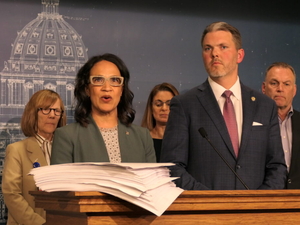
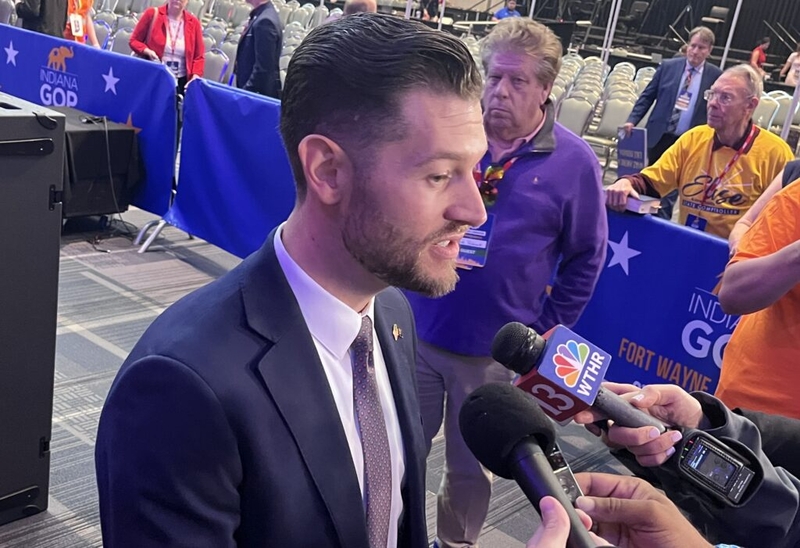
Max Engling speaks with reporters after winning the Republican secretary of state nomination on June 20, 2026. (Photo by Tom Davies/Indiana Capital Chronicle)
Republican Max Engling is threatening to sue Democrat Beau Bayh over a new television advertisement in their increasingly bitter Indiana secretary of state election campaign.
Engling alleges that references in the ad that he had been convicted of reckless driving is “defamation on its face.”
The Bayh campaign is defending the commercial, which features a uniformed sheriff’s deputy saying Engling “has been convicted and investigated at least eight times for reckless driving and reckless behavior.”
Engling’s campaign acknowledged in a weekend statement that his driving record “includes eight speeding tickets, the most recent from 16 years ago, all traffic infractions, not misdemeanor charges or convictions.”
“Beau Bayh can spend money repeating this claim, but he cannot produce a reckless driving charge against me because there isn’t one,” Engling said in the statement. “If Beau has evidence, release it. Otherwise, pull the ad and tell Hoosiers the truth.”
A search of online Indiana court records show Engling with eight speeding tickets in Hamilton or Marion counties between 2006 and 2010 — when he was 19 to 23 years old — but no other court cases.
The Bayh campaign provided the Capital Chronicle with a timeline supporting its ad that also included an expunged misdemeanor criminal reckless case from 2007 in which Engling threw eggs at passing vehicles from a U.S. 31 overpass in Carmel, along with a 2023 speeding ticket in Arlington, Virginia.
That timeline includes no “reckless driving” criminal charges against Engling.
Who’s a real Hoosier? Secretary of state candidates spar over time in Indiana.
Bayh, meanwhile, was initially charged in 2018 at age 22 in Brunswick County, Virginia, with misdemeanor reckless driving for driving faster than 85 mph. That charge was reduced to an infraction for defective or unsafe equipment and Bayh was fined, according to Virginia online court records.
Engling’s campaign said Bayh should “withdraw his latest attack ad and correct its false claim about Engling’s driving record, or face a lawsuit.”
Bayh’s campaign responded to the Capital Chronicle that it “is reckless for Max to drive 87 in a 60mph zone. It is reckless of Max to throw things from an overpass at moving cars.”
“His driving is reckless. His behavior is reckless. His threats of frivolous lawsuits are reckless,” Bayh campaign manager Jack Tormoehlen said in an email. “This ad is accurate and Max Engling needs to take a deep breath.”
The dispute over Engling’s driving record follows attack ads from Engling over Bayh’s voter registration history.
Bayh first registered to vote in 2014 while still a high school student in Washington, D.C., using the address of an Indianapolis condominium owned by his father, former U.S. Sen. Evan Bayh.
An Engling ad says Beau Bayh “voted in Indiana elections 14 times. Had his ballot mailed to his parents’ D.C. mansion. Sounds like voter fraud.”
Bayh, who has never been charged with voter fraud, cast ballots regularly in Indiana through his time as a student at Harvard and during services with the Marine Corps — often by mail but sometimes voting early in person. He moved full time to Indiana in 2024 after graduating from Harvard Law School.
Bayh has defended voting in Indiana, saying he always considered the state home despite mostly growing up in the Washington area after his family moved there when he was three with his father’s election to the U.S. Senate.
The Indiana Supreme Court ruled in 1988 — in a case involving Evan Bayh’s residency — that physical presence in a place is only one circumstance in determining domicile, and that a person’s residency hinges on intent.
Indianapolis, IN