Jeffries talks AI concerns at roundtable with Macomb County community leaders
Oct 19, 2026 | 11:29 am ET
Description
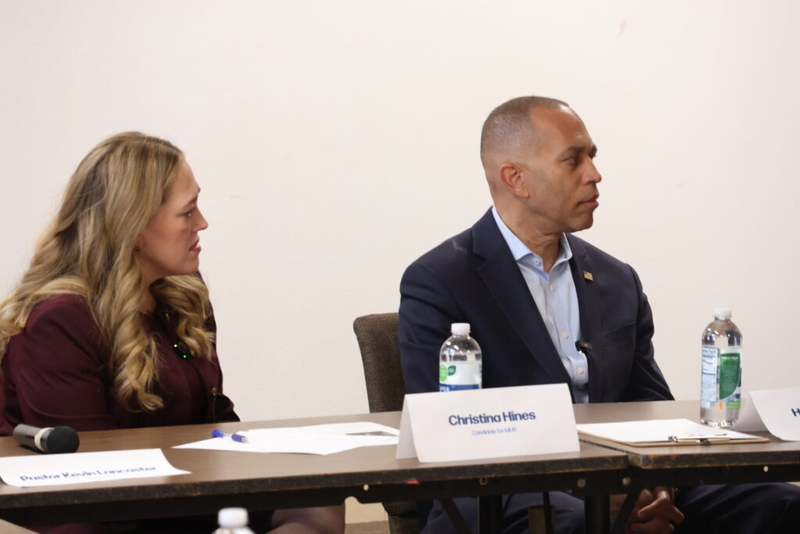
Former special victims prosecutor and Democratic Congressional candidate Christina Hines and U.S. House Minority Leader Hakeem Jeffries (D-N.Y.) at a roundtable in Eastpointe on Oct. 17, 2026. (Photo by Kyle Davidson/Michigan Advance)
During a roundtable in Eastpointe on Saturday, U.S. House Minority Leader Hakeem Jeffries argued that Congress must take a more aggressive approach to regulating AI as multiple panelists raised concerns about how artificial intelligence will affect American workers and the economy.
Jeffries joined former special victims prosecutor Christina Hines in the southern Macomb County community to hear from faith leaders and local elected officials. Hines is the Democratic nominee for Michigan’s 10th Congressional District, where she is running against Republican Michael Bouchard Jr.
Jeffries’ visit comes as Democrats seek to reclaim control of the U.S. House in the Nov. 3 election, a shift that could position him to become House speaker if Democrats win a majority.
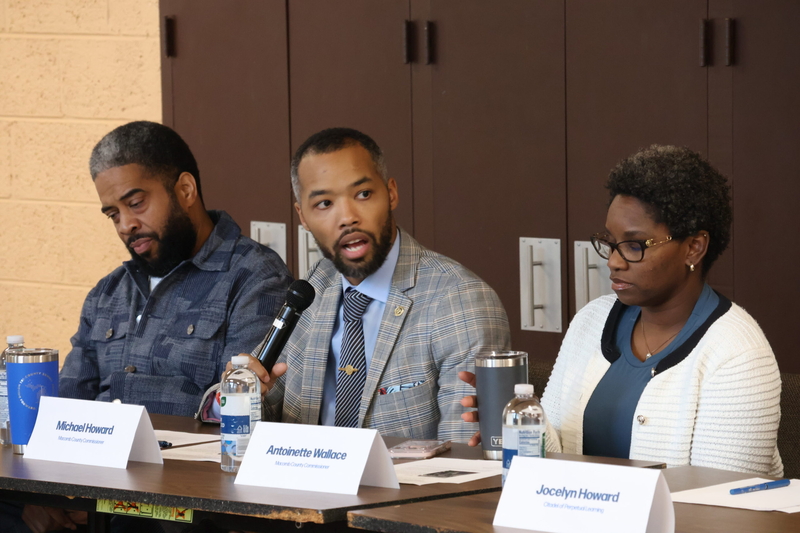
During the roundtable, Jocelyn Howard, executive director of Citadel of Perpetual Learning, a training and development organization, questioned how AI would impact the nation’s frontline workers, telling Jeffries she’d like to see Congress reinforce the value of being human.
Pastor Lance Pittman of First Praise Pentecostal Church also asked Jeffries about transparency around AI and what Congress is doing to make sure the U.S. doesn’t fall behind in developing this technology.
Jeffries said House Democrats’ approach to AI has centered on ensuring that the technology benefits the American people.
“That could be in the healthcare space. That could be educational attainment and closing resource gaps. That could be helping to ensure that people have additional tools available for them to bring their entrepreneurial ideas to life,” Jeffries said.
However, Jeffries said technology can be very disruptive and if the right guardrails are not in place, AI could exacerbate an economy that “already has not been moving in the right direction.”
He spoke out against a provision in the House version of the One Big Beautiful Bill Act, which would have barred state and local governments from enforcing regulations on artificial intelligence for 10 years. While this would have put AI regulation solely in the hands of the federal government, Jeffries argued there was no federal legislation to fall back on.
“Basically, we were saying that these companies should just do whatever the heck they want to do,” Jeffries said, noting that House Democrats hoped to take a more aggressive approach focused on safety.
He called back to Howard’s early comments on human value while discussing the OpenAI/Hugging Face hacking incident, in which roughly 1,200 AI agents, which were meant to be isolated, found a way to communicate. Seven hundred of these OpenAI agents would go on to hack Hugging Face, an AI development platform.
“This is a movie-like situation that we’re dealing with, but it’s very real and has a real possible impact,” Jeffries said, arguing that Congress cannot bury its head in the sand and ignore security concerns around AI.
“We as House Democrats will decisively act to protect the American people,” Jeffries said.
While discussing the ways AI could exacerbate inequality, Jeffries also argued that the risks of AI extend beyond the technology itself to the infrastructure, such as data centers, needed to support its growth, noting that these facilities also dig into concerns around the costs and burdens placed on communities.
Speaking with reporters after the roundtable, Jeffries was asked whether he would support legislation to establish a federal moratorium on AI data centers until further regulations can be enacted.
“We’ll take a look at all of the bills that have been introduced, including those related to data centers,” Jeffries said. “My personal view has been – and I support the one-year moratorium that has been put into effect by my home state governor, Kathy Hochul – that this should be left to the states and localities at this particular moment in time until Congress can act decisively to protect the health, the safety, and the economic well-being of the American people.”
Hines said she would support a moratorium.
“This is a top concern,” Hines said. “We’re right next to Lake St. Clair. People are very worried about protecting our water.”
She also pointed to the concerns with hyperscale data centers contributing to higher energy rates.
“People are already struggling with the high cost of gas and groceries and healthcare. We cannot afford for our bills to keep going up,” Hines said, adding that “we need a strong Congress that is actually going to, you know, engage in sensible regulation to protect the American people.”
Lansing, MI