Mass. upgraded from least competitive elections in the country to second-worst
Oct 19, 2026 | 9:20 am ET
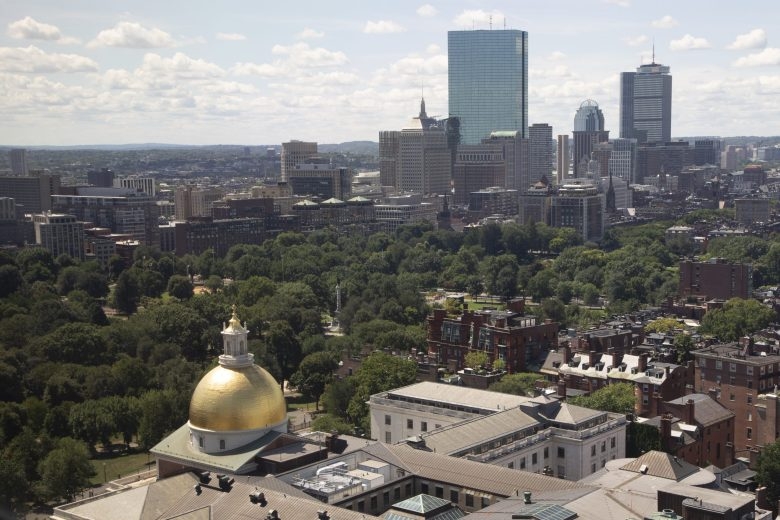
Description
The golden dome of the Massachusetts State House.
FOR THE FIRST time since Barack Obama was president, Massachusetts did not land in dead last place in one assessment of electoral competitiveness.
It came in second to last.
Thanks to a slight uptick in the share of state legislative races with multiple choices for voters this election season, the Bay State climbed from the basement up one single rung higher in Ballotpedia’s biennial competition index.
The nonprofit online political encyclopedia examined all 46 states that have legislative races this fall. Massachusetts ranked 39th for the share of open seats (8 percent), 35th for the share of incumbents who faced primary challenges (14 percent), and 45th for the share of its 200 races where both a Democrat and Republican are on the general election ballot (23 percent). Averaging those three inputs, Ballotpedia awarded Massachusetts an overall “competitiveness index” of 15 on a 100-point scale, lower than every other state except Rhode Island.
All 160 seats in the Massachusetts House and all 40 seats in the Massachusetts Senate are up for reelection every two years. Three out of five of those races are completely uncontested this year, leaving most voters with no choice in their state lawmakers at the same time they will face a record-tying number of ballot questions.
The lack of options is far from a new development. In every two-year cycle from 2016 to 2024, Massachusetts landed at the bottom of Ballotpedia’s national competitiveness rankings.
Republicans are outnumbered about six to one in the Legislature, and while many Democrats avoid drawing primary opponents, the lack of competition is especially fueled by the low rate of GOP challenges.
Democrats are contesting 94 percent of Massachusetts seats, while Republicans are only vying for 30 percent, according to Ballotpedia. That’s much lower than many other safely blue states like Connecticut (where 80 percent of districts have a Republican candidate) and New York (where 71 percent of districts are being challenged by Republicans).
In California, where Democrats control three-quarters of the state Legislature, Republicans are in fact vying for a slightly higher share (95 percent) of the 100 seats up for grabs this November than Democrats are (93 percent). That fact, plus a high rate of incumbents drawing same-party challengers, prompted Ballotpedia to rank California number one overall in its 2026 competitiveness index.
Other states that see significant competition tend to have split party control or the prospect of one party seizing a majority. In Michigan, where Democrats hold a two-seat margin in the Senate and Republicans hold a six-seat margin in the House, every single legislative district except one has a candidate from each of the major parties.
Little is at stake in the Massachusetts Legislature this November. With so few races, Democrats are guaranteed to retain a veto-proof supermajority in both chambers. Only two other states have a supermajority locked in before votes are cast: fellow Democratic hotbed Rhode Island, and Arkansas, where Republicans dominate.
House Speaker Ron Mariano has not faced an opponent since 2020, and Senate President Karen Spilka has been unopposed in every one of her reelection campaigns since 2010.
Laura Giordano, a spokesperson for the Massachusetts Democratic Party, said the latest Ballotpedia rankings showing the Bay State second-to-last in the country on electoral competition is not itself a worrying sign. The party does not get involved in contested primaries, she noted.
“We did see some really competitive races this cycle, which brought some excitement for some people, but on a whole, it’s not something [about which] we’re incredibly concerned,” Giordano said.
Beacon Hill critics across the partisan spectrum have long lamented the lackluster competition, arguing that entrenched leadership leads to a sluggish pace of work and elected officials out of touch with what their constituents want. Reformists pushing a dramatic change to the state’s electoral landscape made that a central pitch of their ballot question campaign.
If voters approve Question 3 this fall, Massachusetts would cease to operate separate Republican and Democratic primary elections and instead place all candidates onto a single, “all-party primary” ballot. The top two finishers would advance to the general election, even if they are both from the same party.
“Without competition, elected officials don’t have to listen to voters. Everybody feels stuck, and nothing is changing,” Danielle Allen, a Harvard University professor and the campaign’s chief proponent, said in her opening remarks at a CommonWealth Beacon-hosted debate last week. “You don’t get movement on housing and affordability and other issues.”
It’s not a view shared by those dissatisfied with the status quo nor by the people who control the system. Opponents of Question 3 include progressive organizers who think the Legislature’s Democratic supermajority has been too slow to respond to the most pressing issues as well as well as both the state Democratic and Republican parties. While they disagree on how well the system functions today, that constellation of voices agrees that altering how primary elections work will not automatically encourage more candidates to run.
“Under the system proposed with Question 3, there are instances where the top two for November might be Democrats. You wouldn’t have the representation of an independent or a Republican” on the ballot, Giordano said.
Boston