Maryland to require registration of EV chargers, at reduced annual fee
Jun 11, 2026 | 3:10 pm ET
Description
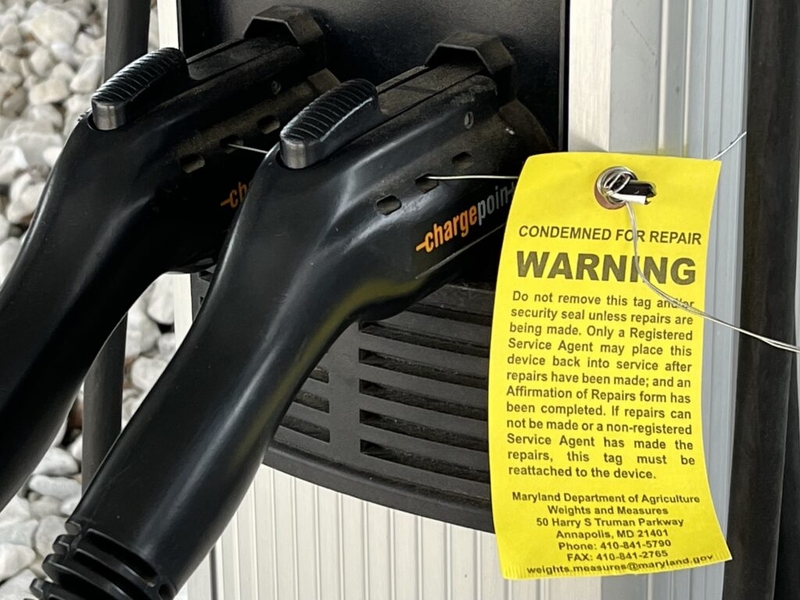
A Maryland Department of Agriculture Weights and Measures yellow tag and wire seal on an EV charger in Catonsville. (Photo by Lanny Hartmann)
Maryland officials are moving forward with a plan to require electric vehicle charger owners to register their devices with the state — and pay a fee — so that the chargers can be inspected.
State officials decided to lower the annual fee from $150 to $75 per charging port, after EV owners and charger companies expressed concerns earlier this year that the program could stymie the spread of chargers in Maryland. But some concerns linger.
“We’ve listened to the concerns, support and feedback shared by electric vehicle owners, local businesses and industry partners,” Maryland Agriculture Secretary Kevin Atticks said in a news release Thursday. “Reducing the registration fee allows us to continue supporting a reliable and accurate electric vehicle charging network while easing the cost for Maryland residents and businesses.”
Charger owners are required to register their ports with the Maryland Department of Agriculture using an online form no later than July 1, or they could face fines. The registration date was delayed about six months as the department worked to address concern from stakeholders.
The department, which already has a Weights and Measures program that inspects gas pumps and commercial scales for accuracy, will largely be testing EV chargers for accuracy, but will also be flagging inoperable or malfunctioning chargers along the way, officials have said. Some inspections have already begun.
In response to concerns, the department also issued clarifications about which chargers must be registered with the state. The registration requirement applies to any publicly available charger where a commercial transaction takes place, but chargers at private residences and free chargers are excluded.
But chargers in parking lots for apartment and condo complexes, or workplaces, must be fenced off or otherwise blocked from public access, marked for private use and must not be listed on public charging websites. Some EV advocates and charging companies have expressed worries that those stipulations may be hard to meet, and that buildings may choose to remove chargers rather than erecting barriers and paying the annual fees.
To conduct the accuracy testing, the state must purchase costly equipment called a “standard,” part of the reason for the $150 per port fee. But during this year’s General Assembly session, the Agriculture Department partnered with the Maryland Energy Administration to use renewable energy funds to cut the fees in half. The money will come from the Strategic Energy Investment Fund, which has burgeoned in recent years because Maryland’s electric utilities can bypass a requirement to purchase scarce solar energy credits by paying into it.
The fund has become a slight political flashpoint. Republicans in Annapolis have argued that the fund’s growth is representative of policy failures on renewable energy, and that the money should be returned to ratepayers, who essentially fuel the fund in the first place.
Annapolis, MD