Maryland leads states suing Education Department for ‘unlawful’ student loan cap
May 19, 2026 | 7:58 pm ET
Description
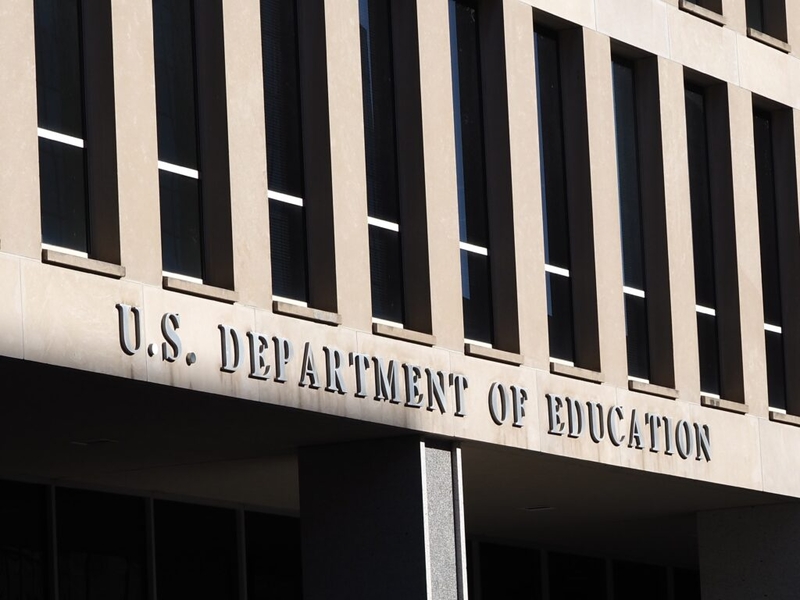
Maryland and 25 other Democratic jurisdictions say that new student borrowing limits set by the U.S. Department of Education violate the law, and will deter students from seeking advanced professional degrees. (Photo by Shauneen Miranda/States Newsroom)
Maryland is at the head of a lawsuit with 25 other Democratic jurisdictions that are challenging a new U.S. Department of Education rule that would limit loan access for students pursuing some graduate and professional degrees.
The suit, filed Tuesday in U.S. District Court in Baltimore, claims a final rule implemented May 1 by the department unlawfully narrows the definition of “professional degree” to exclude students in fields such as nursing, physician assistant and physical therapy.
The suit, which also names Education Secretary Linda McMahon as a defendant, charges that the rule change was done without congressional approval.
“This is just one of several unlawful limitations imposed by the Trump administration’s professional degree definition,” Maryland Attorney General Anthony Brown said in a video message on the suit.
“Federal student loans are a promise that graduate degrees can be within reach for anyone willing to do the work,” brown said. “The Trump administration broke that promise. We intend to make sure they keep it.”
A White House official defended the loan restrictions as an effort to rein in spiraling tuition costs, noting that borrowing was capped at $18,500 in 2006, but was the cap was lifted in 2007 in an attempt to help low-income students who may need to borrow more. Instead, the official said, the move has led to higher graduate school costs and deeper debt for students.
A Biden student loan plan has ended. Here’s what borrowers need to know.
“Fiscal responsibility is a top priority for the Trump Administration, which is why the One Big Beautiful Bill Act put commonsense caps on federal loans for graduate programs to drive down bloated tuition costs and help reduce student loan debt,” said Liz Huston, a White House spokesperson.
But the states claim that One, Big Beautiful Bill Act actually gives a broader definition of professional, and that the department’s rule violates that law.
Under the law, “graduate students” can borrow $20,500 a year, up to $100,000 total, while “professional students” can borrow $50,000 a year for a total of $200,000. That has real financial consequences for some students, the states say, and the schools that rely on their tuition.
“The university will suffer a loss of revenue if – as the Department concedes is likely – not all students can obtain private loans to cover the gap,” according to the complaint, which specifically cited the University of Maryland School of Nursing. “By limiting loans for certain advanced degrees, the rule will discourage students from pursuing those degrees and thereby reduce the supply of potential educators.”
When it approved the One, Big Beautiful Bill Act last year, Congress said that any student loans borrowed by June 30 of this year would be grandfathered into existing loan limits. The act, and its new caps, take effect July 1.
The lawsuit also claims the department’s rule would not protect students who transfer to another higher education institution, temporarily withdraw, or re-enroll in a previous program.
“That is both contrary to the statute and arbitrary and capricious,” according to the suit.
Brown is co-leading the lawsuit with attorneys general from Colorado, Nevada and New York. Other jurisdictions that are signed on to the suit are the District of Columbia and the states of Arizona, California, Connecticut, Delaware, Hawaii, Illinois, Kentucky, Maine, Massachusetts, Michigan, Minnesota, New Jersey, New Mexico, North Carolina, Oregon, Pennsylvania, Rhode Island, Vermont, Virginia, Washington and Wisconsin.
So far this year, Brown’s office has either led, co-led, or joined in slightly more than two dozen lawsuits and amicus briefs.
— This story was updated on Thursday, May 21, to remove a reference to the costs of the University of Maryland School of Nursing program.
Annapolis, MD