Tribal communities respond to reports of euthanized wolf pack
Oct 06, 2026 | 4:15 am ET
Description
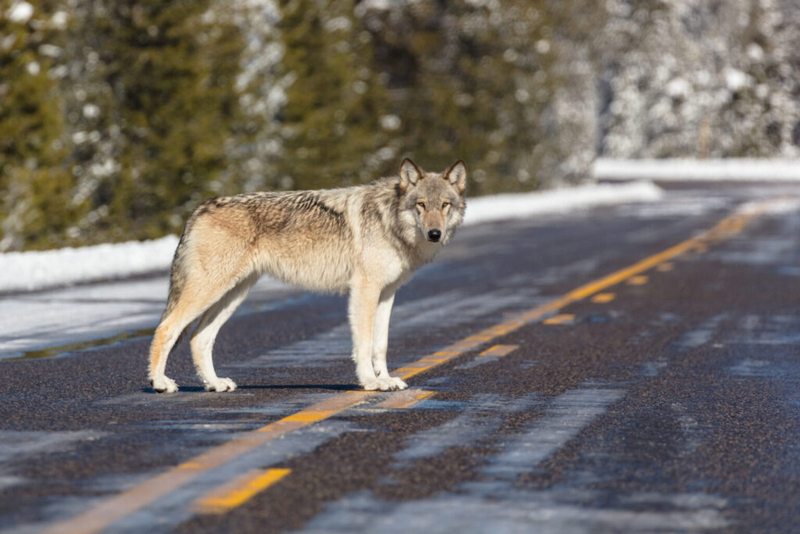
A wolf makes its way across a road in Yellowstone National Park. (Jacob W. Frank/Courtesy of the U.S. National Park Service)
The Great Lakes Indian Fish & Wildlife Commission is condemning what it calls a lack of communication between state agencies and tribal communities after nine wolves were trapped and euthanized in Price County. In a press release, the commission described the wolves as a pack consisting of four pups, three yearlings, and two adults.
“This action damages existing relationships and fractures trust,” said GLIFWC Executive Administrator Jason Schlender in a statement. The Wisconsin Department of Natural Resources said late last week that the wolves posed a threat to humans following incidents reported in July 2025 and August 2026. Non-lethal measures were unsuccessful in deterring the wolves, a DNR spokesperson said, according to Wisconsin Public Radio.
“We remind the WDNR and USDA Wildlife Services to involve GLIFWC and its member tribes in the decision-making process,” Schlender said in his statement. Wolves represent powerful symbols, spirits and teachers for many tribal communities. “Simply handing us the remains of our relatives after killing them does not constitute meaningful consultation.”
In 2021, when the DNR held a controversial wolf hunt, tribal communities opted not to hunt wolves on their lands. A quota of 200 wolves had been set by the DNR, a certain portion of which was allocated to tribal communities. Hunters in the rest of the state exceeded the quota in less than three days.
The killing of the nine wolves represents the first time wolves were killed by officials in Wisconsin since a 2022 court ruling returning the animals to the Endangered Species List.
Earlier this month, President Donald Trump signed an executive order to remove the gray wolf from the federal endangered species list.
Wolves have come into conflict with rural and farming communities in Wisconsin, killing livestock and pets and triggering a campaign to restart Wisconsin’s wolf hunt. Wolf attacks on humans are rare, and only two fatal wolf attacks on humans have been documented in the last 20 years.
Randy Johnson, the DNR’s large carnivore specialist, told the Milwaukee Journal Sentinel that efforts to chase off the wolves using sound, lights and hazing were unsuccessful, and that “reports demonstrated a pattern of behavioral escalation, with the wolves showing less response to hazing and more acclimation to human presence.”
Investigative reports obtained by the Wisconsin Examiner describe three separate complaints made in August. The complaints describe wolves, sometimes collared, coming within close proximity of properties, such as in yards, driveways, or grassy areas. One of the reports mentioned chicken depredations. Another report stated that a wolf had come within 20 yards of a man mowing brush on his tractor in an effort to deter the wolves. The third report mentioned a person who saw a wolf near five-gallon bait bucket for bears. The reports described the wolves as unafraid of people, and said efforts to deter them had been ineffective.
The Great Lakes Indian Fish & Wildlife Commission states that it was left out of the decision to euthanize the wolves, and that the Wisconsin DNR and federal government had met multiple times since 2025. “At no time during that period did WDNR or federal representatives contact GLIFWC staff to inform them of reported threats, share data, or provide decision-making criteria, bypassing consultation with GLIFWC and its member tribes,” the commission stated.
It added that courts have ruled that the state of Wisconsin is required to co-manage resources within ceded Indigenous territories, such as those where the nine wolves were killed. This cooperation was reaffirmed in an executive order from Gov. Tony Evers in 2019, directing state agencies to consult with tribal governments on “matters that may directly or indirectly impact tribal nations.”
The commission says in its statement that the gray wolf is known to the the Lake Superior Ojibwe as Ma’iingan, is considered a clan relative, and is a key cultural figure that has been mistreated and misunderstood.
“People are often afraid of wolves, and wolves are too often mischaracterized,” said Conrad St. John, St. Croix tribal chairman and Voigt Intertribal Task Force chair. “Our elders relay that our communities have co-existed with Ma’iingan since the very beginning and we still don’t have any documented cases of attacks on humans in Wisconsin.”
Alex Bohman, GLIFWC biological services director, said that wolves strengthen deer populations by removing sick, weak, or old animals. “Tribes have coexisted with wolves for hundreds of years and can bring traditional ecological knowledge, as well as western science and data to these discussions.” Bohman said that state and federal agencies should engage with the commission and its member tribes on wolf management. “Ideally, this will lead to agreement on the most appropriate course of action,” she said.
Madison, WI