Maryland lawmakers open limited window for public testimony on redistricting
Jul 29, 2026 | 2:31 pm ET
Description
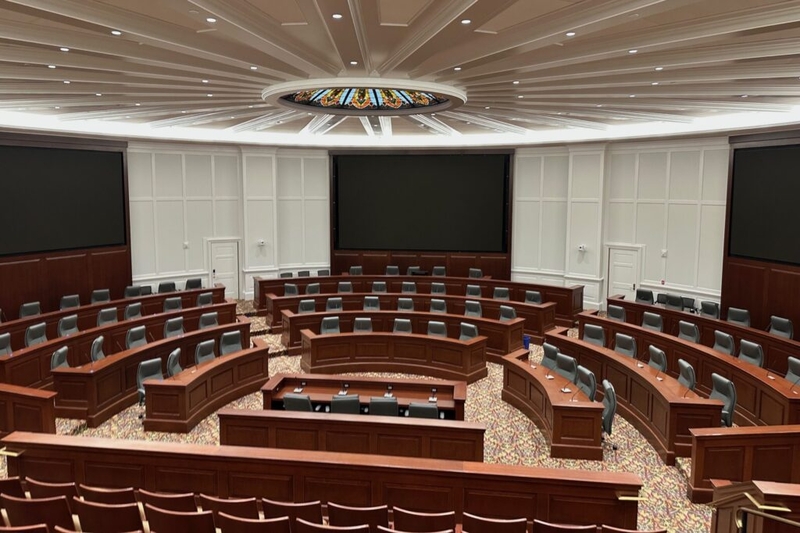
House and Senate lawmakers will convene in the Department of Legislative Services joint hearing room for Monday's redistricting debate. The room can seat two Senate and two House committees and over 200 people in the gallery. (Photo by Bryan P. Sears/Maryland Matters)
Marylanders looking to testify during next week’s special session on congressional redistricting will have their chance Monday afternoon, but speakers will be limited and sign-up must be done in advance.
Those are among the rules released Wednesday by legislative leaders ahead of the Aug. 3-5 special session, where lawmakers will consider adding a question to the November ballot asking voters whether they would like to change Maryland’s procedure for congressional redistricting.
The short session will feature a joint hearing by House and Senate election committees at noon Monday in Annapolis. Anyone can submit written testimony but a total of only 50 witnesses will be allowed to speak – virtually or in person – and they will be limited to two minutes each.
Marylanders looking to testify Monday must sign up on the General Assembly website between 8 a.m. and 6 p.m. Friday, by first making a “MyMGA” account on the site, according to an update posted to the website Wednesday. If more than 50 people sign up to speak, the committee chairs will decide who gets the microphone.
Just one bill is expected to be considered next week, and legislative leaders posted identical House and Senate versions of the bill Wednesday that included language for a potential ballot question.
If approved, the question would essentially overturn a 2022 decision from a Maryland judge that required congressional districts to be “compact, contiguous and mindful of jurisdictional and geographic boundaries.” The measure, if passed, would clarify that this requirement only applies to General Assembly districts, and it would send Maryland’s districts directly to the state Supreme Court for legal review.
Any redistricting changes could not take effect before the 2028 election.
House, Senate leaders draw hard line on special session topics
A map passed by the House this past legislative session, which stalled in the Senate, would have connected the red Eastern Shore to blue Annapolis, bridging the Chesapeake Bay. If a map similar to that one is ultimately enacted, it’s possible that enough Democratic voters would be added to flip the firmly GOP district, currently represented by Rep. Andy Harris (R-1st) — Maryland’s only Republican representative in Congress.
It’s possible that other redistricting bills could be discussed at the joint hearing, but Senate President Bill Ferguson (D-Baltimore City) and House Speaker Joseline Peña-Melnyk (D-Prince George’s and Anne Arundel) have explicitly barred bills on other subjects. They directed legislative staffers not to draft bills that do not focus on redistricting, to the chagrin of Republican members, who were aiming to introduce several bills focused on affordability issues.
Maryland Republicans have attacked the redistricting push as an effort to eliminate the only representation in Congress for Maryland Republicans. But Maryland Democrats, who control both chambers in the General Assembly, say they are only responding to congressional redistricting in red states, pushed by President Donald Trump (R) to redraw their districts before the next Census in order to benefit the GOP during this year’s mid-term elections.
Though Maryland Gov. Wes Moore (D) campaigned hard for redistricting, and a map sailed through the House of Delegates, the idea did not reach the Senate floor. Ferguson was a staunch opponent, arguing that the redistricting plan was legally perilous.
He cited a 2022 decision by Judge Lynne Battaglia that overturned the legislature’s 2021 map, on the grounds that it did not comply with the “compact and contiguous” requirement. Prior to her ruling, the requirement was believed only to apply to General Assembly districts, not congressional districts.
But Ferguson reversed course in late April, shortly after the legislature adjourned, after the U.S. Supreme Court issued its decision in Louisiana v. Callais, finding that congressional districts drawn to consider race were unconstitutional. Ferguson felt that decision “gutted the Voting Rights Act.”
“Maryland must respond as the ground shifts under us,” Ferguson said in a statement at the time, signalling his intent to evaluate a special session on the topic for the first time.
— This story was updated at 3 p.m. on Wednesday, July 29, to include the proposed legislation.
Annapolis, MD