Many girls, young women try to avoid pregnancy after sex with unproven methods
Nov 02, 2026 | 3:24 pm ET
Description
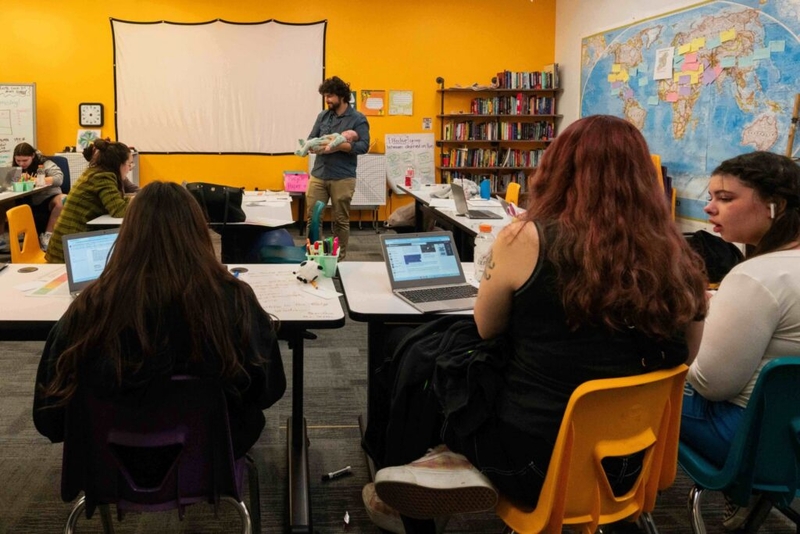
A teacher holds a student’s baby while his class completes coursework at a high school for young parents in Spokane, Wash. A new study finds that many girls and young women try to avoid pregnancy after sex with unproven methods. (Photo by Camilla Forte/The Hechinger Report)
To prevent pregnancy after sex, U.S. teenage girls and young women are more likely to rely on unproven strategies such as prayer, exercise and jumping up and down than they are on evidence-based methods such as Plan B emergency contraception, according to a new study.
The study, published in The Journal of Sex Research, is based on a survey of 1,259 girls and women between the ages of 15-29. A quarter of the 633 respondents who reported having sexual intercourse and were not pregnant said they had used a post-coital method to prevent pregnancy.
Of those, about 9% said they’d used evidence-based emergency birth control such as Plan B or a copper intrauterine device.
But about 16% used methods without proven efficacy, including prayer (9.4%), douching (6%), jumping up and down or exercising (3.3%), ingesting something by mouth (1.9%), punching one’s stomach or uterus (1.4%), taking medicine or vitamins (0.9%), inserting something vaginally (0.5%), or using an enema (0.2%). About one-fifth of this group used more than one method — praying and douching being the most common combination.
These types of methods were more common among minors and non-white respondents.
“There is a need to better understand what is underlying these practices or the use of these strategies,” said Riley J. Steiner, an associate professor at the University of Pittsburgh School of Medicine and one of the authors of the study.
“We really don’t want young people to be seen as misguided or to be judged for these practices,” she said. “They’re trying things, and so how do we best support them to meet what their goals are?”
The release of the study comes on the heels of the Trump administration cutting and reshaping programs such as Title X and the Teen Pregnancy Prevention Program, created to lower the rate of unintended pregnancy and to inform people of safe and effective options for preventing pregnancy.
In August, a federal judge blocked the U.S. Department of Health and Human Services from implementing sweeping changes to grants under the Teen Pregnancy Prevention Program, amid an ongoing lawsuit brought by Hennepin County, Minnesota; King County, Washington; an Iowa Planned Parenthood affiliate; and SIECUS: Sex Ed for Social Change, a nonprofit advocacy group. However, grant funding that has already been cut won’t be restored for now, the judge ruled.
The Trump administration has cast doubt on the safety of hormonal contraception, which is increasingly perceived as controversial on social media.
“In our current environment where there’s a lot of mis- and disinformation online and structural constraints that make it hard to access medically evidenced contraceptive methods, it does make sense that people are behaving in broader ways to try to manage that risk,” Steiner said.
But she also noted that the study found the lack of information on contraceptive methods was more likely to drive people to choose post-coital methods rather than concerns about hormones or an inability to obtain clinical care.
Meanwhile, sex education varies widely across the country. And this year several states modified their sex education policies, according to an analysis by SIECUS.
In Alabama, Republican Gov. Kay Ivey signed a law requiring sex education to be focused on promoting “sexual risk avoidance,” updated terminology for “abstinence-only” instruction. The law prohibits sex education before fourth grade and prohibits school districts from partnering with organizations that do not promote “sexual risk avoidance,” as well as organizations that provide or promote abortion.
Instructors are prohibited from teaching students about birth control, but parents can opt out of sex education classes.
Federal judge halts proposed HHS changes to teen pregnancy prevention program
Currently, 15 states offer abstinence-only sex education, according to SIECUS.
In Wisconsin, Democratic Gov. Tony Evers signed a law requiring instruction on adoption as part of sex education. In Arizona, Democratic Gov. Katie Hobbs vetoed a bill that would have required instruction on adoption and newborn safe-haven laws whenever contraception or sexually transmitted infections are mentioned. The state already requires instruction to refer to adoption and parenting as the “preferred choice” over abortion.
Three states – Alabama, Louisiana and South Dakota – enacted laws requiring or requesting instruction on fetal development in schools or the viewing of a fetal ultrasound or animated video, such as the “Baby Olivia” video developed by anti-abortion groups.
In California, Democratic Gov. Gavin Newsom signed bills requiring instruction on human trafficking and dating abuse and digital violence.
Stateline reporter Sofia Resnick can be reached at [email protected].