Mainers’ grand bargain
Sep 09, 2026 | 12:14 pm ET
Description
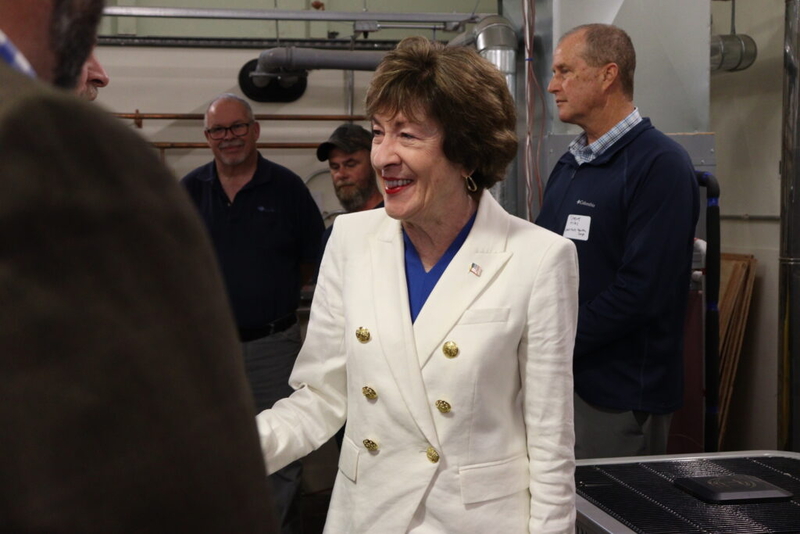
Republican U.S. Sen. Susan Collins of Maine tours the Maine Energy Marketers Association Technical Education Center in Brunswick on Sept. 3, 2026. (Photo by Emma Davis/ Maine Morning Star)
As the only Senate Republican representing a state that has voted three times against President Donald Trump, U.S. Sen. Susan Collins is once again amplifying her power as a chief appropriator who delivers outsized earmarks for the state.
She has also positioned herself as a bulwark, protecting Mainers from Trump’s dramatic cuts to government programs as well as his fierce cruelty towards political opponents and vulnerable populations.
As she seeks re-election, Collins is arguing that her presence in the U.S. Senate protects her constituents from a regime that she supports 95% of the time and when Mainers head to the polls in November, they are largely voting on whether her seniority and the privileges and protections it affords the state is worth the cost to the rest of the nation.
Collins as protector
“I focus on results, not rhetoric,” Collins told Maine Morning Star in an interview last year when asked about calls for her to more publicly challenge some of the actions of the White House, touting the success she’s had behind the scenes.
“Because I have these relationships with the president’s Chief of Staff Susie Wiles and with Cabinet members, I have been able to restore funding that was in jeopardy,” Collins said.
Collins used that influence as Maine became a frequent target of Trump’s second administration after Gov. Janet Mills’ heated exchange with the president over the state’s transgender protections.
For example, Collins said she consulted with the Trump administration to restore the U.S. Department of Agriculture grants to the University of Maine, renegotiate the Maine Sea Grant, and reverse the cancellation of a decades-old program that allows parents to register their newborns for a Social Security number while at hospitals.
She also took credit for the end of the U.S. Immigration and Customs Enforcement surge in January.
“I have been urging Secretary Noem and others in the Administration to get ICE to reconsider its approach to immigration enforcement in the state,” she wrote on X on Jan. 29. “I appreciate the Secretary’s willingness to listen to and consider my recommendations and her personal attention to the situation in Maine.”
The Press Herald later reported that beginning on Jan. 22 federal authorities were planning to leave the state because of a pending snowstorm. And in the months that followed, federal agents continued to arrest and deport Maine residents, the vast majority of whom had no criminal record, though in a less confrontational manner.
Collins as appropriator
Collins’ influence as chair of the Senate Appropriations Committee is cited by many of her supporters as the main reason for their vote, particularly when it comes to securing funding for the state.
As the Morning Star previously reported, Collins has secured more than $1 billion for Maine since 2022, when Congress reinstated earmarks. During the most recent cycle, Maine received the second highest allocation of federal funding per capita in the country, securing $460 million for roughly 200 projects across the state.
Though Collins’ congressional colleagues, including U.S. Rep. Chellie Pingree, who is a senior member of the House Appropriations Committee, also secured millions in funding, many projects are attached to Collins and publicized by her office.
During the latest congressional recess, Collins visited a childcare center in Bangor, a defense manufacturer in Biddeford, a bridge dedication in Millinocket, a lobster pound in St. George, as well as a crisis care center and affordable housing development in Calais. She christened the launch of a 3D-printed boat at the University of Maine and signed a truss for the new Kenduskeag Public Library — all to tout investments that she requested or secured in recent years.
The senator works hard for the people of Maine and her team makes sure we know it.
And that pork does come at a cost. Under Republican rule, Congress and the White House have taken an ax to spending on healthcare and social programs that predominantly support vulnerable populations, which is already having a ripple effect on state budgets, including Maine’s.
Collins as moderate
Collins has frequently brandished her reputation as the most bipartisan senator to distance herself from the more disgraceful actions of her party.
Supporters like to characterize the senator as a “thorn in the president’s side,” with one letter to the editor using the example of her opposition to Todd Blanche, Trump’s former criminal defense lawyer. But like many of Collins’ opposing votes, it did not stop him from being confirmed as attorney general.
The Bangor Daily News’ recent analysis of times Collins cast the deciding vote found that, even though she does break from her party more than any other senator, it very rarely results in an outcome that’s in the Democrats’ favor, and among the 56 times she did, roughly half were before the first Trump administration. The analysis also weighs each vote equally, and so fails to account for the significance or impact of the legislation passed or blocked by Collins.
Which leads me to her very high profile 2018 vote in support of Brett Kavanaugh’s confirmation to the U.S. Supreme Court, which she has said she does not regret, despite it ultimately leading to the repeal of the federal right to an abortion. That act had a devastating impact on women’s health, rights, access to reproductive care, and economic opportunities across the country. Democrats won’t stop talking about that vote in relation to Collins because it was a time she could have wielded her power in defense of issues she purports to care about, but chose not to.
Perhaps if the impact was closer to home, if Maine residents weren’t protected by the state’s strong abortion protections, Collins would feel differently.
The solidarity vote

Ultimately, Collins is banking on Maine’s swing voters opting for what they see as local interest — money for firetrucks, a direct line to Cabinet members when the state is under threat — over Democrats winning control of the Senate, which would significantly curtail Trump’s agenda.
And while it is an understandable impulse in this moment of precariousness and scarcity, it stands in contrast with a wider view of mutual caring and support that extends beyond the boundaries of Maine.
Solidarity is the notion that you are not just fighting for your own betterment, but others’ as well, and only by joining together in a struggle can you build enough power to win. In local parlance, a rising tide lifts all boats.
Collins’ opponent, Troy Jackson, has made this idea his personal motto (and campaign merch). As part of his Solidarity Forever tour, the Democratic nominee is currently driving around the state in a minivan with those words affixed to the exterior, frequently donning t-shirts amplifying the call long associated with the labor movement.
For Jackson — who came to politics by helping lead a blockade near the Maine-Quebec border to stop logging companies from hiring cheaper labor and depressing wages and who spent 20 years in the Maine Legislature working to pass stronger labor protections, increase access to childcare and lower drug costs — solidarity is “a lifestyle, not a slogan.”
“I learned a long time ago that working people can win fights that nobody expects us to win when we stand together and when the people we elect remember whose side they’re supposed to be on,” Jackson told the audience at the annual Southern Maine Labor Council’s Labor Day event in Portland on Monday.
Maine voters, particularly the 40,000 or so who have previously backed Collins but not Trump, will in many ways be deciding on how they want to approach the remainder of his presidency — whether that is linking arms and demanding change for everyone or capitalizing on power and access in the hope of shielding the state.
But whether it is measles or skyrocketing oil prices or foreign corruption or unregulated AI or fascist extremism (the list goes on!), the threats of this presidency know no bounds.
Augusta, ME