Maine GOP lawmakers push suite of bills targeting trans students amid federal scrutiny
May 07, 2025 | 4:17 pm ET
Description
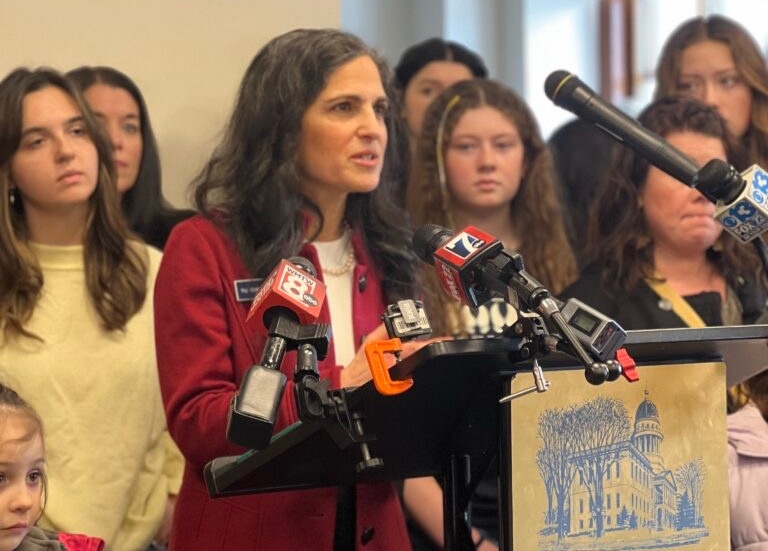
Rep. Elizabeth Caruso of Caratunk touted her proposal to bar transgender girls from competing in sports that align with their gender identity as a women’s rights issue during a March 2025 press conference. (Photo by Eesha Pendharkar/ Maine Morning Star)
While Maine has so far remained steadfast in defending the rights of transgender students, state Republican lawmakers are pushing to roll back many of those protections — including access to bathrooms and locker rooms, participation in school athletics, and the use of affirming pronouns.
At least 28 other states, led by Republican majorities, have enacted one or more of these restrictions, according to the Movement Advancement Project, which tracks thousands of anti-LGBTQ+ bills and laws nationwide. So far, Maine has stood apart, successfully safeguarding transgender students’ rights — even prevailing in federal court, where a judge ordered the U.S. Department of Agriculture last week to resume funding it had frozen over the state’s inclusive policies.
The months-long standoff between the state and federal government began after Rep. Laurel Libby (R-Auburn) posted a photo of a trans student athlete on her legislative Facebook page. That post went viral and soon thereafter President Donald Trump singled out Maine for its policy allowing trans girls to participate in girls’ sports, prompting Gov. Janet Mills to tell the president she would see him in court.
Since that exchange, at least three federal agencies opened investigations into Maine, claiming the state’s inclusion of transgender athletes violated Title IX. While on the federal level, Mills has defended Maine’s Human Rights Act, which protects people from discrimination based on gender identity, she has also said the issue is “worthy of debate” on the state level. And internal communications obtained by the Maine Morning Star show staff from the Maine Attorney General’s office flagged two proposed anti-trans bills to the U.S. Department of Health and Human Services.
Amid this federal scrutiny, those two bills — along with six others — are scheduled for a public hearing on Thursday.
‘This is about more than sports’: The real stakes for trans athletes
The bills threaten to “roll back civil rights, ban transgender girls from participating on girls’ sports teams, and open the door to harassment, bullying and abuse of all youth,” said Gia Drew, executive director of Equality Maine, in a statement about the legislation.
“Every student should have the freedom to be themselves, to be safe, and to feel respected at school.”
Four bills about trans athletes and school bathrooms
The two bills flagged for the Trump administration, LD 868 and LD 233, were sponsored by Republican Reps. Elizabeth Caruso of Caratunk and Dick Campbell of Orrington.
Campbell’s bill introduces a blanket ban on “allowing a person whose biological sex assigned at birth is male” to participate in a girls athletic program. Caruso’s bill is broader; allowing for a co-ed program, but also restricting access to bathrooms and locker rooms for trans girls.
A third bill, LD 1134 introduced by Sen. Susan Bernard (R-Aroostook), similarly bans transgender girls from accessing girls athletics, school facilities and bathrooms.
During a press conference in March, Caruso, Assistant House Minority Leader Katrina Smith of Palermo and Libby, who posted the photo of the trans athlete, touted the proposals as a women’s rights issue, arguing they are essential to “protect girls” from losing to or being harmed by trans girls.
In addition to cosponsoring Bernard’s bill, Smith also introduced legislation, LD 1704, specifically focused on banning school districts from adopting policies that allow students to use bathrooms aligned with their gender identity (as opposed to sex assigned at birth). Her bill also directs the Maine Department of Education to update its rules to reflect this change.
Broader bills impacting Maine Human Rights Act
Two bills specifically seek to weaken the Maine Human Rights Act, which was amended in 2021 to explicitly protect people from discrimination based on their gender identity. Caruso also introduced LD 1337, which would amend the provisions in the Maine Human Rights Act that govern unlawful educational discrimination “to provide that they may not be construed to affect the rights of a female athlete” under Title IX. Title IX does not mention transgender students, so Caruso’s bill is relying on the Trump administration’s interpretation of the federal law. Caruso’s bill would also exempt privately-run women’s shelters from the human rights law.
In a press conference last month, Rep. Michael Soboleski (R-Phillips) announced his bill, LD 1432, which would remove consideration of gender identity from the human rights act. During that event, Republicans called on Democrats and Mills to pass the bill to avoid the risk of losing federal funding.

“The problem is that the term gender identity and the Human Rights Act is being interpreted way too broadly by the left,” said Senate Minority Leader Trey Stewart (R-Aroostook). “And what it’s saying is there’s no boundary between men’s and women’s spaces.”
Earlier this year, Iowa became the first state in the nation to remove civil rights from a state law when its legislature voted to remove gender identity from its civil rights act.
But Maine has protected trans people from discrimination in court for years before gender identity was added as a protected class, Drew from Equality Maine said.
“To some people, it may seem like gender identity as a protected class is this new idea or concept, but it really isn’t,” she said.
“It’s been really part of the conversations since 2005 at least, and it’s been tested multiple times in the courts,” Drew added, pointing to several cases including the landmark 2014 ruling by the Maine Supreme Judicial Court, which found that denying a transgender girl access to the girls’ restroom at her school violated her rights under Maine’s Human Rights Act.
Bill to ban students from using affirming pronouns
Rep. Sheila Lyman (R-Livermore Falls), a retired teacher and member of the Education Committee, introduced legislation aiming to mandate that educators in public and charter schools refer to a student by the name and gender listed on their birth certificate.
The only exception schools can make under Lyman’s proposal, LD 1002, would be if upon a student’s enrollment, a parent or guardian provides written permission or documentation showing a legal name change.
Pronoun bans are also common across the country in Republican-led states, with some extreme versions such as Florida’s law that criminalizes the use of affirming pronouns.
The Maine Department of Education has encouraged districts to develop policies affirming LGBTQ+ students, including honoring their pronouns.
Augusta, ME