A look at who could be SC’s next agriculture chief
Oct 16, 2026 | 4:00 am ET
Description
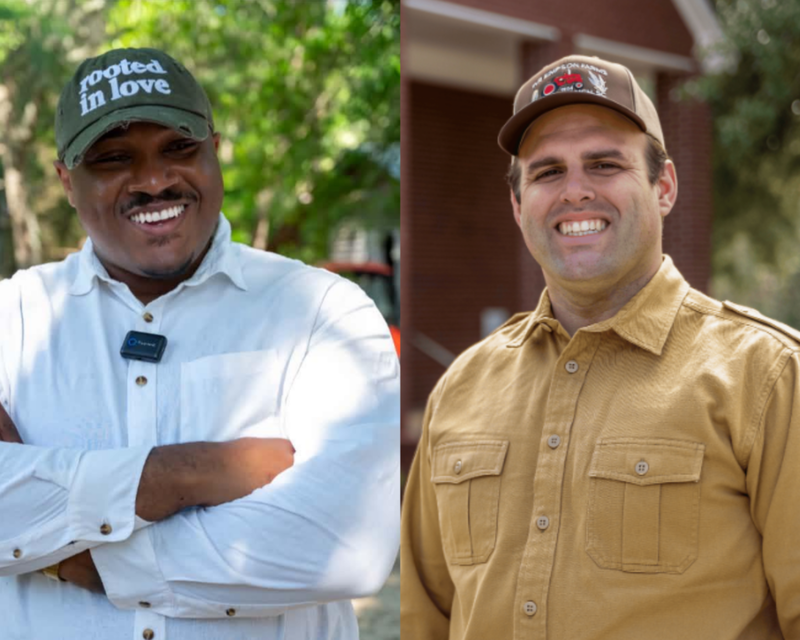
Democrat DeShawn Blanding (right) and Republican Cody Simpson (left) are each running to be the next South Carolina agriculture committee. (Photos courtesy of the Blanding and Simpson campaigns)
COLUMBIA — The race to be South Carolina’s next agriculture commissioner features a Republican with a background in state government who’s backed by President Donald Trump and a Democrat with federal government experience who touts a willingness to buck the administration.
Both nominees hail from rural Clarendon County. But their paths diverge.
Republican Cody Simpson is a fifth-generation farmer who left the fields to become Gov. Henry McMaster’s agriculture adviser until his May 2025 appointment as the U.S. Department of Agriculture Farm Service Agency’s executive director for South Carolina. It’s a long title he shortened to “Trump’s farmer in South Carolina.”
Democrat DeShawn Blanding, a former staffer for agriculture committees in the U.S. House and U.S. Senate, is working to restart his family farm that skipped a generation.
Whoever wins Nov. 3 will be the first new commissioner in 22 years, replacing Republican Hugh Weathers of Orangeburg County, who said four years ago he’d retire at the end of this term.
The commissioner is chief advocate for the more than 22,600 farms statewide. While South Carolina lost its status as primarily agrarian decades ago, agribusiness — a combination of agriculture and forestry — remains South Carolina’s No. 1 industry, accounting for nearly 260,000 jobs, according to the state Department of Agriculture the commissioner oversees.
The agency’s duties include promoting the state’s various agribusiness sectors, keeping the food supply safe, and — since 2024 — handling all inspections of places that sell food, such as restaurants and cafeterias.
The job entails more than people realize, Blanding said.
“Farmer advocacy is a key part of it, but this entire food system is the commissioner of agriculture,” he said. “This is about a food supply chain — about the food, fiber and fuel that we need to sustain ourselves.”
Both Simpson, 35, and Blanding, 29, say a top priority will be protecting South Carolina’s farmland from encroaching development.
“We’ve got to have a farm to come back to,” Simpson said. “We have to protect our farms, our families, and our future.”
The state has lost about 1,900 farms in the last two decades, according to the U.S. Department of Agriculture. And a 2022 report by American Farmland Trust, titled “Farms Under Threat,” gave South Carolina the nation’s eighth-worst threat ranking.
Both nominees’ proposals to reverse that trend in the nation’s fastest-growing state include preserving more land through the state’s Working Farmland Protection Fund, created by state law in 2024. This year’s state budget puts $10 million toward that effort, following $12 million last year, and $3 million in the launch year.
Here’s a look at differences in the nominees’ backgrounds and platforms:
Blanding
Blanding, who became the nominee without a primary opponent, is the president and founding partner of the consulting firm AgQuity Solutions.
The Manning native left South Carolina after high school, first to get his bachelor’s at North Carolina Agricultural and Technical State University, then to Washington, D.C., to earn a master’s degree from George Washington University. He stayed in the nation’s capital to work for congressional agriculture committees, as well as stints with two nonprofits: the Union of Concerned Scientists and the Rural Coalition.
He moved back home in 2024 to care for family and restart his family’s former farm.
Blanding said his grandfather, a fourth-generation farmer, discouraged his children from continuing the family tradition due to discrimination he faced as a Black farmer, including struggling to get loans and being offered lower prices for his products than white farmers. When he died in the 1990s, the family sold their livestock and farming equipment.
But Blanding and his father have worked over the last year to farm again on 5 acres. He’s working to clear the land to plant specialty crops and raise cattle.
His personal experience is why he wants the Department of Agriculture to be of more help to historically disadvantaged farmers, including small farms and Black farmers.
His “Growing Together” policy proposal includes putting a so-called “navigator” in each county to help farmers cut through bureaucracy, keeping food processing and packaging in South Carolina, and hiring more food inspectors.
Programs Weathers started that he wants to build on include the Growing Agribusiness Fund, launched in 2023 with a $40 million allocation in the state budget. This year, legislators put an additional $20 million into the initiative. And he has a specific goal for farmland preservation: 40% more land protected by 2040.
“Where our campaign is really trying to focus on is smoothing out processes, filling in a lot of those gaps, and then more importantly, making the South Carolina Department of Agriculture a primary resource for our farmers and our agricultural system, and not a secondary resource to the U.S. Department of Agriculture,” Blanding said.
Unlike his opponent, he said, he’s willing to publicly criticize the Trump administration when policies harm farmers, such as rising diesel costs due to the war with Iran.
And he touts his experience in both writing and advising agriculture policy.
Simpson
Simpson, who won a four-way GOP primary, contends he can better help farmers by working with the Trump administration and ensuring the federal government understands their needs.
He left his appointed federal job and jumped into the race in February after both McMaster and Trump gave a preliminary endorsement.
A social media post from Trump encouraging him to run concluded with “RUN, CODY, RUN!” Two weeks later, he announced his bid. He then quickly broke fundraising records for the unusually competitive down-ballot race.
That fundraising has enabled him to get his message on TV.
“We’ll encourage South Carolina-grown in every grocery store,” he says in an ad titled “From the Pump to the Plate,” released last week.
“And I’m going to make sure every gallon you pump is accurate,” he says, referring to the agency’s job to inspect and certify gas pumps.
Simpson, who has bachelor’s and master’s degrees from Francis Marion University, joined McMaster’s office in 2018 after volunteering for his gubernatorial campaigns since 2010.
Though he lives in Columbia, he still helps out at his family farm during harvests in the unincorporated Home Branch community in Clarendon County.
His plans for modernizing the agency include putting licensing and permitting systems online, auditing all existing programs, and adding an office focused on disaster preparedness and recovery.
He also wants to assist farmers in getting USDA certifications that enable them to sell their products in more markets and host roundtable discussions with chefs and waiters about their needs.
“We want to return their voice,” Simpson said. “Cutting this red tape and bureaucracy, in order to do that, you’ve got to talk to people. You got to talk to the people that are doing it every day, and I’m not talking just about the business owners.”
He also supports legislation that would ban citizens from China or any other country the U.S. labels a “foreign adversary” (also Russia, North Korea, Iran and Cuba) from buying farmland in South Carolina.
A proposal not specific to farmland passed the state Senate in 2023, but that bill died in 2024 without the House taking it up. Similar legislation passed the House earlier this year but died with the end of session without a vote in the Senate.
The election
The Nov. 3 ballot includes two minor-party candidates: Libertarian Michael Sullens of Anderson and Chris Nelums of Columbia for the United Citizens Party.
A Democrat hasn’t won the seat since Leslie Tindal, who switched his party affiliation during his third term to Republican. He was first elected in 1982 and served until 2002.
Columbia