Crowley says he would repeal data center tax subsidies, regulate AI and social media
Oct 16, 2026 | 4:30 am ET

Description
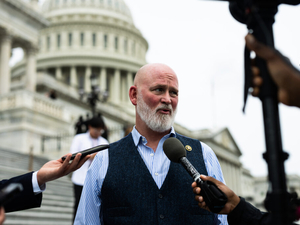
Crowley at a press conference in Madison in August 2026. (Photo by Baylor Spears/Wisconsin Examiner)
Democratic gubernatorial candidate and Milwaukee County Executive David Crowley said he would sign a bill to repeal tax incentives for data centers if he’s elected, marking a change in his position on the issue.
Gov. Tony Evers and Wisconsin Republicans approved a provision during the 2023 state budget that exempts data center developers from paying sales and use taxes for the “sale of property and equipment to construct, renovate or operate data centers.” The policy is estimated to have already saved data center developers $1.5 billion.
However, as data centers have become increasingly unpopular, Democrats and Republicans alike have changed their minds on providing these subsidies.
A group of Republican lawmakers, some of whom voted for the budget that created the tax subsidies in 2023, introduced a bill earlier this month that would repeal the tax breaks, though the bill won’t go anywhere as the Legislature is out of session.
Crowley said he would “absolutely” sign that bill to repeal the tax subsidies if it were sent to him as governor during an event at the Overture Center on Wednesday evening.
“The fact that these tech companies are getting a billion dollars in tax breaks — it’s being delivered on the backs of hard-working families,” Crowley said. “I want to be very clear about my position. We’re going to be aggressive when it comes down to holding data centers to account, making sure that we protect our land, protect our water, have strict environmental standards, but also communities need to have a seat at the table.”
Crowley had previously been noncommittal when it came to repealing the tax benefit for data centers. He told the Milwaukee Journal Sentinel that he did not “believe Wisconsin should automatically roll back all data center tax incentives” but that he believed that the state needed “a more rigorous review of whether taxpayers are receiving sufficient value for the incentives being provided.”
Republican candidate and U.S. Rep. Tom Tiffany had previously criticized Crowley’s position on the tax incentives, saying that he wanted to give “a blank check to data centers” and that data centers “do not need to be subsidized by us, the taxpayers.” Tiffany has not always been a champion of tough regulation on data centers, either. He previously voted for legislation in Congress that would have banned state and local governments across the country from being able to enforce laws or regulations on AI models, systems, and related digital infrastructure, including data centers, for 10 years.
Crowley’s changing position comes with less than three weeks left until Election Day and as data centers and AI continue to be unpopular across the political spectrum. A September Marquette Law School poll found that 74% of Wisconsinites say the costs of data centers outweigh the benefits.
This week Crowley laid out an 11-point policy plan for restricting and regulating AI and social media companies. The policies include:
- Requiring platforms to set kids’ accounts and new accounts to the highest privacy setting and cut off unsolicited messages. Users over 18 would have the option to turn the restrictions off.
- Prohibiting infinite scroll, autoplay and other addictive features for minors’ accounts as well as a ban on push notification for the users overnight and during the school day.
- Banning surveillance advertising.
- Allowing parents the option to sue platforms over design choices that harm a child including content promoting suicide, eating disorders and drug sales
- Regulating AI chatbots by restricting them for users under 13, prohibiting chatbots from posing as doctors and therapists and requiring disclosures on AI chatbots designed to form emotional bonds with individuals
- Increasing the penalties for online predators and sextortion and implementing those same penalties for creating or sharing AI-generated sexual images of children
- Penalizing companies that knowingly make money from scam ads
- Requiring identification verification for advertisers before they can place ads
- Requiring platforms to implement a scam reporting tool that’s easy to use and requiring that they confirm the reports and report the action that they took within a set timeframe
- Funding the state Department of Justice and the Department of Agriculture, Trade and Consumer Protection to support their work to combat online fraud and enforce anti-trust law
- Investing in county and tribal adult protective services and aging and disability resource centers, so victims of scams have support to recover
Crowley said during the Wednesday evening event that the state needs to do something in the absence of the Trump administration and Congress taking action.
“It’s unfortunate that the federal government has actually not put in these guardrails to protect our young people, protect our families, but also to protect our seniors,” Crowley said. “Look, I’m a father, I have three daughters and I want to make sure I can protect my girls from these chatbots. You have, you know, social media platforms that allow them to chat about sexuality. That’s not what I want my 9 and 7-year-old to be introduced to. My oldest right now is a freshman at Whitewater. I don’t want her having pictures out there, and all of a sudden, she can’t be protected.”
Crowley said the policies are aimed at putting the burdens on the tech, social media and AI companies, rather than on individuals.
Tiffany also supports some guardrails for these companies. He said in a statement to the Examiner that the state needs “common sense guardrails that protect children and seniors, safeguard personal privacy, and prevent sensitive data from falling into the hands of foreign adversaries, including Communist China.” His campaign noted that in Congress Tiffany cosponsored a law aimed at strengthening law enforcement’s ability to investigate financial fraud targeting seniors. The legislation covered scams involving AI.
“We cannot allow artificial intelligence to become another tool for harvesting Americans’ personal information or exploiting vulnerable individuals. We must hold Big Tech accountable when its platforms enable the creation of sexually explicit AI-generated images of children or expose minors to sexually inappropriate chatbot conversations,” Tiffany said.
Tiffany said he would support imposing age verification requirements for app providers, strengthening parental consent protections and “give parents greater control over their children’s online activity.”
Madison, WI