Listen again: All of Searchlight Report’s candidate and ballot-question interviews
Oct 30, 2026 | 12:30 pm ET
Description
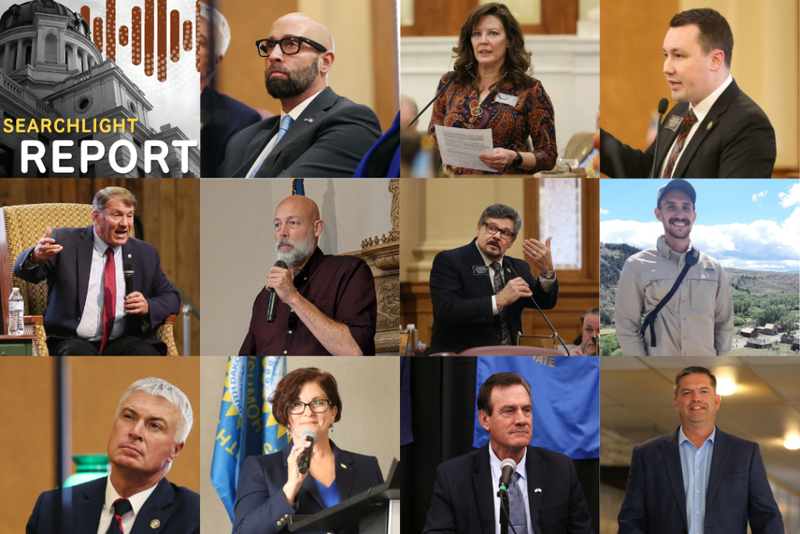
Recent episodes of the Searchlight Report podcast have featured interviews with candidates and people involved in ballot-question campaigns. That includes, from top left, South Dakota State Treasurer Josh Haeder, state Sen. Taffy Howard, R-Rapid City, state Rep. Erik Muckey, D-Sioux Falls; from middle left, U.S. Sen. Mike Rounds, R-South Dakota, independent U.S. Senate candidate Brian Bengs, state Rep. John Hughes, R-Sioux Falls, Dakota Rural Action Organizer Chase Jensen; and from bottom left, South Dakota Republican Attorney General Marty Jackley, Democratic U.S. House candidate Nikki Gronli, Republican Gov. Larry Rhoden, and Democratic nominee for governor Dan Ahlers. (Photos by South Dakota Searchlight; Chase Jensen photo courtesy of Dakota Rural Action)
Throughout this campaign season, Searchlight Report podcast episodes have featured interviews with candidates for major statewide offices and people from each side of the four statewide ballot questions.
With Election Day looming on Tuesday, see below for all of those interviews with candidates for governor, U.S. Senate and U.S. House, and pro and con voices on Amendments I, J, K and L.
For more information on other statewide and legislative races, see South Dakota Searchlight’s online Voter Guide.
Governor race
Republican Gov. Larry Rhoden is seeking his own full term in the state’s top office after being elevated from lieutenant governor when then-Gov. Kristi Noem resigned early last year to serve in President Donald Trump’s administration. Rhoden was one of four Republicans running for his party’s nomination during a primary election earlier this year, which was when he was interviewed for Searchlight Report. The primary race resulted in a top-two runoff election, which Rhoden won.
Rhoden is facing Democratic nominee Dan Ahlers, a businessman and former legislator from Dell Rapids.
Check out these episodes of Searchlight Report to learn more about Ahlers’ and Rhoden’s policy priorities, and to hear a recap of their debate hosted by South Dakota Public Broadcasting and South Dakota News Watch.
U.S. Senate
Republican U.S. Sen. Mike Rounds is seeking reelection to a third term as one of two of South Dakota’s U.S. senators. He faces independent Brian Bengs, who previously ran unsuccessfully as a Democrat against Senate Majority Leader John Thune, R-South Dakota.
Rounds spoke to Searchlight about some of his priorities in the Senate, and Bengs spoke to Searchlight about the issues he’s focusing on during his campaign.
U.S. House
South Dakota’s lone member of the U.S. House of Representatives, Rep. Dusty Johnson, unsuccessfully sought the Republican nomination for governor earlier this year. That leaves the state’s seat in the House up for grabs.
Democrat Nikki Gronli is a former U.S. Department of Agriculture Rural Development state director for South Dakota under then-President Joe Biden. Republican Marty Jackley is the state’s attorney general and has also been U.S. attorney for South Dakota.
Senior Reporter John Hult and Searchlight Report Host Meghan O’Brien asked Gronli and Jackley the same set of policy-focused questions.
Ballot questions
Voters are deciding on four ballot questions this year. All four are proposed state constitutional amendments placed on the ballot by state lawmakers.
Amendment I would repeal the expanded Medicaid eligibility requirement in the state constitution if the federal government’s share of funding for the expansion drops below 90%. There’s also a dispute about whether the amendment would trigger an immediate termination of expanded Medicaid under that scenario, or whether the amendment would merely give lawmakers the opportunity to consider eliminating the expansion in the event of reduced federal funding.
Amendment J would add language to the state constitution specifying that people who are not U.S. citizens are disqualified from voting. The state constitution already includes citizenship as a voting eligibility requirement.
Amendment K would put unclaimed property — including proceeds from abandoned cash, stocks, bank accounts and more — in a higher-earning trust fund managed by the state Investment Council, like other funds such as the retirement pool for public employees. Much of that money has previously gone into the state budget, because not all of the rightful owners come forward to claim their property. Yet they could come forward at any time, leading state lawmakers to put the money in a trust fund available to pay claims, while the fund also generates interest for the state budget. Now they’re asking for permission to let the Investment Council manage the fund for higher returns.
Amendment L would raise the bar for passing state constitutional amendments. If it passes, future amendments would need 60% support from voters for approval, rather than a simple majority.

Pierre, SD