Advocates ask lawmakers to close gaps in New Mexico state law regarding domestic violence
Oct 30, 2026 | 12:32 pm ET

Description
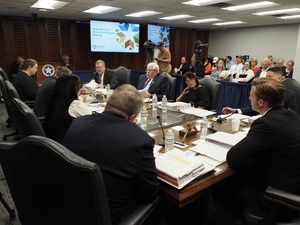
Advocates urged lawmakers on Oct. 29, 2026, to amend the state’s family violence law to close domestic violence and animal abuse gaps, such as those governing weapons. (Photo by Amanda Watford/Stateline)
Advocates pitched proposals to New Mexico lawmakers this week to close what they describe as gaps in state law regarding domestic violence and animal abuse.
New Mexico’s Family Violence Protection Act allows victims of domestic violence to secure an order of protection — which prohibits a person from hurting, threatening or harassing another person — against their abuser.
Under the current statute, a judge must make a finding of a “credible threat” in order to have the abuser relinquish firearms to authorities within 48 hours of the order being issued. This creates issues with sometimes deadly consequences, Miranda Viscoli, co-president of New Mexicans to Prevent Gun Violence, told lawmakers on the interim Courts, Corrections and Justice Committee during their Wednesday meeting.
“The last thing you want is somebody who is a domestic violence abuser to have 48 hours to get rid of their firearm,” Viscoli said. “You want that immediately taken.”
Viscoli highlighted the 2023 murder of Aeriel Gallegos after she received a 20-year order of protection against her abuser, Manuel Weahkee. But just two months later, Weahkee shot and killed Gallegos in Farmington before taking his own life. Even though Gallegos received the order of protection, Viscoli said, the box for the judge to indicate that Weahkee was a credible threat — and therefore must give up his firearms — was unchecked.
State Rep. Joy Garratt (D-Albuquerque) sat beside Viscoli to repropose House Bill 67, which died in the Legislature last session, and would force the domestic abuser identified in a protection order to surrender their firearms immediately, not within 48 hours, and eliminate the requirement that a judge deem a “credible threat” before authorities could seize firearms.
The bill “is closing a gap in domestic violence protection orders,” Garratt said.
Committee Chair Rep. Christine Chandler (D-Los Alamos) expressed support for the proposal, adding that “the intent is to mirror” some of the changes found in House Bill 12, passed in the 2025 legislative session, which eliminated the 48-hour period a person flagged by the state’s “red flag” law had to turn over firearms. The “red flag” law allows law enforcement or a district attorney to file a petition to seize a firearm from a person deemed a threat.
As for Garratt’s effort to amend the state’s law on a victim of abuse’s petition, Sen. Antoinette Sedillo Lopez (D-Albuquerque) expressed concern that eliminating the credible threat requirement might create “Second Amendment scrutiny.” Garratt pointed to the U.S. Supreme Court’s 2024 ruling in United States v. Rahimi, in which the court ruled that federal law can temporarily ban people under domestic violence restraining orders from having guns.
Lawmakers also heard from animal advocates who said the Family Violence Protection Act does not include animals in its definition of abuse or provide any provision allowing animals in protection orders.
“Acts of violence or threats to harm an animal are forms of psychological abuse that abusers will use to control survivors,” Grace Montaño Irwin, government affairs director of Animal Protection Voters, told lawmakers. Between 18% and 48% of domestic violence victims either delayed leaving an abusive situation or returned to their abuser “out of fear” for their pets’ welfare, according to an American Society for the Prevention of Cruelty to Animals study.
As a solution, Montaño Irwin recommended that lawmakers add “harm or threats to harm an animal” to the statutory definition of abuse and require courts to include animals in orders of protection. She noted that New Mexico is one of eight states nationwide lacking these legislative protections.
“For many individuals experiencing abuse, animals are more than companions,” Montaño Irwin said. “They offer comfort, support and security.”
Sedillo Lopez said she plans to introduce a bill incorporating the animal advocates’ recommendations in next year’s legislative session that starts in January, saying, “This bill, I think, is going to be the most popular and probably draw bipartisan support. Data and experience show that if somebody is abusing animals, they’re likely abusing humans as well.”
Santa Fe, NM