Lincolnites favor changing timing of city elections, limiting terms of City Council members
Nov 05, 2026 | 1:11 pm ET
Description
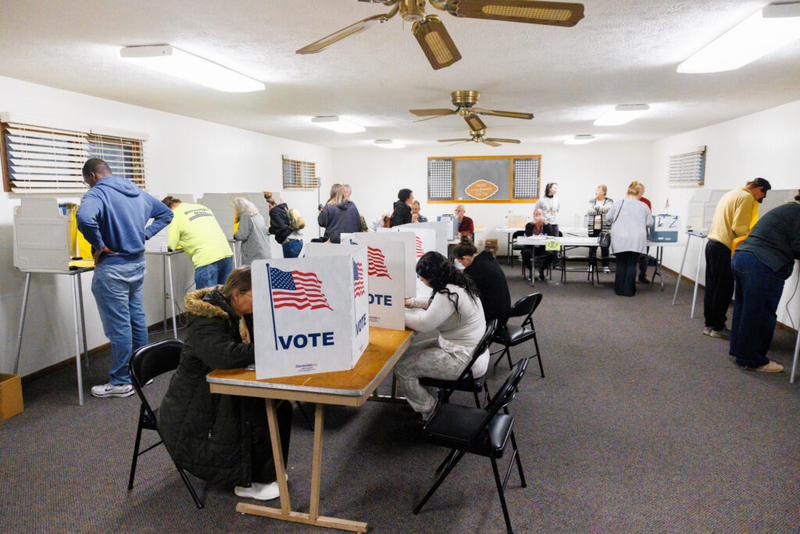
Voters fill out ballots and check in with election workers at a polling place in Lincoln, Nebraska, Tuesday, Nov. 3, 2026. Tables and voting booths fill the room as neighbors exercise their right to vote. (Photo by Michelle Montenegro/Nebraska News Service)
LINCOLN — Voters in Nebraska’s capital city widely favored ending off-year elections after 2029 and limiting Lincoln City Council members to two consecutive four-year terms.
Lincoln voters saw five city charter amendments on their ballot. Of those, the conservative-led Good Government Lincoln campaign and the blue leadership of the city of Lincoln proposed competing ideas around whether to change Lincoln’s practice of holding municipal elections in every odd year or whether to place term limits on Lincoln City Council members.
A fifth question, from Good Government Lincoln, sought to allow voters in the 3-mile boundary outside Lincoln city limits, the extraterritorial zoning jurisdiction, to vote in municipal elections.
The city of Lincoln initially refused to place the three Good Government Lincoln petitions on the Nov. 3 ballot. The campaign was wrapped up in allegations of fraudulent signature collection on a first batch of petitions this summer, and seven out-of-state circulators were arrested. However, the campaign regrouped and submitted new signatures in mid-August.
The city argued the measures needed to instead appear on May 2027 city ballots.
Nebraska Attorney General Mike Hilgers, a former Lincoln state senator who now lives in Lincoln’s ETJ, took city officials to the Nebraska Supreme Court. He prevailed, and the justices ordered the city to place all measures on the Nov. 3 ballot. The Supreme Court ordered Lincoln officials to pay the state $9,150 in costs from the litigation.
City officials went on the offensive with two alternative proposals. Under the Nebraska Constitution, if two conflicting measures pass, the one with the most affirmative votes, regardless of the winning percentage, wins.
Mixed election results
The latest election results are as of 3:15 a.m. Wednesday, Nov. 4. The Lancaster County Election Commission has approximately 6,000 early vote ballots to count on Friday, and 3,000 provisional ballots will be processed Nov. 13. It’s unclear how many of those are from voters within Lincoln city limits, the only Lancaster County voters who could vote on the measures.
For moving election dates, both versions passed, but voters favored the city’s alternative of Ballot Question 3, to end off-year elections after 2029, compared to Good Government Lincoln’s Ballot Question 2, to end off-year elections after city elections in 2027.
The city’s alternative had 56,308 positive votes to Good Government Lincoln’s 50,950 votes.
Under the city’s proposal, four district-bound City Council members and the mayor elected in 2027 would serve through 2030, and three at-large council members elected in 2029 would serve through 2032.
Under Good Government Lincoln’s proposal, a term for anyone elected in 2027 would end at the end of 2028, and previous council members elected in 2025 would serve through 2030.
Lincoln Mayor Leirion Gaylor Baird, a chief opponent of Good Government Lincoln, was elected in 2019 and 2023. She has not yet announced whether she’ll run in 2027. Lincoln mayors are limited to three four-year terms. She backed the two city alternatives.
Voters also passed both versions of the term-limit proposals. The Good Government Lincoln proposal, Ballot Question 4, had nearly 6,000 more affirmative votes. It would limit City Council members to two consecutive terms. The city’s alternative, Ballot Question 5, would have allowed council members to serve three consecutive four-year terms instead, similar to the mayor.
Term limits would count for any terms that begin in 2027 or at future city elections.
Finally, voters appear likely to reject Good Government Lincoln’s Ballot Question 6 to allow non-city residents to vote in municipal elections, excluding bonds, beginning next year. As of the Wednesday results, about 48% of voters favored the measure.
Sponsor, Lincoln mayor weigh in
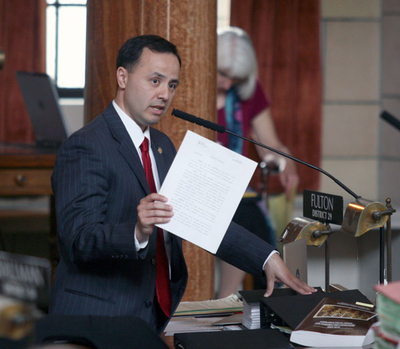
Former state Sen. Tony Fulton of Lincoln, a sponsor behind Good Government Lincoln, told Nebraska Public Media that the campaign “defined the terms of the playing field for Lincoln’s future.”
“We’re grateful to every Lincolnite who signed a petition, knocked on a door or voted for our proposals,” Fulton, a former state tax commissioner, said in a statement. “Because of you, our city elections will be normalized, and our city council will be subject to term limits.”
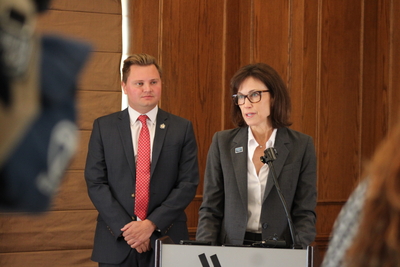
Just before 6 p.m. Wednesday, Gaylor Baird wrote in a Facebook statement to thank Lincoln voters for supporting the city’s alternative on the timing of elections while rejecting the proposal to allow non-city residents to vote in city elections.
The mayor said the voters’ actions “demonstrate that our community values sensible, effective, and ethical leadership.”
“While powerful political interests spent more than a million dollars in an attempt to manipulate our local elections for their own gain, Lincoln voters proved they can make their own decisions about what’s best for our city,” Gaylor Baird said in her campaign post.
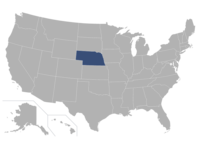
Lincoln, NE