Acton, Brown win in huge Democratic night in Ohio
Nov 05, 2026 | 12:57 pm ET
Description
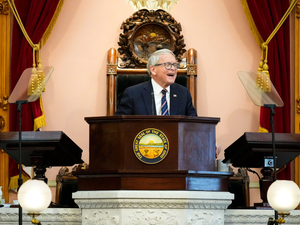
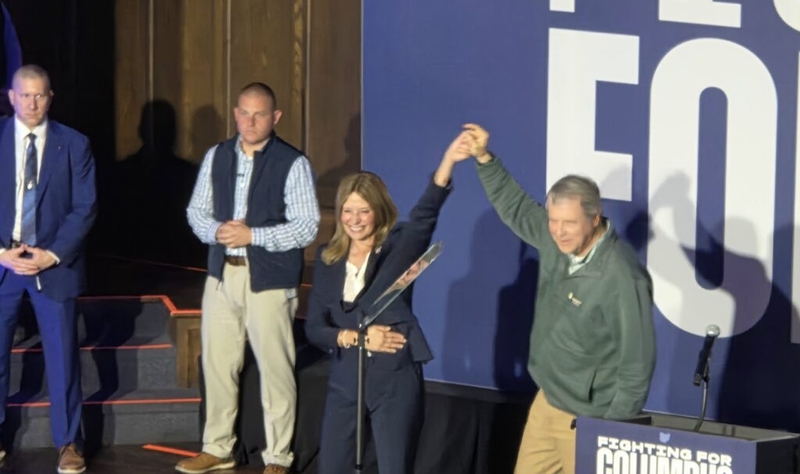
Sherrod Brown and Amy Acton. The Democrats appeared headed to victory in the U.S. Senate and the Ohio governorship, respectively on Tuesday. (Photo by Marty Schladen, Ohio Capital Journal.)
As did residents of many other recently Republican states, Ohioans awoke in a new political world on Wednesday.
Political newcomer Amy Acton became governor-elect and former U.S. Sen. Sherrod Brown again became senator-elect in a state that President Donald Trump won by more than 11 percentage points just two years earlier.
Democrats also won further down the ballot, capturing such powerful offices as state attorney general and secretary of state — which could have implications for elections and voting that Republicans have steadily restricted since 2020.
Despite extreme partisan gerrymandering, Democrats also broke the GOP’s veto-proof majority in the Ohio House, giving Acton a better shot at enacting her legislative agenda.
Many political watchers said the Democratic rout in Ohio and elsewhere was partly due to good candidates. But Trump’s historic unpopularity was at least as much of a factor, they said.
“This was obviously a repudiation of Trump that shaped what happened in Ohio, shaped what happened across the country,” said University of Cincinnati political scientist David Niven. “The lesson you take away from that politically is that it’s really, really hard to function as a party if your president is 20 points underwater in his job approval.”
Speaking at the Columbus Metropolitan Club, Republican political consultant Mark Weaver said Trump’s unpopularity and the war he started in Iran helped Ohio Democrats just as similar factors did in 2006.
“An unpopular Republican president caught up in the Middle East war, troublesome economy, a Republican governor who’s in his final term, who’s not popular with his base, an unpopular, unpopular Republican gubernatorial candidate,” Weaver said. “Those are the elements of 2006.”
There are ways in which Trump’s my-way-or-the-highway style was probably even more harmful to Ohio Republicans’ chances than President George W. Bush’s entanglements were 20 years ago.
Brown’s opponent, Ohio Republican U.S. Sen. Jon Husted, repeatedly supported unpopular Trump measures such as tax cuts for the rich, cuts to healthcare, against releasing the Epstein files, in support of the Iran war, and to protect Trump’s tariffs, which many economists say made inflation worse.
But it was Trump’s interference in the Republican gubernatorial primary that may have cost Republicans even more. He cleared a crowded field of experienced Ohio pols by endorsing Cincinnati billionaire Vivek Ramaswamy.
Ramaswamy went on to run an highly criticized campaign that Forbes noted for its nastiness.
Then Ramaswamy cranked the nastiness up to historic levels by spending $4 million on an ad that effectively questioned allegations by a 12–year-old Amy Acton that her stepfather had raped her. The ads featured Acton’s troubled, long-estranged mother calling Acton a liar without telling viewers that her husband was indicted and they both fled to Pennsylvania to avoid prosecution.
The backlash was swift, bipartisan and fierce.
But Niven said it didn’t cost Ramaswamy the race.
“Ramaswamy didn’t lose because he ran the ad,” he said. “He ran the ad because he was losing. But did this hurt the (Republican) ticket? I don’t think there’s any question. It could have been the margin by which some of those statewide offices were lost.”
Sandy Theis, a former Statehouse reporter and longtime Ohio political observer and consultant, said the backlash was particularly strong among women and that antipathy manifested up and down the Democratic ticket — particularly races involving women.
Allison Russo won the secretary of state’s race and Marilyn Zayas won a seat on the Ohio Supreme Court with larger vote shares than did Brown and Attorney General-elect John Kulewicz.
While Brown got 50% of the vote and beat Husted by a 4.85-point margin, Acton got 52.3% of the vote and beat Ramaswamy by nearly eight points, according to preliminary results.
Theis said that she hoped the backlash and the resulting Democratic wins translate into change.
“I hope this means we’ll finally get to see the Epstein files and get more affordable electricity,” she said. “Women are waiting.”
Ohio State political science professor emeritus Paul Beck said that to return to the Senate, Brown was able to reverse some of his losses when now-Sen. Bernie Moreno beat him in 2024.
“He did significantly better among working-class whites in Northeastern Ohio — people who were labor union members and worked in industries that have seen a downturn in jobs,” Beck said. “I think he also did better among younger Ohioans.”
But after the celebrations end, successful Democrats have to find ways to show voters they’re trying to deliver on their campaign promises, Beck said. Many observers are saying Trump’s failure to do that cost him dearly and will continue to until his term ends in 2028.
Beck said Brown and other Democrats in Congress would be wise to seize back legislative power that has been ceded to the administration. And he said it should use the power of the purse to ease Trump’s cuts to the social safety net.
“I think that would be their top priority, and the other thing would be the Iranian war,” Beck said. “And maybe the tariffs. Congress has ceded a lot of authority to the executive — not just Trump, but executives before him.”
On the state level, Acton will have to find ways to work with Republicans to find ways to soften the impact of the Trump healthcare cuts on average Ohioans, Beck said. The worst part of those will hit Jan. 1, when strict new work requirements and other cost-cutting measures take effect.
“Hundreds of thousands of Ohioans are going to be affected,” Beck said. “It’s going to be bad for them, and it’s going to be bad for rural hospitals that try to treat many of them. But it’s an issue where (Acton) can gain some capital by protecting rural hospitals from closing down.”
Niven, of the University of Cincinnati, said that in the wake of the drubbing, Republicans may be less subservient to Trump. But he was skeptical that they would be much inclined to work with Democrats because the ones who remain are from the most partisan districts.
However, Niven said, Trump may function over the next 24 months as an incumbency-protection machine for Democrats.
“It’s hard to imagine these legislators coming together to work for the common good,” Niven said. “But the Trump factors can’t be ignored. If there are two more years of building self-monuments and wrecking the economy, it doesn’t matter what Gov. Acton or anyone else does, the (Democratic) incumbents are all going to get reelected.”
Capital Journal reporter Megan Henry contributed to this story.
Columbus, OH