Limits of South Dakota law on new trials for DNA evidence debated at state Supreme Court
Nov 10, 2026 | 6:36 pm ET
Description
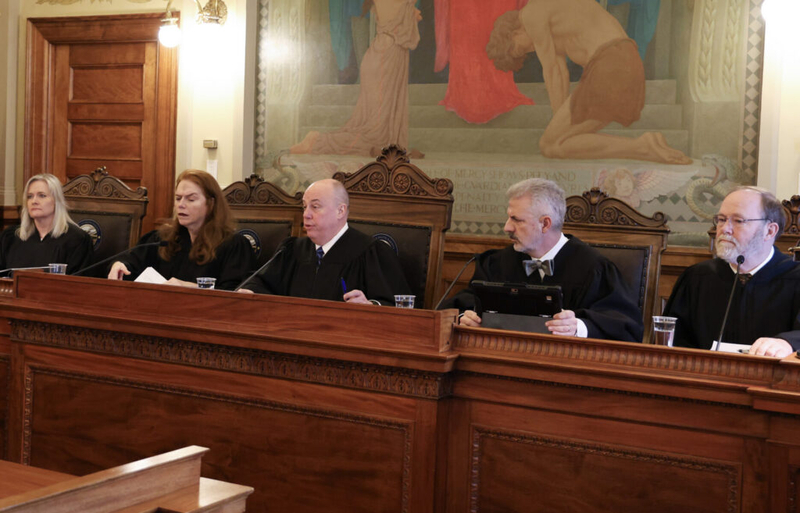
The South Dakota Supreme Court conducts a hearing Feb. 14, 2024, at the Capitol in Pierre. From left are Justices Patricia DeVaney, Janine Kern, Steven Jensen, Mark Salter and Scott Myren. (David Bordewyk/SD NewsMedia Association)
An impending South Dakota Supreme Court decision stands between a man who’s spent 42 years in prison for a double murder and his chance to convince a jury he never should’ve been there.
The decision and underlying case will offer guidance on how judges are meant to apply a South Dakota law. The statute lets them grant a new trial if new DNA evidence “would result in acquittal” when considered alongside “all other evidence” in a case.
A Rapid City judge granted 84-year-old George Luna a new trial based on that 2009 law. The Attorney General’s Office appealed, setting up Tuesday’s Supreme Court hearing in Pierre.
Tony Mangan, spokesman for the attorney general, told South Dakota Searchlight that, “to the best of our knowledge,” Luna is the only person to have been granted a new trial based on that law.
Decades of attempts
Luna has maintained his innocence in the beating deaths of his estranged wife and her mother since the crime in 1983, before DNA testing became a common factor in criminal trials. He got a life sentence in 1984. He’d appealed the initial conviction to the state Supreme Court and exhausted his other available appeals by 2004.
Between 2007 and 2015, Luna tried unsuccessfully to force the state to conduct DNA testing on evidence collected in his case, representing himself.
South Dakota Supreme Court says father doesn’t have a right to police records about son’s death
In 2015, a lawyer for a nonprofit group filed for DNA testing on Luna’s behalf, setting in motion a series of tests that found none of Luna’s DNA on more than a dozen pieces of evidence collected from the crime scene.
The tests also found no conclusive evidence for the presence of DNA from either of the two men Luna’s initial defense team had suggested as possible “third-party” perpetrators. But the results left open the possibility that strands of hair found in one victim’s hand belonged to one of them.
A circuit court judge ordered a new trial in 2023, concluding that a new trial would likely result in an acquittal. The ruling also said Luna would be allowed to present “third-party perpetrator” evidence, which he wasn’t allowed to do in 1983.
In 2024, further DNA testing conducted by the state in response to that ruling showed that the strands of hair belonged to a female, ruling out one of the alleged third-party perpetrators.
A judge reviewed that evidence, but reached the same conclusion on the likelihood of acquittal, once again ordering a new trial.
State: DNA adds nothing new for jury to consider
Tuesday’s arguments focused largely on the certainty of the circuit judge’s conclusion about the likelihood of an acquittal.
Luna was convicted based largely on a collection of circumstantial evidence, not physical evidence. That reality played into arguments from both his own lawyer and the assistant attorney general arguing against a new trial.
State’s high court says survival bunker owners can pursue eviction for gun incident
Without DNA evidence to show that another person was present at the crime scene, Assistant Attorney General Matt Templar said, there’s little Luna might be able to offer a new jury.
In 1983, prosecutors pointed to microscopic bits of glass found on Luna’s clothing to say he’d been present at the murder scene, where a window had been broken. They also pointed to what Templar called “incessant threats” by Luna against the victims in the months leading up to the murders. Luna’s alibi — that he was at a Rapid City hotel at the time of the killings — was “shaky,” Templar said.
“You put all of that together, it proves beyond a reasonable doubt that George Luna was the one that committed these murders, not some unknown third-party perpetrator,” Templar told the justices.
Because the DNA evidence shows no proof of a third-party perpetrator, Templar said its existence doesn’t amount to “compelling” proof that a jury would reach a different conclusion.
Defense: New trial warranted
Justice Patricia DeVaney pointed to that issue in her questioning of John Murphy, the Rapid City lawyer who now represents Luna.
To earn a new trial under a law linked to DNA evidence, shouldn’t the chance of success at a new trial “somehow still tie into the DNA evidence?” DeVaney asked Murphy.
Yes, Murphy said, and it does. Early rounds of DNA testing showed that Luna’s DNA wasn’t present on a towel and stain on the sink, where the killer was thought to have cleaned up after the crime.
The new testing amounts to evidence that “expressly excluded George Luna from being present in the house,” Murphy said.
The DNA law on new trials “mandates an expansive factual review” of an entire case, he said, and that happened before Luna was granted a new trial. The judge’s order was “a 66-page, single-space report with 204 footnotes” on the evidence, he said.
The DNA evidence alone needn’t prove that another person killed Luna’s ex-wife and mother-in-law, Murphy said, for a judge to find “compelling” proof that its existence would swing a jury toward a not guilty verdict.
“The third-party perpetrator issue is kind of a red herring that’s been manufactured by the state, Murphy said.
In his rebuttal, Templar said the first jury knew that police found none of Luna’s fingerprints at the scene and still convicted him. It’s “not unusual” for police to find no fingerprints or DNA from a suspect, or for someone to be convicted regardless.
“These results,” Templar said, referring to the DNA testing, “do nothing to contradict other credible evidence that supports his guilt beyond a reasonable doubt.”

Pierre, SD